How to Give AI Your Priorities: What Wins When Two Goods Clash
With Josh Schultz ·
Answer. Give AI your priorities in ranked order, plus a few rules of thumb. Then, when two good things pull against each other, it knows which one your shop protects first. Without that list (your values: what wins in a tie), it falls back on generic advice.
The picture
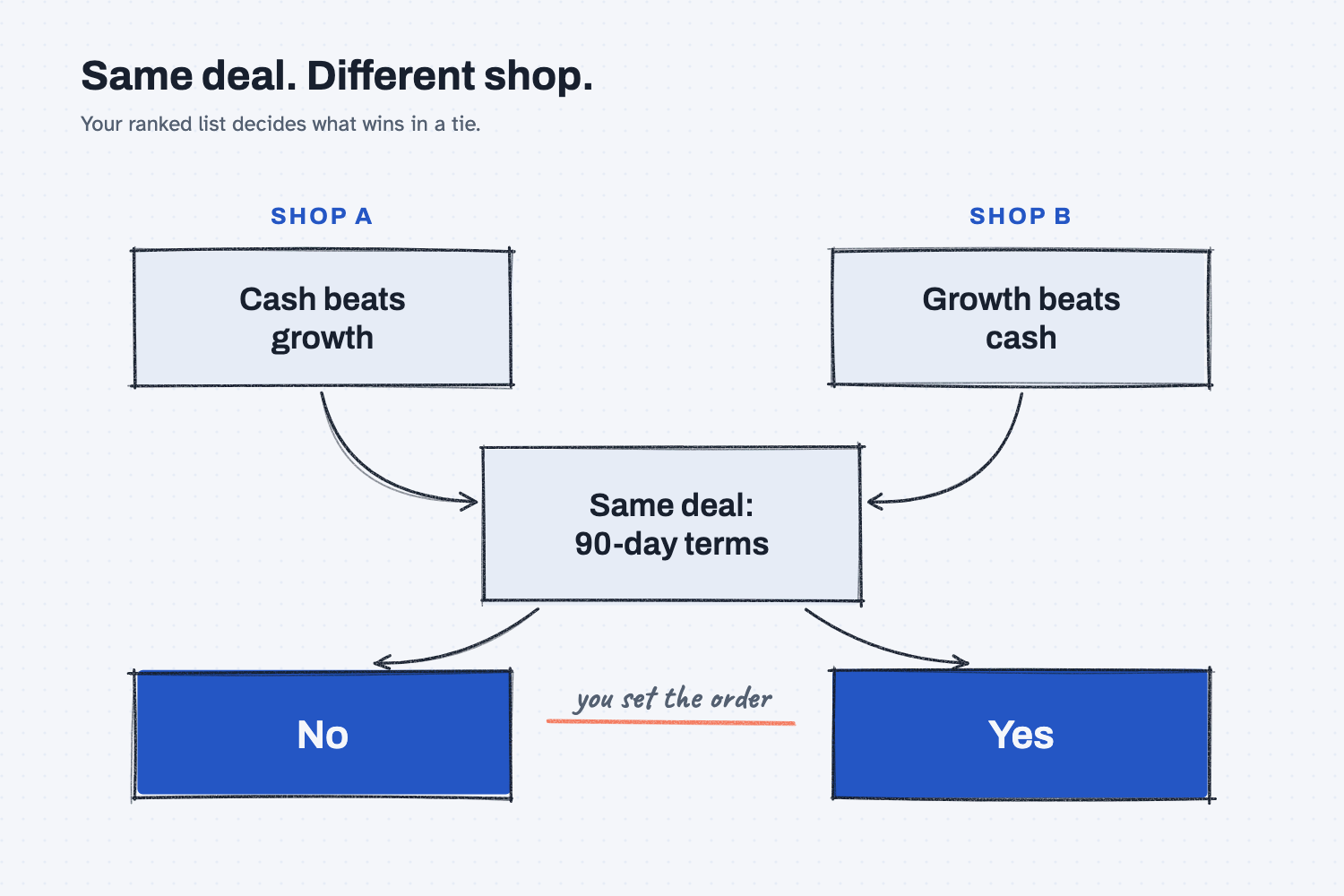
The picture shows one deal in the middle, 90-day payment terms, with two different shops on either side. The shop whose list says cash beats growth gets the answer No, and the shop whose list says growth beats cash gets the answer Yes. Both answers are right for their own shop, which shows that the list is what decides.
Think of it like this
Think about a new supervisor's first week. They know the rules and they know the machines, but they do not yet know what wins when two good things collide, such as shipping on time versus holding the lot for one more check, or keeping a big customer happy versus protecting the margin.
So a good plant manager tells them the order: safety first, then the customer, then the margin. With that order in hand, the new supervisor can make calls the way the plant would make them.
AI is that new supervisor at the start of every chat. It knows a lot, but it does not know your order unless you tell it.
Why does it matter at work?
Without your list, AI uses a generic one. Sometimes that matches your shop, and sometimes it is the opposite of what you decided this year.
Here is an example. Carol Whitaker, who owns Mesquite Ridge Metal Works, has decided this is the year to build the oilfield business. A new oilfield customer, Bayou Drilling Supply, offers a 12-month order for heavy skid frames, but they want 90 days to pay instead of the usual 30.
Luis Ramos, the controller, asks AI whether to take the deal, and it says no because longer terms mean cash risk. That is a sensible answer for a lot of shops, but it is the wrong answer for Mesquite Ridge this year.
So Luis adds the shop's priorities to his AI settings, with "growth beats cash this year" near the top. Now the same question gets a yes, with a reason that matches Carol's plan.
How does it work?
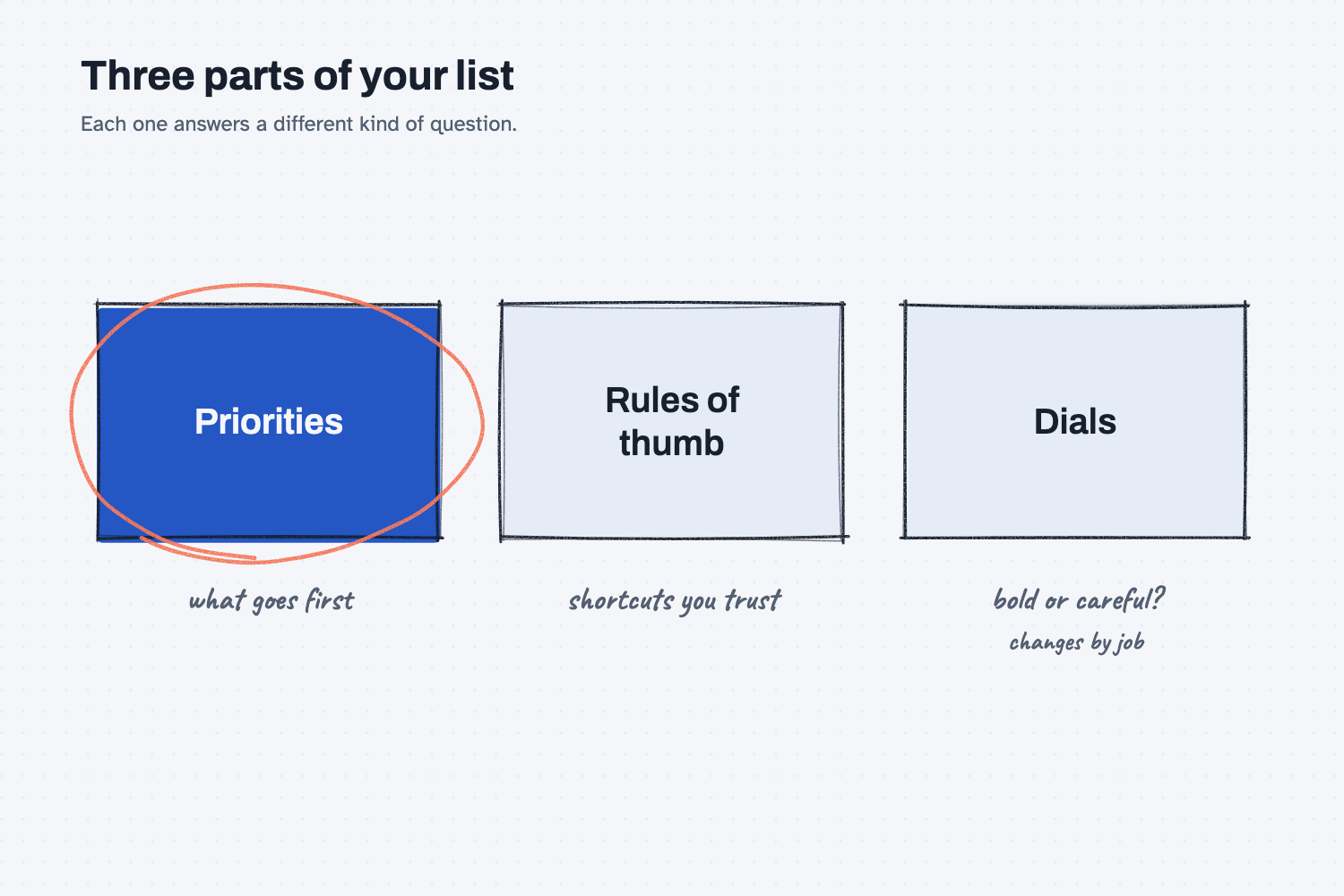
Your list has three parts, and each one answers a different kind of question.
Priorities, in order. These say what you protect first when you cannot have everything, such as safety over schedule, the customer over this month's margin, or cash over growth (or the other way around). As I put it in my framework notes: "Values set the order. When a decision has to give something up, values say what goes first."
Rules of thumb. These are the shortcuts your best people use without thinking, such as "If a supplier is late twice in a quarter, dual-source it" or "New customers get 30-day terms the first year." I wrote it this way: "Heuristics are fast. They are also where a lot of hard-won learning hides."
Dials that change by job. Your shop is not bold or careful in the same way for everything, so these settings say how bold or careful, and how urgent or patient, to be for each kind of job. As I wrote: "A shop can be urgent on a line-down customer order and patient on a capital equipment buy."
Where the list goes. Put the list in your AI settings so every chat starts with it. It is the role layer from how to stack context for AI, which sits above your data and your question and colors every answer.
Where do people get it wrong?
Most mistakes come from writing values that cannot break a tie. These are the four I see most often.
- A list with no order. "We value safety, quality, customers, and growth" sounds fine, but it does not say which one wins, so number them.
- Values everyone agrees with. "Do great work" decides nothing, while a good priority is one that a competitor might rank the other way.
- Never updating it. "Growth beats cash" can flip next year, so check the list whenever your goals change.
- Keeping rules of thumb in your head. If the rule lives only with your veteran, AI cannot use it, and neither can the new hire.
Try this in 2 minutes
This test shows the same deal with and without a ranked list, and you can use any chat tool.
- Open a new chat and paste only the deal:
A new customer, Bayou Drilling Supply, offers us a 12-month order for heavy skid frames: $640,000 for the year.
They want to pay in 90 days. Our normal terms are 30 days.
Should we take the deal as offered? Answer yes or no first, then 2 short lines why.
- Open a second new chat. Paste the priorities first, then the same deal:
OUR PRIORITIES, IN ORDER:
1. Safety and product quality beat the ship date.
2. The customer relationship beats this month's margin.
3. Growth beats cash this year. We are building the oilfield business.
OUR RULE OF THUMB:
- Give a big new account the terms they need, then earn better terms later.

A new customer, Bayou Drilling Supply, offers us a 12-month order for heavy skid frames: $640,000 for the year.
They want to pay in 90 days. Our normal terms are 30 days.
Should we take the deal as offered? Answer yes or no first, then 2 short lines why.
- If you want to see the answer flip back, change line 3 to
3. Cash beats growth this quarter.and change the rule to- New customers get 30-day terms. No exceptions the first year.
When I tried this, the deal on its own got a "No." The reply said: "Net-90 on a new, unvetted customer means carrying about $160K in receivables at any time." That is a fair answer for a lot of shops.
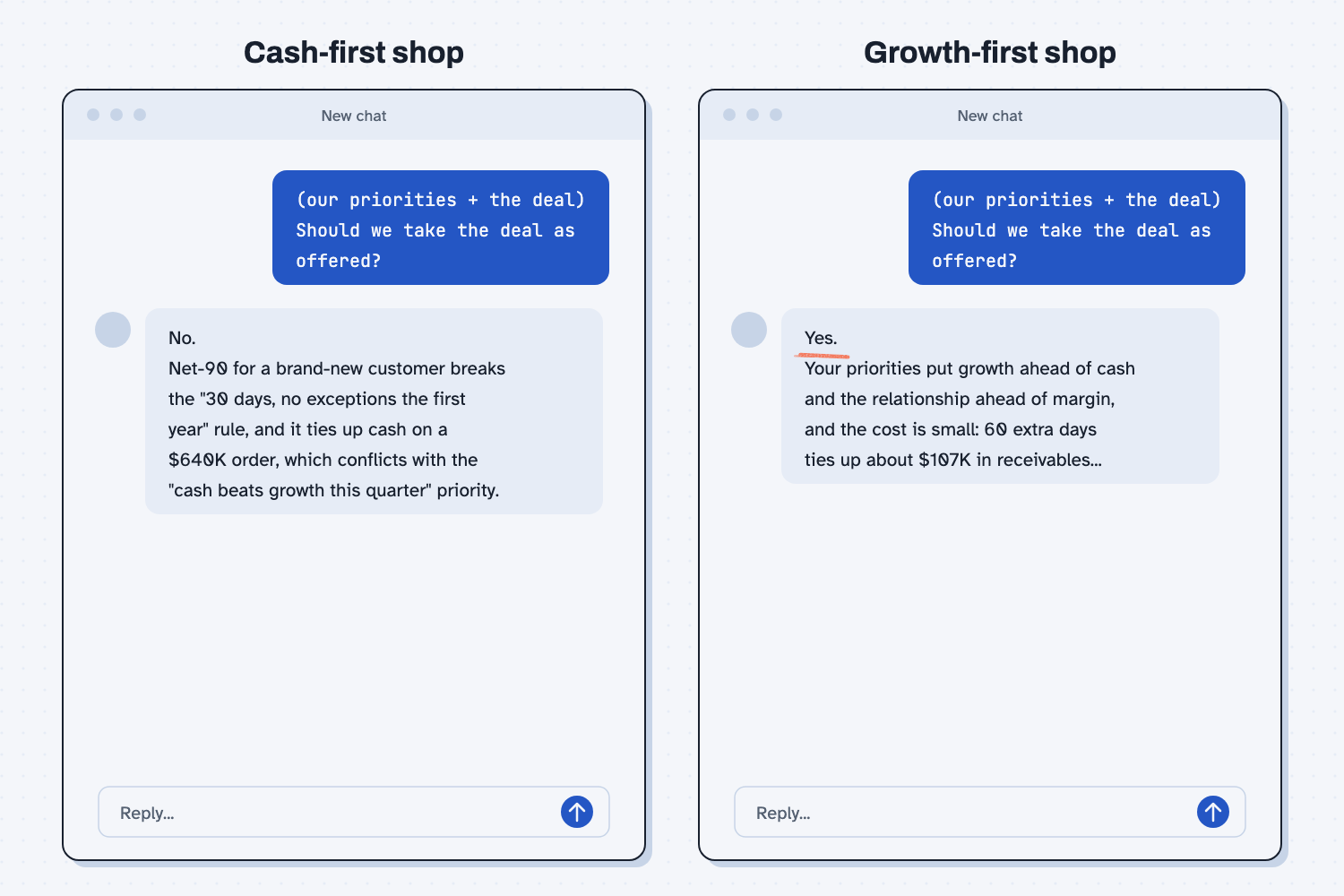
With the cash-first list, the answer was also "No," but this time it leaned on my list. It said the deal "conflicts with the 'cash beats growth this quarter' priority."
With the growth-first list, the answer flipped. It said: "Yes. Your priorities put growth ahead of cash and the relationship ahead of margin, and the cost is small." The list is what changed the call.
Keep in mind that priorities only matter when two good things clash. If the answer is obvious, a list adds little.
Frequently asked questions
What's the difference between a priority and a rule of thumb?
A priority says what wins in a tie, like "the customer beats this month's margin." A rule of thumb is a shortcut for one kind of call, like "dual-source after two late shipments." You want both.
How many priorities should I write?
Write three to five, and number them. With more than that they start to blur together, and if two of them never clash, you probably only need one.
Where should I put my priorities?
Put them in your AI settings, or in a project's instructions, so every chat starts with them. You type them once and update them when your goals change.
Will AI always follow my list?
It is a strong nudge, not a guarantee. In my test, it followed the list and named it in its reason. Still, read the reason it gives, and check that it matches how your shop actually thinks.
Use it today
Related: How to teach AI your judgment shows how to write down the reasons behind your calls.
From my training: this comes from my framework on capturing how a company decides when the rules run out.