AI Multiplies What You Know. It Doesn't Replace It.
With Josh Schultz ·
Answer. AI multiplies what you know. Two people can get the same first answer, but the one with domain judgment (knowing the work well enough to spot what's off) catches the miss and pushes past it. The other one sends the first answer on.
The picture
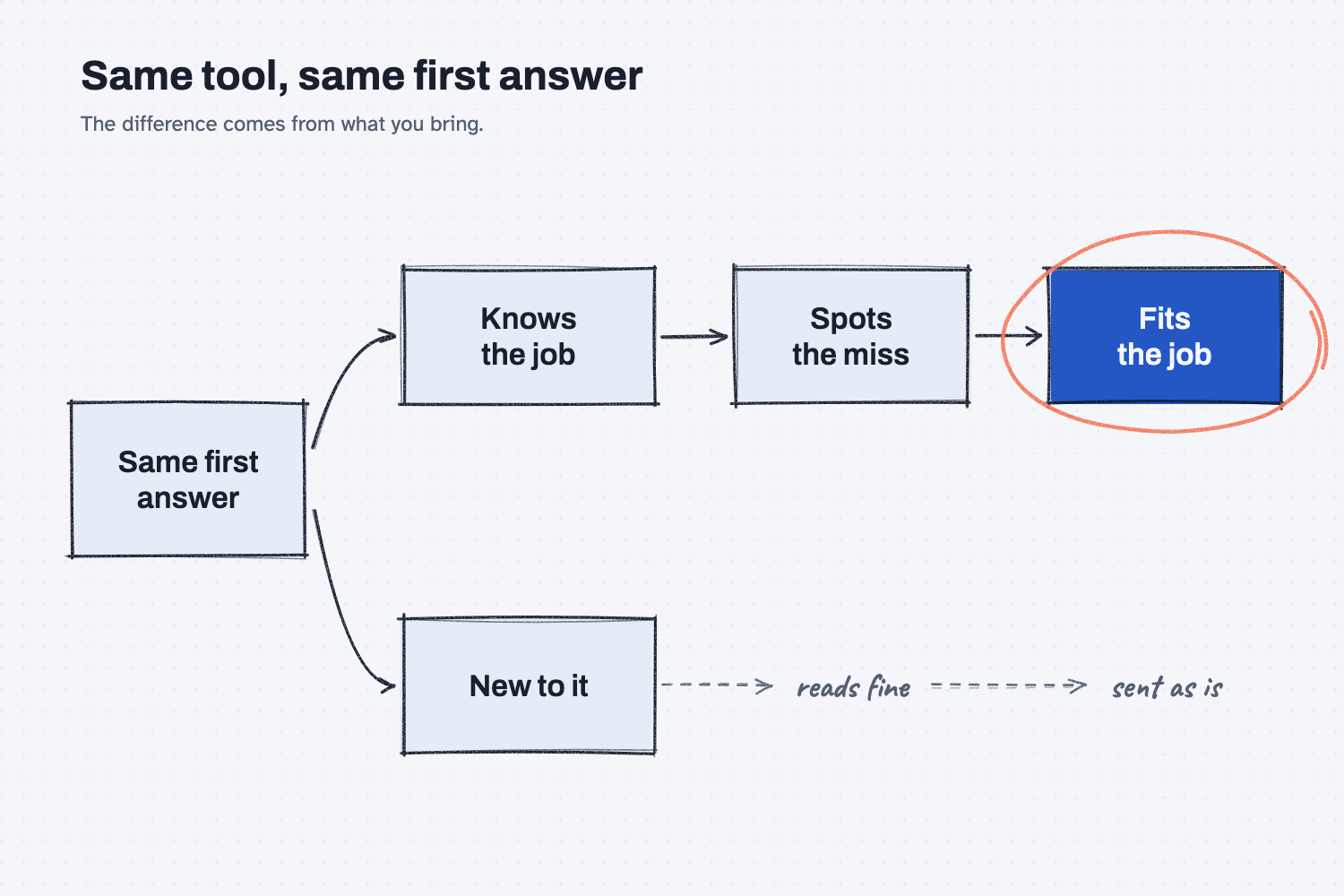
Both people start in the same spot, with the same answer from the same tool. The split happens after the answer comes back. The person on the top path knows the job, so they spot the miss and end up with something that fits the job. The person on the bottom path is new to it, so the answer reads fine to them and goes out as it is.
Think of it like this
Think about a power drill. If you hand it to a good carpenter, they work three times faster. If you hand it to someone who has never built anything, they also work faster, but they drill the hole in the wrong spot, only more quickly.
The drill does not know where the hole goes, and you do.
AI is the drill. It makes the work cheap and fast, but knowing where the hole goes is still your job.
Why does it matter at work?
Your experience is the part AI can't supply, which makes it the most valuable thing you bring to the tool.
Here is how I put it in my field notes: "AI makes output cheap. Judging output stays hard, and judgment comes from knowing the work."
Here is how that plays out. Hector Lee is the production planner at Mesquite Ridge Metal Works, and he asks AI to lay out next week's schedule for the CNC machines from the open orders. It comes back clean and well organized.
But it puts the MR-1010 gearbox housings on the mills Monday morning, and Hector knows those castings are still in heat treat at the foundry until Wednesday. He sends the schedule back, and the second version moves them.
Someone new to planning would have gotten the same clean schedule, and nothing in it would have looked wrong, so it would have gone straight to the floor.
How does it work?
Knowing the work helps at every step around the AI, not inside it. My notes list four places where it shows up.
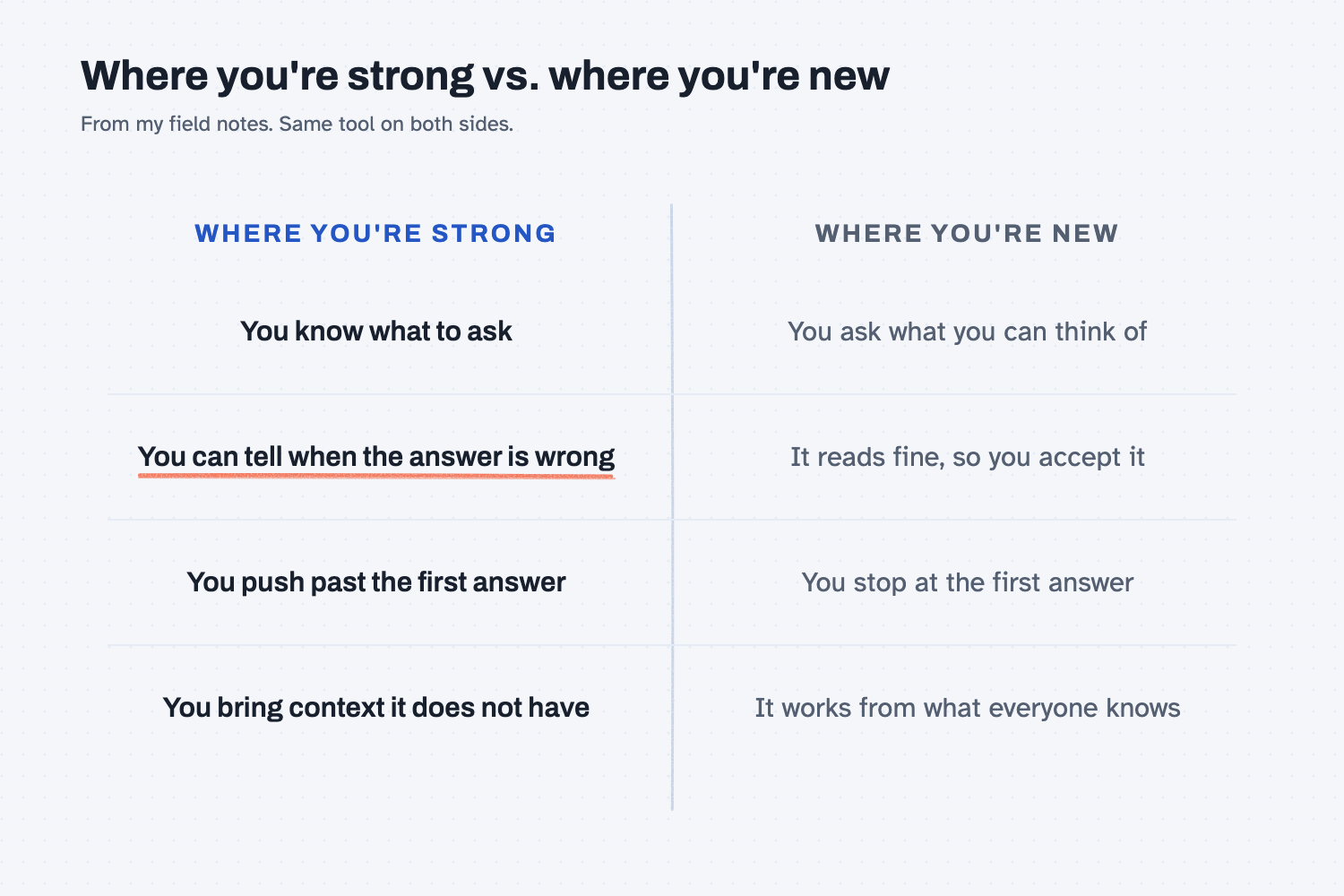
The picture compares the two kinds of person, row by row, and the four places are listed below.
You know what to ask. A pro asks about the thing that usually goes wrong, while someone new asks about whatever comes to mind.
You can tell when it's wrong. This is the big one, because the answer reads fine either way. Only someone who knows the work sees the bad date, the missing step, or the part that is still in heat treat.
You push past the first answer. A pro sends it back with what is missing, while someone new stops because it looks done. (That first answer is usually the likely answer, not the best one.)
You bring what it can't know. That means your customers, your machines, and your history, because the AI works from what everyone knows until you add yours.
Now for the fair part. On simple, clear tasks, AI helps newer people the most, and research points that way too. It is on judgment calls that the gap between people gets wider instead of smaller.
Where do people get it wrong?
Most mistakes come from thinking the tool does the knowing. These are four I would watch for.
- Thinking AI levels everyone out. It lifts the floor on simple tasks, but on judgment calls it makes the gap between people bigger.
- Trusting it most where you know least. That is exactly where you can't tell it is wrong, so check it with someone who knows the work.
- Trusting it blindly in your own field. In my notes: "Do not trust the first answer, even in your own field. Strong people get fooled too."
- Keeping what you know in your head. If you send the same fix back every week, write it down once and keep it where the AI reads it every time.
Try this in 2 minutes
This test shows what your know-how adds. Use any chat tool. The sample is a steel receiving checklist, and for the real thing you should use a question from your own job.
- Open a new chat and paste this:
Write a 5-step checklist for receiving steel bar stock at a metal shop. Keep each step to one line.
- Read the checklist like a pro, and write down what is wrong, missing, or too generic.
- In the same chat, send your notes back. Here are the sample notes:
Here is what you missed:
- If the mill cert is missing, red-tag the bundle and hold it. Don't put it on the rack.
- One bundle can hold two heat numbers. Check the tag on every bar.
- 4140 comes annealed or heat treated. Check which one we ordered.
- Enter the heat number in ShopLine ERP so we can trace it to the finished part.
Rewrite the checklist. Keep it to 6 steps, one line each.
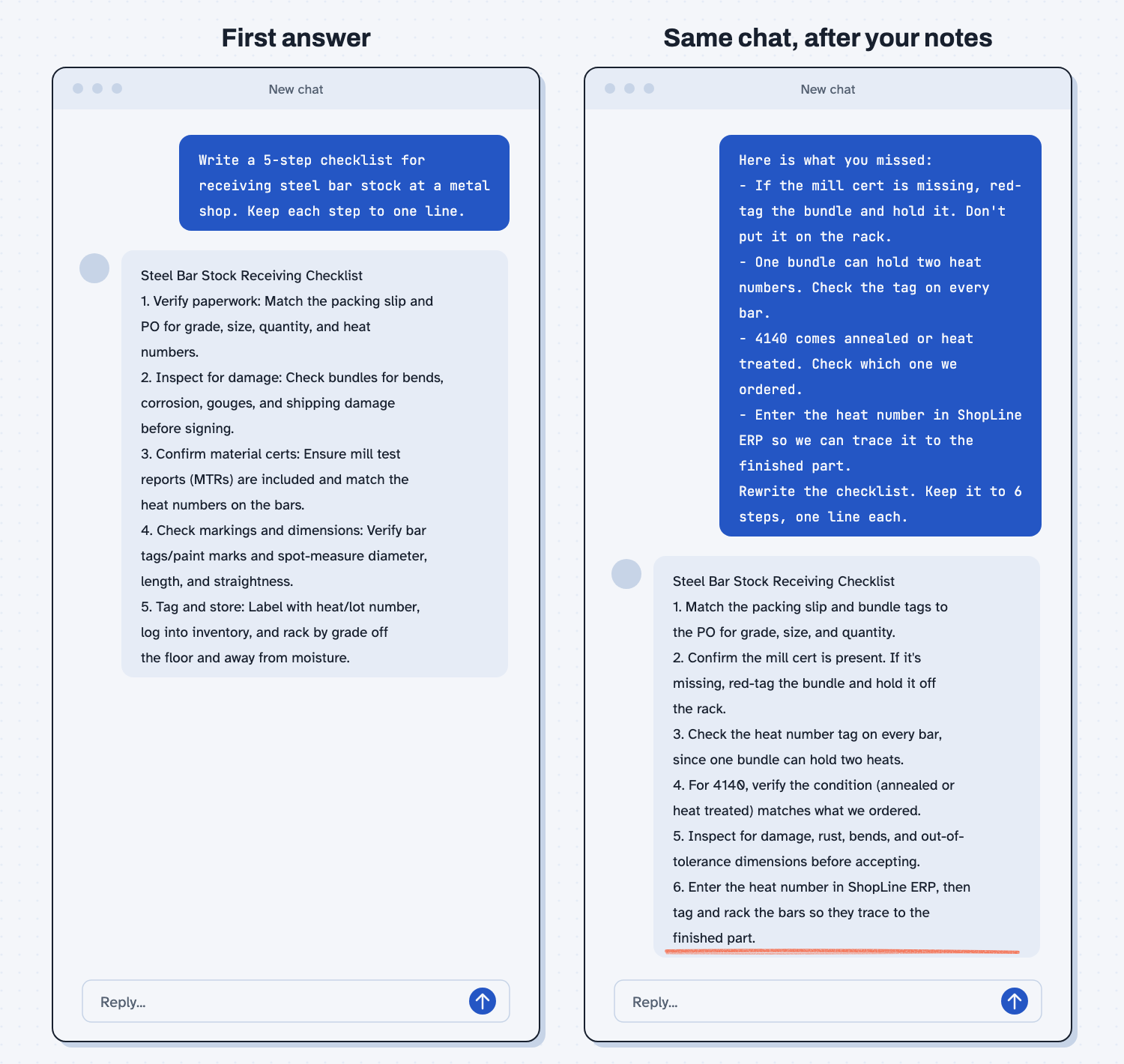
When I tried this, the first checklist was tidy and sensible. It even said "Match the packing slip and PO for grade, size, quantity, and heat numbers." But it only asked you to match the heat numbers. It never said what to do if the mill cert is missing, and it never warned that one bundle can hold two heat numbers. It had nothing on 4140 condition and no ERP entry, and it said "log into inventory," which is close but is not your system.
After the notes, the rewrite had all four points: "If it's missing, red-tag the bundle and hold it off the rack." "Check the heat number tag on every bar, since one bundle can hold two heats." "For 4140, verify the condition (annealed or heat treated) matches what we ordered." And: "Enter the heat number in ShopLine ERP, then tag and rack the bars so they trace to the finished part."
The AI did not get smarter between the two answers. You did the multiplying.
Frequently asked questions
Does this mean AI is only for experts?
No. On simple, clear tasks, AI helps newer people the most. What you know matters most on judgment calls, where a clean answer can still be wrong for your shop.
What if I'm new to my job?
Use AI to learn, and check it with someone who knows. Ask it to explain why each step matters, then ask your lead which parts are wrong, and you will learn the job faster that way.
How do I keep from typing my notes every time?
Write them down once and save them in your settings or a project, so they sit on top of every chat. The lesson on how to stack context for AI shows where each piece goes.
Can AI tell me when its answer is wrong?
Not reliably. It gives a likely answer and sounds the same whether it is right or not. The lesson on how AI writes one word at a time shows why.
Use it today
- Have Claude build your quote report: you know what a good report looks like, and Claude writes the script.
From my training: this comes from my field note "AI Exaggerates."