How to Get Your Company to Approve AI: Make a One-Page Ask
With Josh Schultz ·
Answer. To get approval for AI at work, give your boss or IT one page that names a single task, says which data you will and will not use, names the tool and plan, and explains how you will check the work. A narrow ask is easier to approve than a general request to "use AI," because the person reviewing it can see exactly where the limits are.
The picture
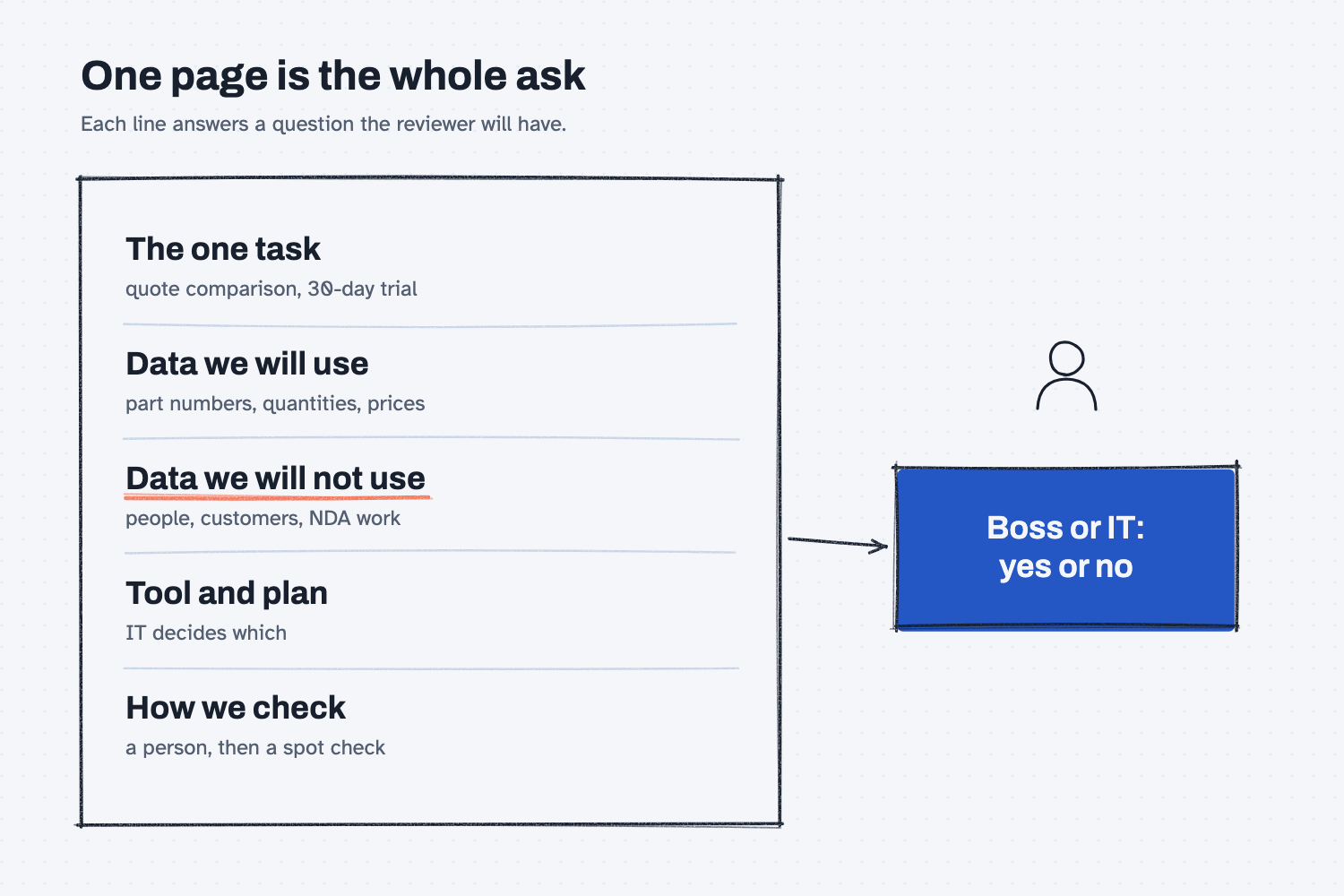
The page on the left holds everything a reviewer needs and nothing more. Each line answers a question that a careful boss or IT manager will ask, and the arrow shows that the page goes to that person for a yes or a no. The line "Data we will not use" is circled because that list is what tells a cautious reviewer that you have thought about the risk.
Think of it like this
Think about what happens before a new setup runs a full order in the shop. Nobody says "let me run the machine." They say which job it is, what material it will cut, who is trained on it, and who will inspect the first part before the rest are made. The first-article inspection is how the shop gets to say yes without worrying.
A request to use AI works the same way. You name the job, the material (your data), the person running it, and the first check, so that approving it feels like a normal, controlled decision and not a leap.
Why does it matter at work?
If you do not ask, you can only skip AI or use it quietly and risk breaking a rule you did not know about. A clear ask gives you a third path, which is permission you can defend.
Here is an example. Dana Ortiz, the senior buyer at Mesquite Ridge Metal Works, wants to use AI to compare supplier quotes, a job that takes her about half an hour each time. She does not ask Walt Brandt, the VP of Operations, whether the company allows AI. She brings one page that names quote comparison as the only task, lists part numbers and prices as the data she will use, and lists employee information, customer names, and anything under a nondisclosure agreement (an NDA, a legal promise to keep information private) as data she will not use. She proposes a 30-day trial for one buyer, and Walt can say yes because he can see the limits.
How does it work?
The page has four parts, and each one answers a question the reviewer will have.
Name the one task and the trial. A single task is easy to judge, and a trial with an end date makes the decision small and reversible. If you are not sure what the task should be, where to start with AI at work shows how to pick one.
Say which data you will use and which you will not. This is the part reviewers care about most. List the kinds of information that go in, and list what stays out, such as employee records, customer names, anything under an NDA, and anything with a password or a bank detail. If your company has no rules yet, your list becomes a sensible first draft, and the idea of what an AI tool is allowed to touch can help you think it through.
Name the tool and plan, and let IT choose. Say which tool you would like to use, and say plainly that IT decides which tool and which plan are acceptable. Business plans usually give a company more control over data settings than a free personal account does, so ask IT which plan fits, and do not assume. You do not need to know the settings yourself, because the person approving it will.
Explain how you will check the work and what you will keep. Say that a person checks every result before it is used, and that a second person spot-checks a few. This is the idea of human in the loop AI written in one line. Add that you will keep a short record of what went in, what came out, and who checked it, as described in AI audit trail, so that anyone can trace a number back later.
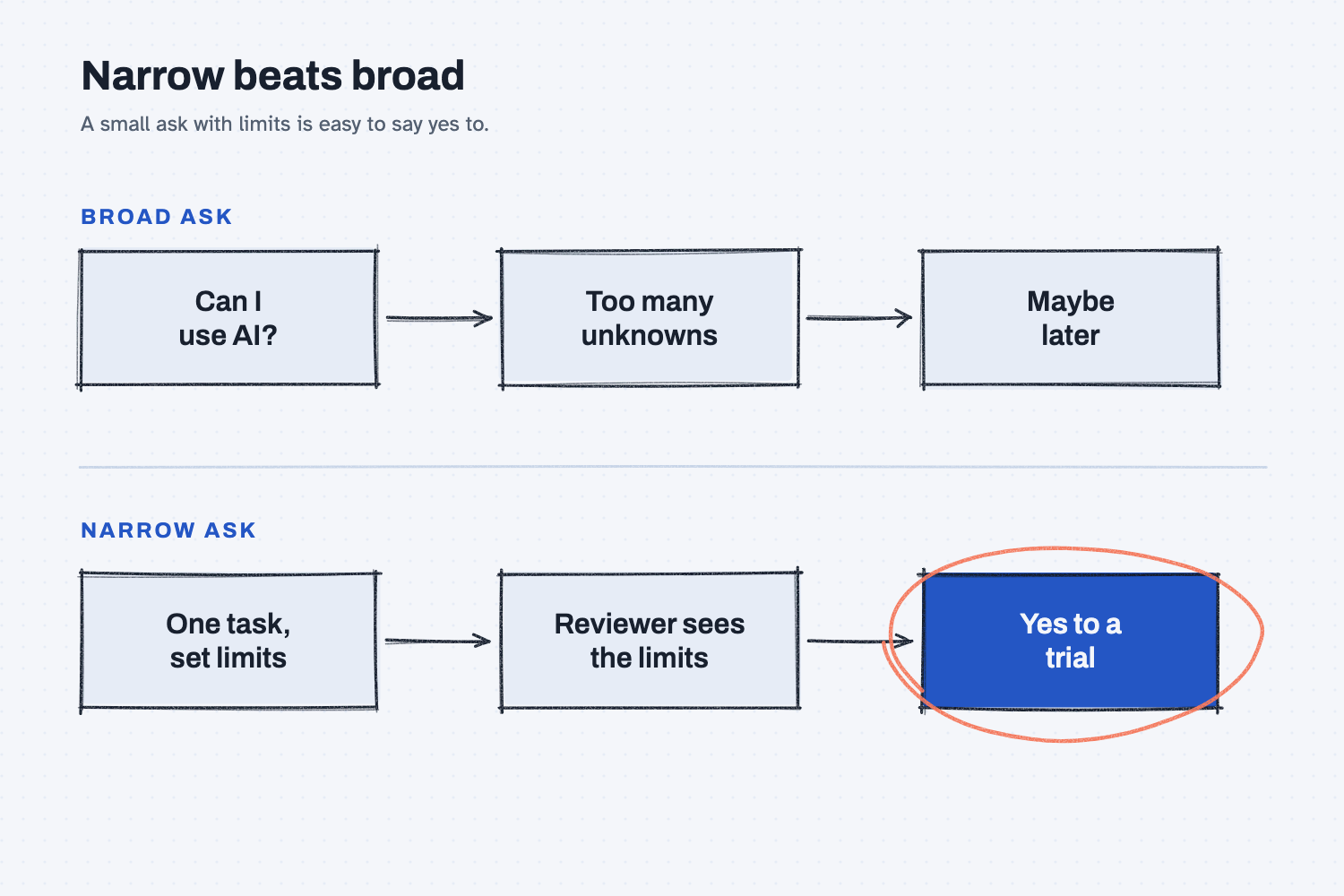
The second diagram shows why the narrow ask works. A broad question gives the reviewer too many unknowns, so the safest answer is "maybe later," while a narrow ask with clear limits lets the reviewer see the risk and approve a small trial.
Where do people get it wrong?
Most requests fail because they are too broad or too vague. These four are the common ones.
- Asking about "AI" in general. A request that covers everything gives the reviewer nothing to approve, so name one task.
- Leaving out what you will not use. A reviewer who sees only what goes in will imagine the worst about what else might go in.
- Using real data while you wait. Until you have a yes, practice with made-up sample data, which is safe to use and shows you are careful.
- Treating approval as a one-time yes. Offer to report back at the end of the trial with what you did, what you checked, and what you found, so the next request is easier.
Try this in 2 minutes
This test asks AI to draft the one-page ask from a few facts, with a rule that it must not invent anything. You can use any chat tool.
- Open a new chat and paste this:
Write a one-page request to our IT manager asking permission to try an AI chat tool at work. Use only the facts below and do not invent any details, names, or policies. If something is missing, write "to confirm" instead.

Facts:
- The one task: comparing supplier quotes for the same part and building a side-by-side table. About 30 minutes each time, a few times a week.
- Data we will use: supplier part numbers, quantities, and quoted prices. We start with made-up sample data, then real quotes.
- Data we will not use: employee information, customer names, anything under an NDA, anything with a password or bank detail.
- Tool and plan: whatever IT approves. I would suggest a business plan with the data settings IT chooses, not a free personal account.
- How we check: the buyer checks every number against the original quote, and a second person spot-checks a few lines.
- Records: a short log of what went in, what came out, and who checked it.
- Trial: 30 days, one buyer.

Use these headings: The task, Data we will use, Data we will not use, Tool and plan, How we check the work, Trial, What I need from you.
- Here is what I expect: a page with all seven headings, and the phrase "to confirm" wherever I did not give a fact, such as a start date.
- Look for anything the AI added that you did not say, and fill in each "to confirm" yourself.
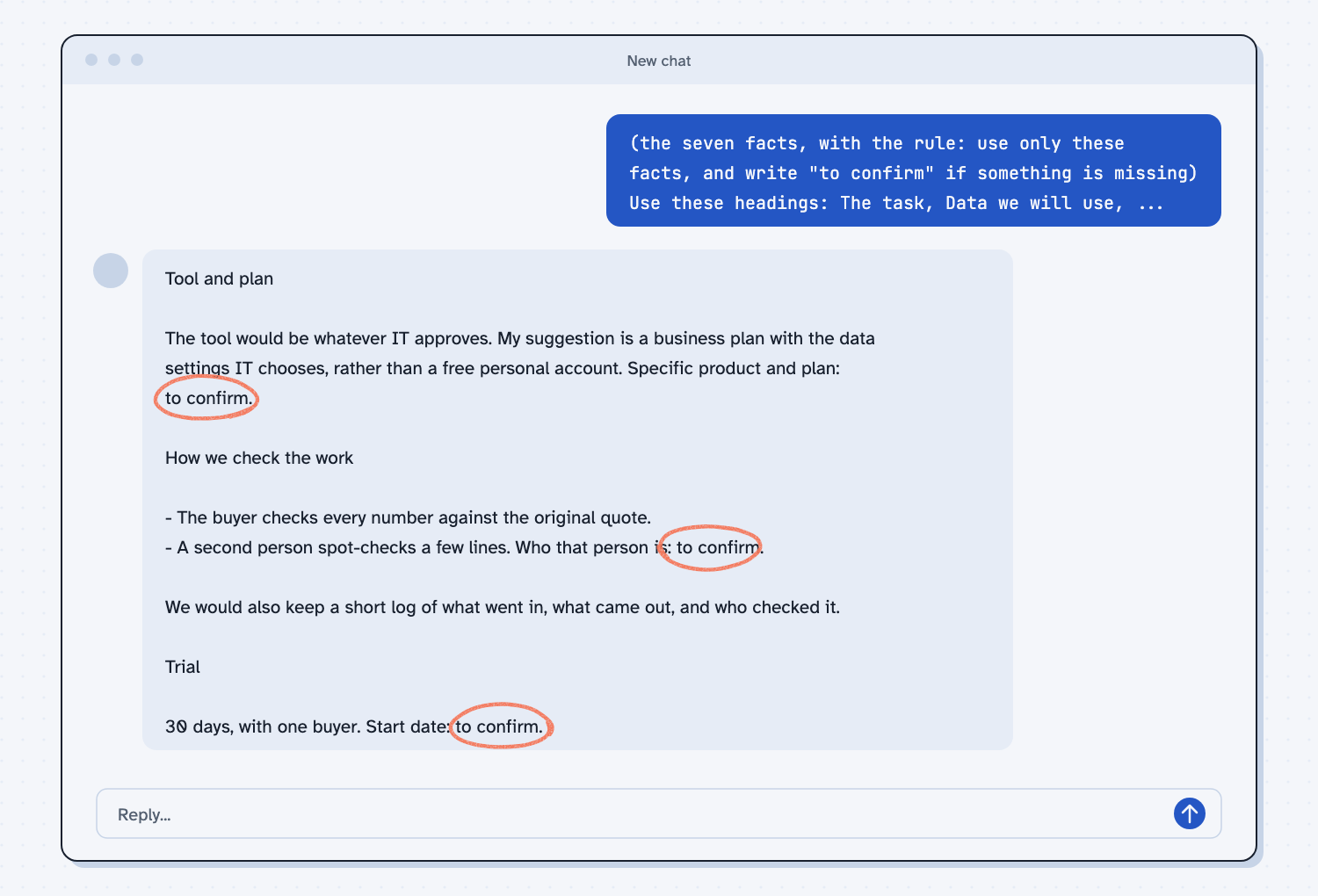
When I tried this, the draft used all seven headings and left the blanks marked instead of filling them in. On the tool it wrote, "The tool would be whatever IT approves," followed by "Specific product and plan: to confirm." On the second checker it wrote, "Who that person is: to confirm," and on the trial it wrote, "Start date: to confirm."
Its list of requests for IT was also useful: "Approval to run the 30-day, one-buyer trial described above" and "Any policies or conditions we need to follow (to confirm)." The draft is not ready to send until you fill in those blanks, but it gives you a clean page to edit, and the "to confirm" marks show you exactly what to settle with your team first.
Frequently asked questions
Who should I ask for approval?
Start with your direct manager, and bring in IT or whoever sets your company's rules on software and data. Ask your manager who that is if you do not know.
What if my company has no AI policy?
Then your one-page ask becomes a useful first draft of one. Offer a small, time-limited trial with clear limits, and let the reviewer decide what to add.
Can I use AI at work before I get approval?
Do not put real company data into an AI tool until you know it is allowed. Until then, practice with made-up sample data, which carries no risk.
How long should the trial be?
A short, fixed period such as 30 days works well, because a decision with an end date is easier to approve. Offer a short report at the end.
Use it today
- Safe use of AI at work: read the basics before you write your ask.
- Related idea: Keep a log of what AI did
- Related idea: Let AI clear the easy 80 percent
From my training: the first ask is always one task, one tool, and one way to check the work.