Levels of AI Automation: Start With a Draft, Earn Trust
With Josh Schultz ·
Answer. There are four levels of AI automation (how much of a job you hand to AI): manual, assisted, delegated, and autonomous. You choose the level for each task, not for the whole company. Start low by letting AI draft, and move a task up only after the AI has earned your trust.
The picture
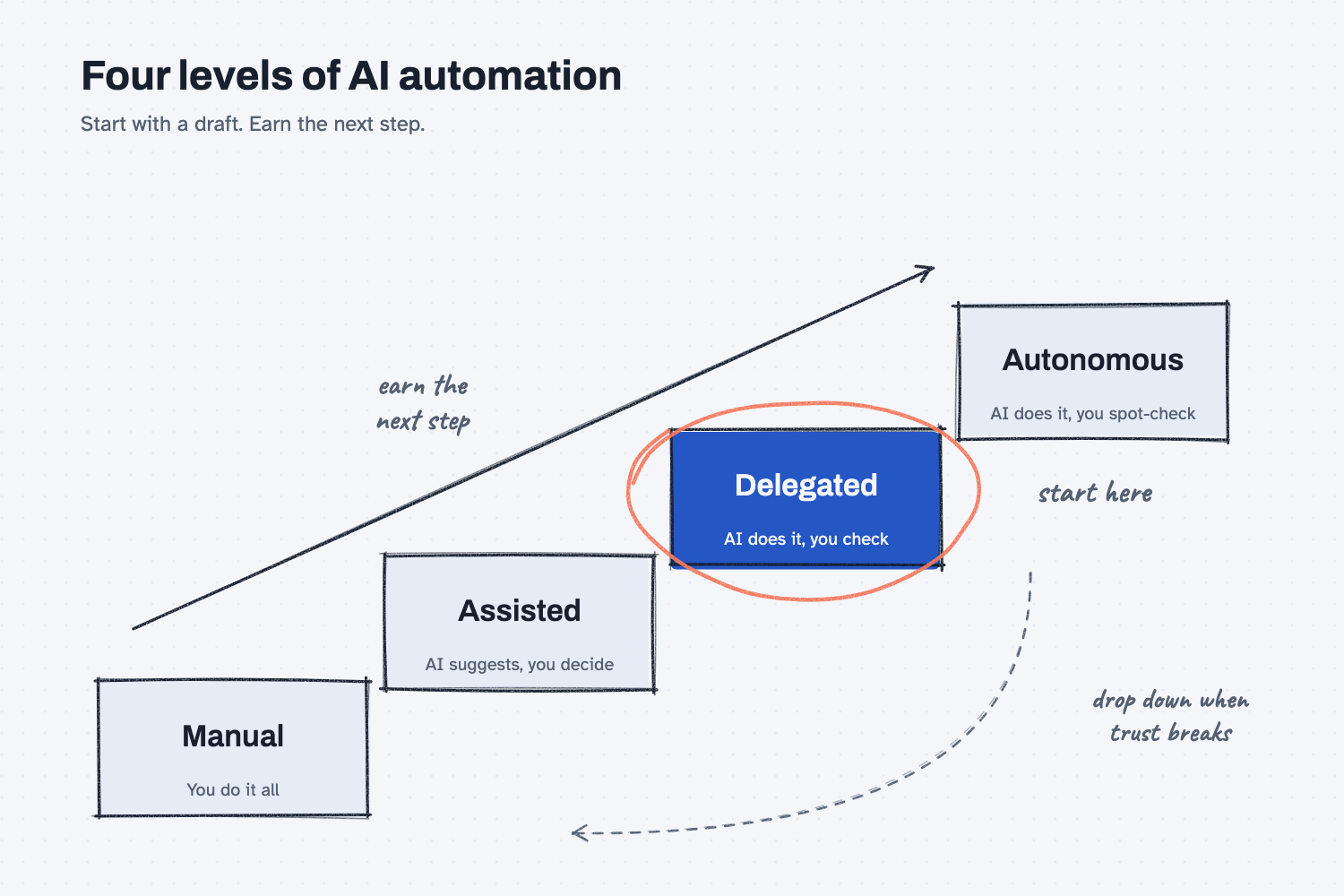
The picture shows four steps, and each step up means AI does more of the work while you do less. The circle marks where most new work should start, which is the step where AI does the job and you look at it before it goes anywhere. The arrows are the rule for moving between steps. AI climbs one step at a time, and it can also drop back down when it makes a mistake.
Think of it like this
Think about how you bring a new hire up to speed during their first month.
In the first week, you do the work and they watch. In the second week, they start making suggestions and you make the decisions. By the third week they write the email themselves, and you read it before it goes out. After a while you trust them enough to stop reading every one, and you only spot-check a few.
You didn't hand them the keys on day one, and you didn't give them every job at the same level either. They might send order notes on their own while you still check every price they quote.
AI earns room the same way, one task at a time.
Why does it matter at work?
It matters because the level you choose, and not the tool itself, decides how much damage a mistake can do. The same AI can be perfectly safe at one level and risky at the next.
Here is an example. Alicia Reyes runs customer service at Mesquite Ridge Metal Works, where her team answers RidgeLine dealers all day. She lets AI draft three kinds of replies, and at first she reads every one before it goes out.
After a few weeks, the "your order arrived, thank you" notes need no edits. So she moves those up, which means AI sends them on its own and she checks a few each Friday.
New ship dates stay where they were, because one wrong date sent to a dealer before spring planting costs more than the time she would save. Warranty calls stay with her as well, since AI can sort out the facts but she has to make the decision.
So she is using one tool for three tasks, at three different levels.
How does it work?
Each level answers one question, which is who does the work and who checks it. Here are the four levels.
Manual. You do all of the work yourself, and AI is not part of the job. In my experience, "A lot of people are still doing manual."
Assisted. AI acts as a thought partner, so you ask, it suggests, and you decide and do the work. This describes most chat use today. "Assisted is using AI to figure things out faster."
Delegated. You hand AI the job, it does the work, and you check the result before anything goes out. "Delegated is I give it this and see what it gives me back." For work that touches customers, money, or rules, this is often the right place to stay.
Autonomous. AI does the job on its own, often in the background, and you check a sample instead of every item. "Autonomous is constantly running in the background."
A task moves up when the work you have checked keeps coming back right, and it moves down when trust breaks. In my notes, I put it this way: "That is not failure. That is the system working." The rule I give every team is short: "Start with draft, and earn act."
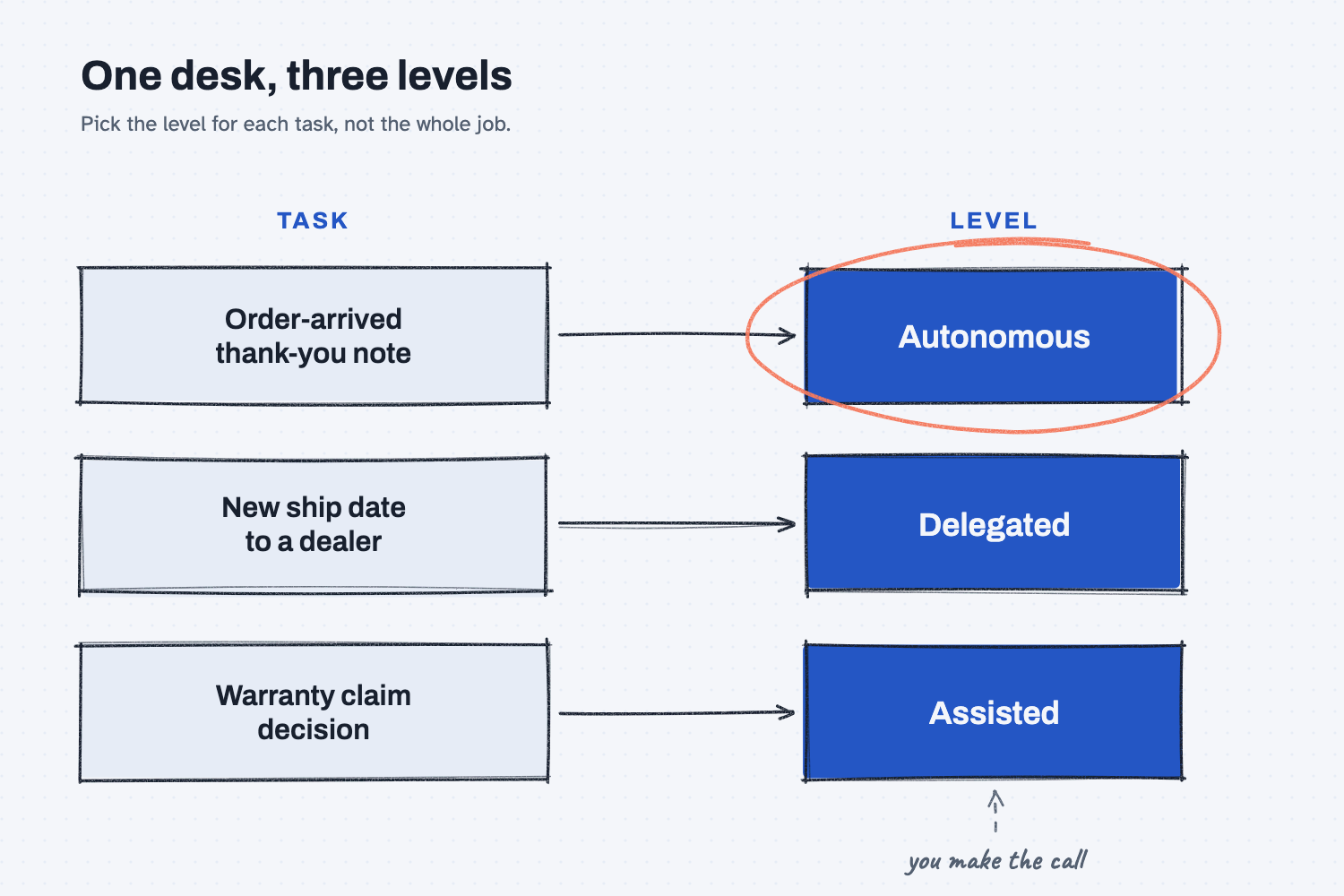
This second picture shows Alicia's three tasks, each placed on its own level. The thank-you note sits at the top because it is low risk, while the warranty decision sits lower because it needs her judgment.
Where do people get it wrong?
Most mistakes come from picking one level for everything. Here are four I watch for.
- One level for the whole job. A phrase like "AI handles customer email" hides five different tasks, so pick a level for each one.
- Jumping straight to autonomous. It may look great in a demo, but you should let it draft for a few weeks first and count how often you fix it.
- Never moving up. If you have checked 50 drafts and changed nothing, you are spending time you don't need to, so move that task up and spot-check instead.
- Not moving back down. One bad send is a warning sign, so drop that task one level, fix the cause, and let it earn its way back.
Try this in 2 minutes
This test shows how a chat tool sorts tasks by level, and you can use any chat tool.
- Open a new chat and paste this:
Here are four levels of using AI at work:
Manual: I do it all.
Assisted: AI suggests, I decide and do the work.
Delegated: AI does the job, I check it before it goes out.
Autonomous: AI does the job on its own, and I check a sample.

Place each task on one level. Answer as a table: Task, Level, Reason (under 10 words).
1. Thank-you note when a dealer's order arrives
2. Telling a dealer a new ship date
3. Deciding whether to approve a warranty claim
4. Sorting supplier emails into quotes, invoices, and other
- Before you read the answer, write down where you would put each task yourself.
- Compare your list with the reply, and then swap in four tasks from your own week.
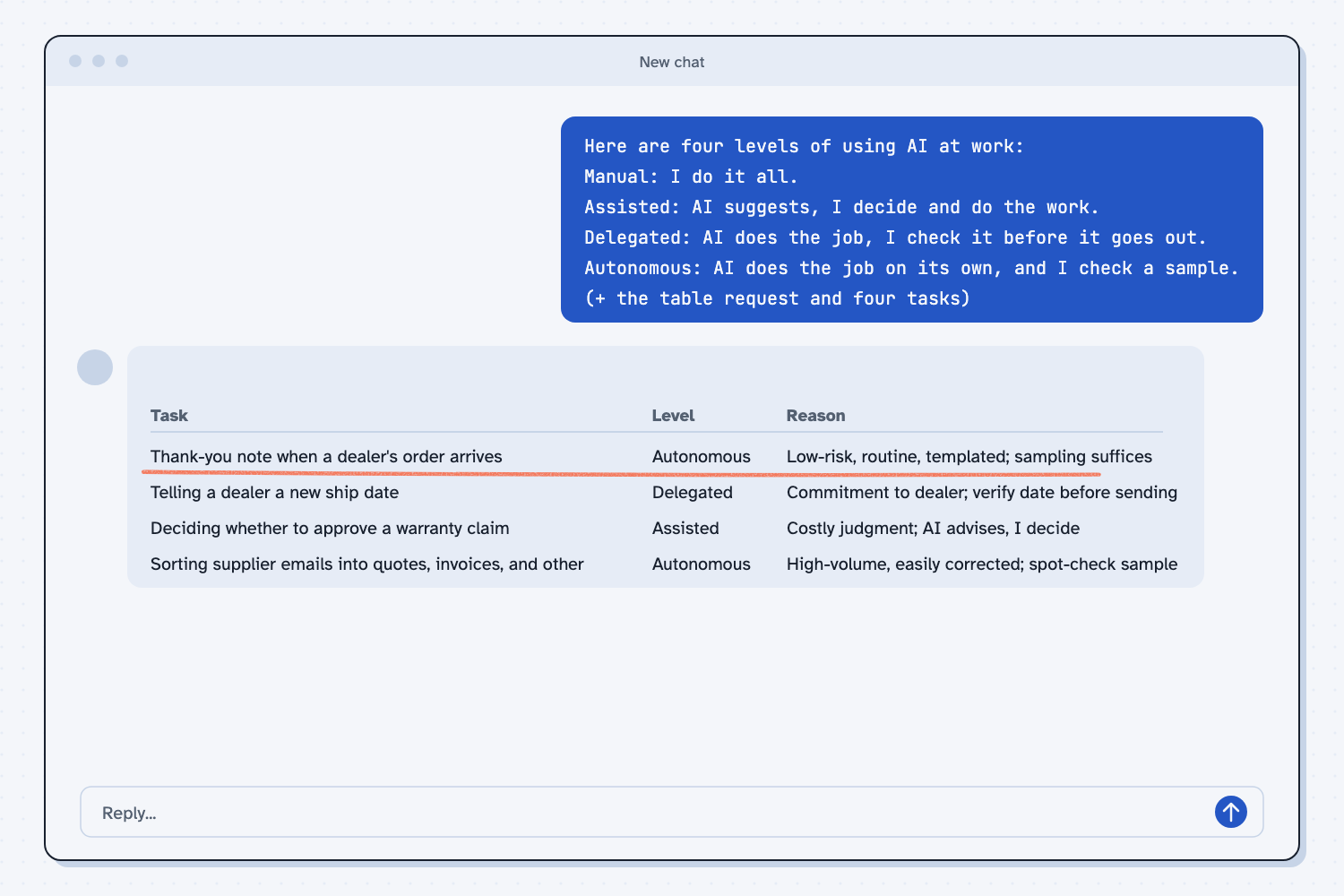
When I tried this, the sort looked a lot like Alicia's. Ship dates went to delegated, with the reason "Commitment to dealer; verify date before sending." Warranty claims went to assisted, with the reason "Costly judgment; AI advises, I decide." Email sorting went to autonomous.
The thank-you note also went straight to autonomous, with the reason "Low-risk, routine, templated; sampling suffices." Alicia waited a few weeks before she let those go, but the chat tool had no trial period in mind. It also put nothing at manual, which tells you the final call is yours, because you know your dealers and the AI does not.
Frequently asked questions
Which level should I start at?
Start at delegated for most new tasks, which means AI drafts and you check before anything goes out. For anything you can't take back, like money, a promise to a customer, or a safety call, stay at assisted until you trust it.
How do I know a task is ready to move up?
Count your fixes. If the last 20 or so drafts went out with no real changes, try the next level and spot-check. If you are still fixing things often, the task stays where it is.
Is autonomous AI safe at work?
It can be, for the right tasks: ones with low risk, that are easy to undo, and that you check by sample. Sorting email is a good fit. Approving a refund is not, until the AI has a long record.
What is the difference between an agent and the autonomous level?
An agent is a kind of AI that works in steps, while the level is how much you let it do without you. An agent can still work at the delegated level, drafting while you sign off.
Use it today
- Email suppliers about what's missing from their quotes: this guide stops at "drafts for a person to send" on purpose.
From my training: this is the four-level ladder I use with every team before we decide what AI should touch. Read chat vs. agent for what an agent is.