Make AI Check Its Own Work Before You Send It
With Josh Schultz ·
Answer. You can make AI check its own work, but you have to ask, because AI stops as soon as it has a first draft. Give it a short checklist and ask it to grade the draft and fix whatever fails. This is called critique and revise, and it takes only one more message.
The picture
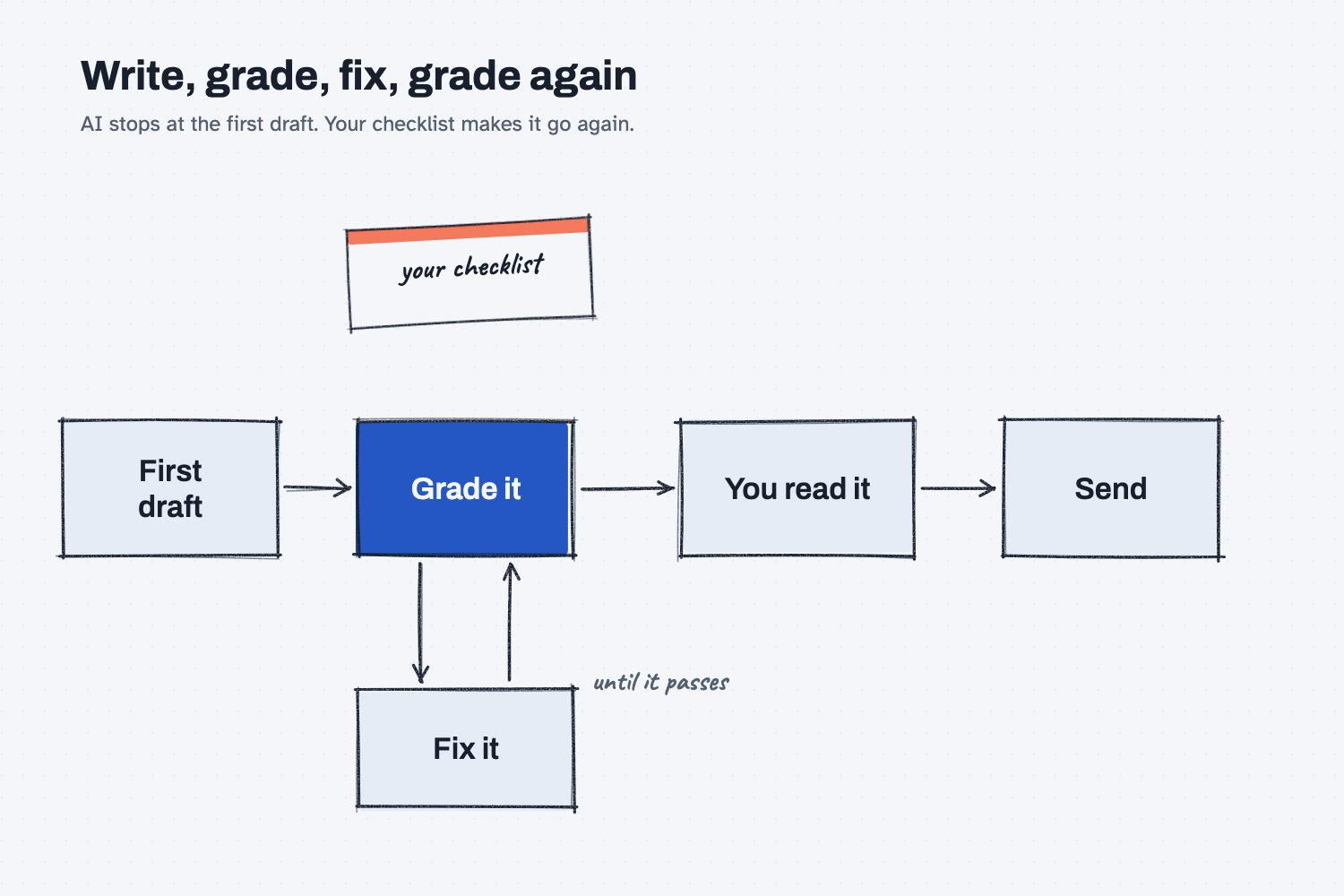
The diagram shows a loop. The first draft is not the end, so it goes to a grading step where it is checked against your list, and then it is fixed and checked again. Only when it passes do you read it and send it. AI will run this loop for you, but it will not start the loop on its own.
Think of it like this
Think about the first part that comes off the machine on a new job. Nobody runs the whole lot from that first part. The operator measures it against the inspection sheet, adjusts the setup, and checks again, and only then runs the rest.
AI makes the first part and drops it straight in the bin without checking it. That isn't because it is careless. It simply has no inspection step built in, so you give it the inspection sheet.
Why does it matter at work?
A first draft that is 80% right goes out the door looking 100% right, and the missing 20% is usually the part that gets results.
Here is how I put it in my field notes: "A person wants to succeed, look good, and be better. That drive is why a good person rewrites the first draft. A model has none of it. It is finished when it has produced an answer."
Here is how that plays out. Dana Ortiz is the senior buyer at Mesquite Ridge Metal Works, and a steel order from Red Creek Steel is 12 days late. She asks AI for a follow-up email and sends the first draft, which is polite and asks for "an update."
Red Creek writes back, "We'll update you soon," and two more days go by. With one more message, a checklist pass, the email would have asked for a confirmed ship date by a set day. It was the same tool, and the only thing missing was that one message.
How does it work?
You give the AI a standard, and it grades the draft against that standard. My notes sum up the loop in a few words: "Write, grade, fix, grade again." And then: "Quality goes up each pass."
The checklist is the standard. Keep it to three to five lines, and make each one something you can mark pass or fail. "Gives the PO number" is easy to grade, but "Sounds professional" is not.
Grading finds the gaps. Checking a draft against a list is easier than writing a perfect draft in one try, and that is true for people as well as for AI.
It can't make up your facts. If the check says the draft doesn't say what the delay costs you, the AI can only guess at the cost, so you need to add the real number yourself.
The grader has blind spots too. The same AI is checking its own work, so it can miss the same thing twice, which means you are still the final inspector.
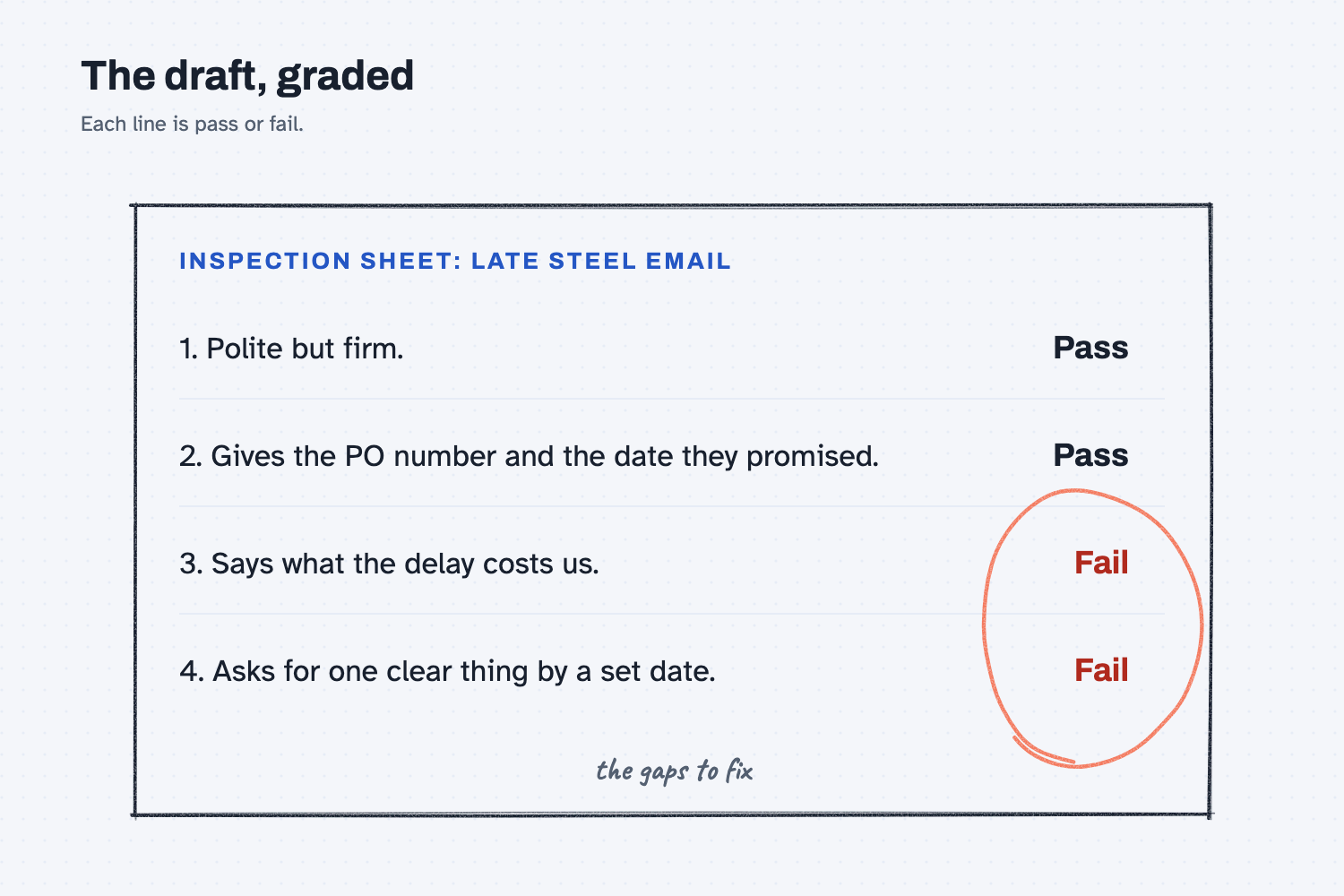
The inspection sheet above is the kind of checklist you would write. Two lines pass and two fail, and the two that fail are circled because those are the ones the AI needs to fix.
Where do people get it wrong?
Most mistakes come from treating the first draft as the finished part. These are four to watch for.
- Sending the first draft. It is the first part off the machine, so check it before you run the lot.
- Asking it to "make it better." Better at what? Without a list, the AI guesses, and its guess is the likely answer, not the best one.
- Trusting the rewrite. The AI can fill a gap with a guess. One rewrite said "our crew will sit idle and the customer's delivery will slip," and I never told it that, so read the draft yourself.
- Letting it fill in facts. When the check flags something missing, add the real information yourself instead of letting the AI invent the number.
Try this in 2 minutes
This test lets you see the second pass for yourself. You can use any chat tool.
- Open a new chat and paste this:
Write a short email to Red Creek Steel. Our 4140 bar stock on PO 40118 was promised for March 3. It is now 12 days late. We need it to start a Prairie Wheel job on March 20. Keep it under 120 words.
- In the same chat, paste this checklist:
Check your email against this list. Mark each line pass or fail. Then list 3 weaknesses and rewrite the email.
1. Polite but firm.
2. Gives the PO number and the date they promised.
3. Says what the delay costs us.
4. Asks for one clear thing by a set date.
- Compare the first draft with the rewrite.
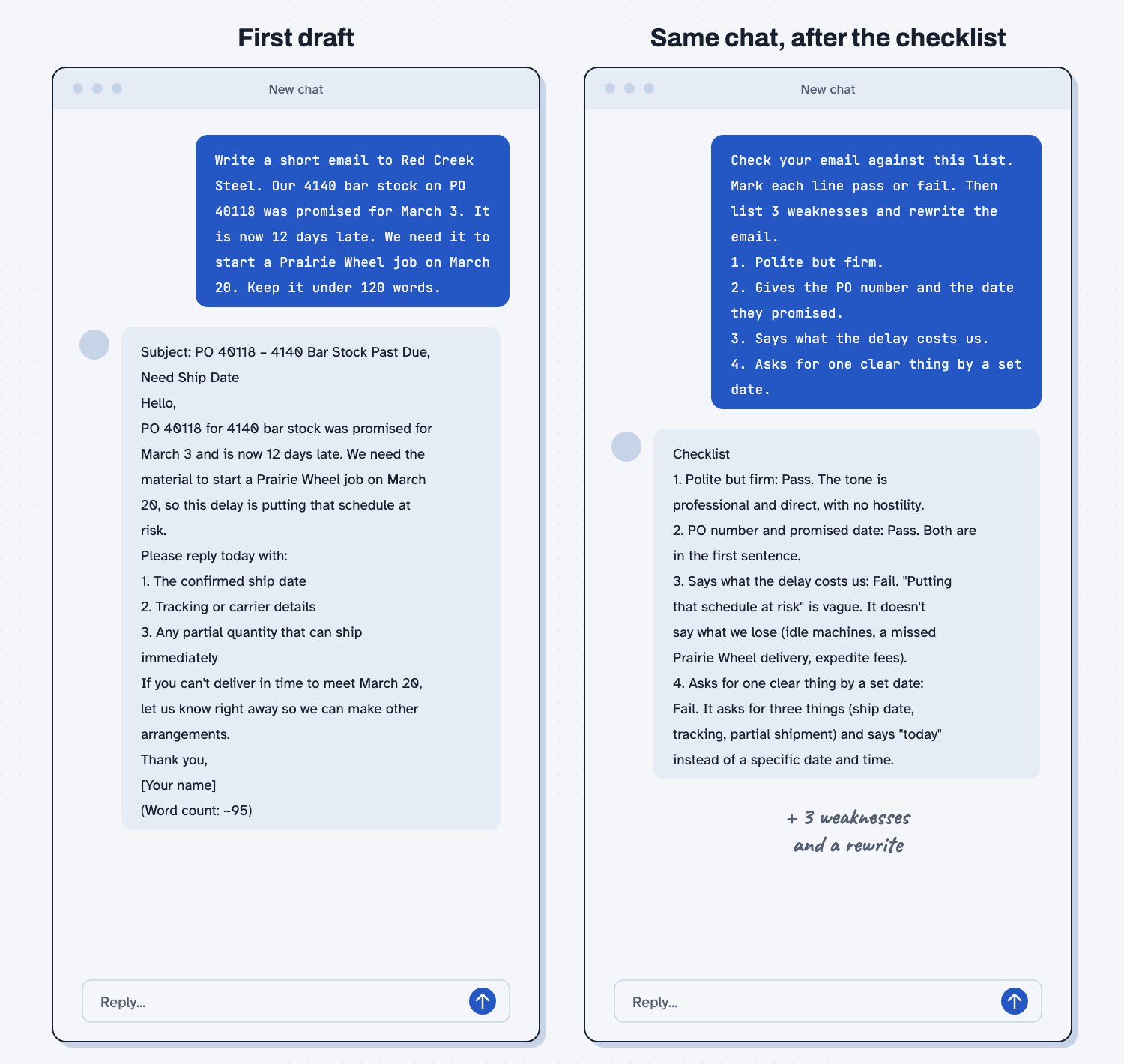
When I tried this, the first draft was a decent email. It asked Red Creek to "reply today" with a ship date, tracking details, and any partial shipment, but it never said what the delay costs us, and "today" is not a date.
Then I pasted the checklist, and the AI graded its own email like this:
- Says what the delay costs us: Fail. "Putting that schedule at risk" is vague.
- Asks for one clear thing by a set date: Fail. It asks for three things (ship date, tracking, partial shipment) and says "today" instead of a specific date and time.
The rewrite then asked for just one thing: "Please confirm in writing by noon on March 16 a ship date that gets the material to us by March 18."
It also did something good, which was to leave a blank for the cost: "Without it, we will [state the real cost, e.g., idle the machine cell and miss our Prairie Wheel delivery]." It said to fill that in before sending, and that is right, because the real cost is yours to add.
Another rewrite handled that gap differently by filling it with a guess: "Without it, our crew will sit idle and the customer's delivery will slip." Nobody told the AI that, and it might or might not be true. That is why you still read the draft before it goes out.
Frequently asked questions
Can't I just ask it to "make it better"?
You can, but better at what? A checklist tells it what better means. Without one, it guesses, and you get a polished version of the same first draft.
How long should the checklist be?
Three to five lines. Each line should be something you can mark pass or fail. "Gives the PO number" works. "Sounds professional" is hard to grade.
Does this work for more than emails?
Yes. You can use it on SOPs, quote summaries, reports, and meeting notes. Write the checklist once, save it, and reuse it every time you do that kind of job.
Should a second AI check the first one?
It can help on big decisions. But a second AI can share the same blind spots, so it doesn't replace you. You still read the work before it goes out.
Use it today
- Have Claude build your quote report: send a check prompt that has Claude go through every row.
From my training: this comes from my field notes "Best, Not Predictable" and "AI Primitives and Wiring."