What Is a Token? The Pieces AI Reads, Writes, and Bills By
With Josh Schultz ·
Answer. A token is a small piece of text, often a short word or part of a longer one, that an AI reads and writes in. Limits on how much an AI can hold, and the prices for using it, are counted in tokens instead of words or pages.
The picture
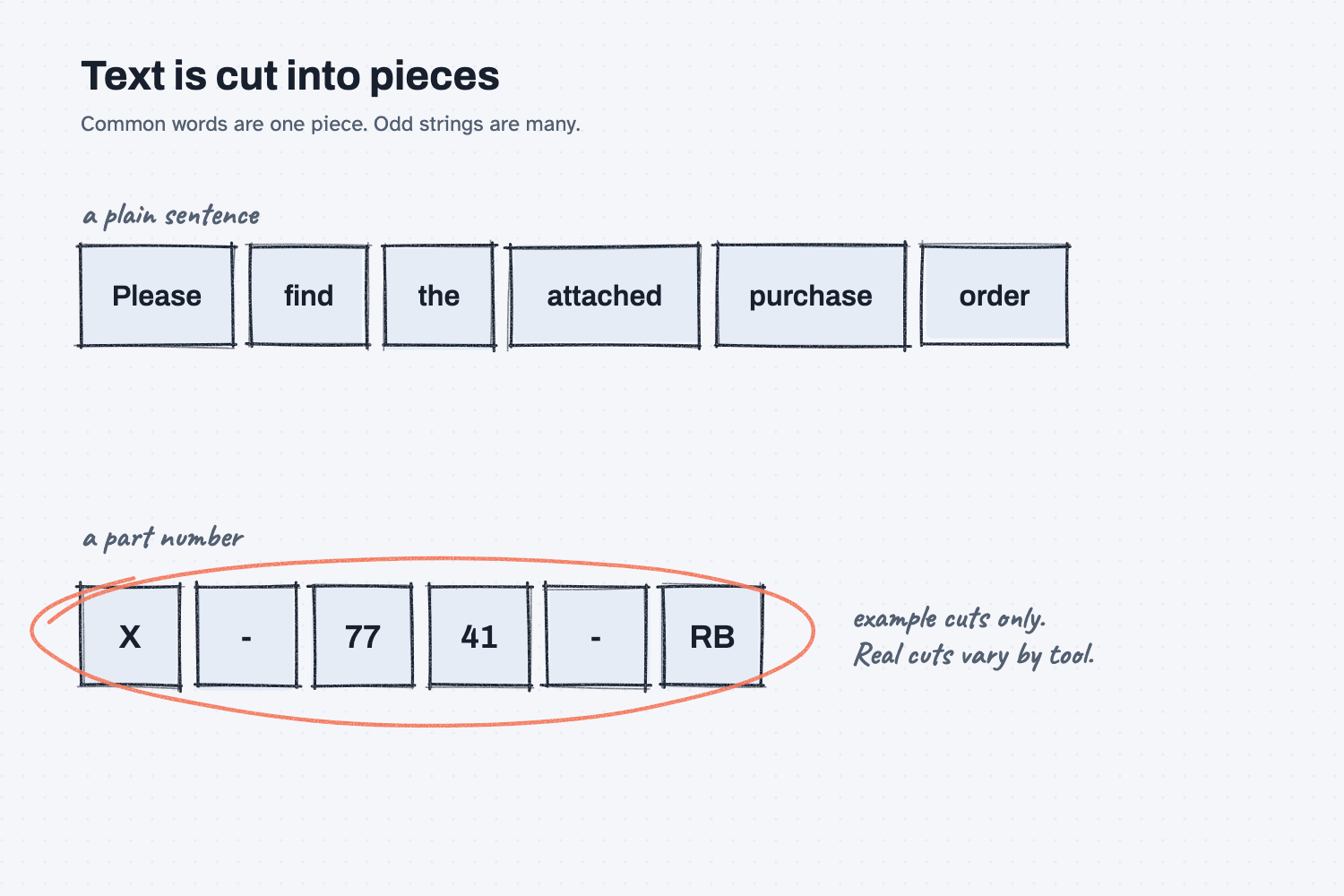
The top row shows a plain sentence cut into pieces, and here each common word becomes one piece. The bottom row shows a part number, which the AI breaks into many small pieces because it is not a word it sees often. The exact cuts shown here are only an example, since each AI tool cuts text its own way. The point of the circle is that a short string like a part number can cost more pieces than a longer everyday word.
Think of it like this
Freight carriers do not bill you by the number of items in the shipment. They bill by a standard unit, like the pallet or the pound, because that is what actually uses up space on the truck. A hundred loose bolts and a hundred engine blocks are very different loads, even if the count is the same.
AI tools work the same way. The standard unit is the token, because that is what uses up the AI's working space and its computing time. So an AI does not count your message in words. It counts it in tokens, and both the limit on how much it can hold and the bill for using it follow that count.
Why does it matter at work?
Tokens matter because two things you care about are measured in them. The first is the limit on how much the AI can hold at once, and the second is the price when a company pays by use.
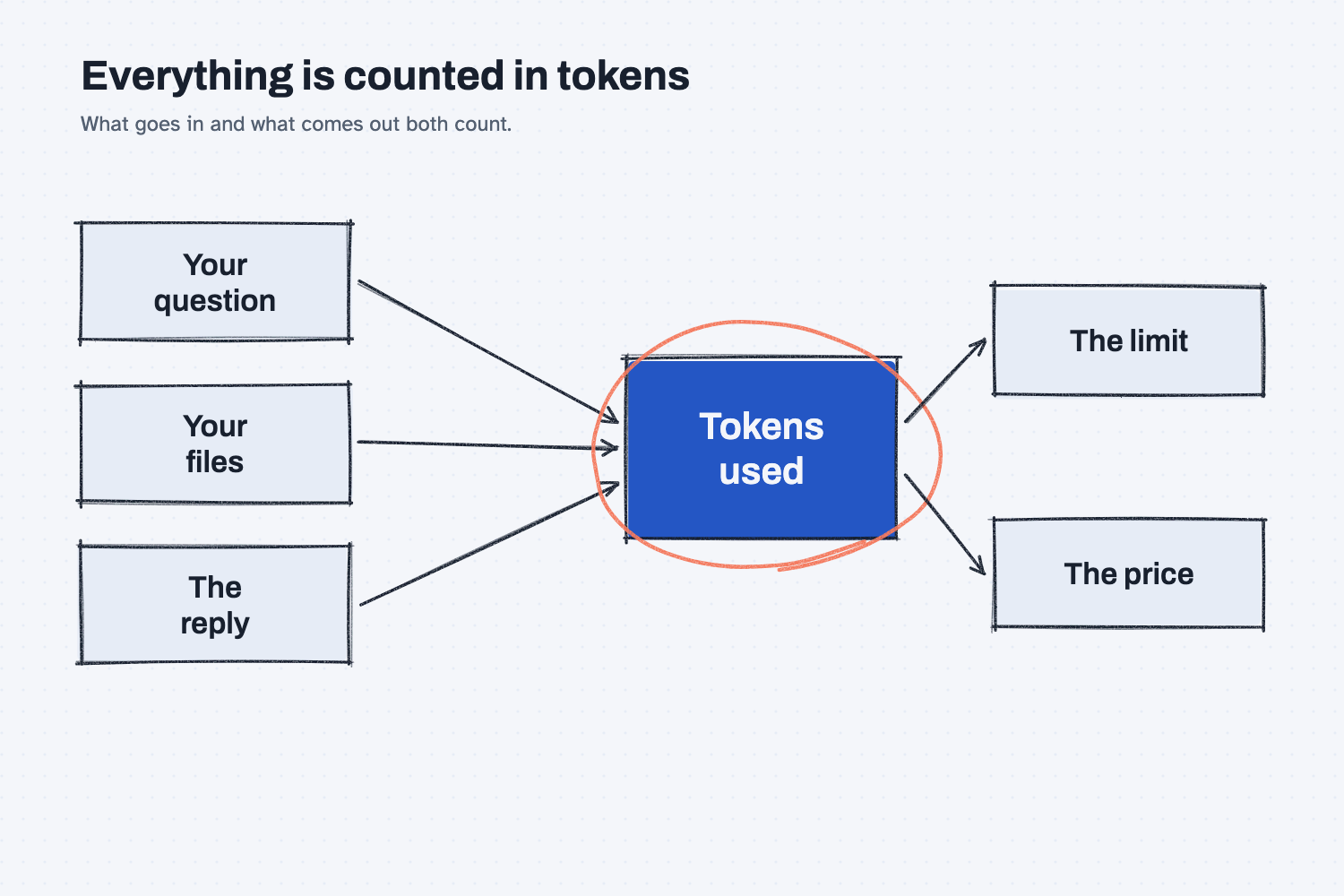
The limit is the one from what a context window is. The window is measured in tokens, and it has to hold everything at once: your question, any files you attached, the earlier chat, and the reply being written. If you paste a very long email thread, you are spending part of that space before the AI writes a word.
The price shows up when a company builds a tool on top of an AI, as Mesquite Ridge's IT might for reading invoices. Vendors usually list their prices per million tokens, and they usually charge more for the tokens the AI writes than for the ones it reads. Chat plans are mostly flat monthly fees, so you may never see a token count, but you may meet a usage limit that is counted the same way. What does AI cost? goes through the full picture. For your own numbers, check the vendor's price page, because they change.
How does it work?
There are three parts. Text is cut into pieces, the pieces are counted, and the count sets the limit and the bill.
Text is cut into pieces. Anthropic's glossary says tokens "can correspond to words, subwords, characters, or even bytes." Common words are usually one piece, while rare words, names, and codes get split into several, which is how the AI can read a word it has never seen before.
The pieces are counted. Each tool counts in its own way, so the same text can have a slightly different count in different tools. The glossary says that for older Claude models a token is about 3.5 English characters, and that newer Claude models count about 30 percent more tokens for the same text. For exact numbers, use the vendor's token counter for the tool you use.
The count sets the limit and the bill. Both what goes in and what comes out are counted. A long answer uses tokens just as a long question does, which is why asking for a short answer can save both space and money.
Here is a rough size guide, and it is meant to be loose. A page of about 500 words is somewhere around 700 to 1,100 tokens, depending on the tool and the text. A short email is a few hundred, and a long report is many thousands. Tables, code, part numbers, and text that is not in English use more tokens than plain English prose does.
Where do people get it wrong?
The most common mistake is to treat a token as a word. It is close enough for a rough estimate, but it is not the same, and that gap shows up in the places that cost money.
- Counting words and expecting the limit to match. Fifty pages of tables or part lists can fill a window much faster than fifty pages of letters.
- Forgetting the reply counts. The answer uses space and money too, so ask for what you need and no more.
- Pasting everything. A bigger input is more tokens, so paste the part that matters and not the whole export. How AI answers from your files shows a better way to feed it large documents.
Try this in 2 minutes
This test shows that a chat tool can only estimate its own tokens, and that odd strings cost more than plain words. You can use any chat tool.
- Open a new chat and paste this:
Roughly how many tokens is a one-page business letter of about 500 words? Give a rough range in one line. Then, in two plain sentences, say whether a part number like X-7741-RB would take more or fewer tokens than a common word like "order", and why. Be honest about what you cannot know exactly.
- What you should see is a rough range, a note that the part number takes more pieces, and a reminder that it cannot count exactly.
- If you want an exact count, use the token counter that the vendor provides.
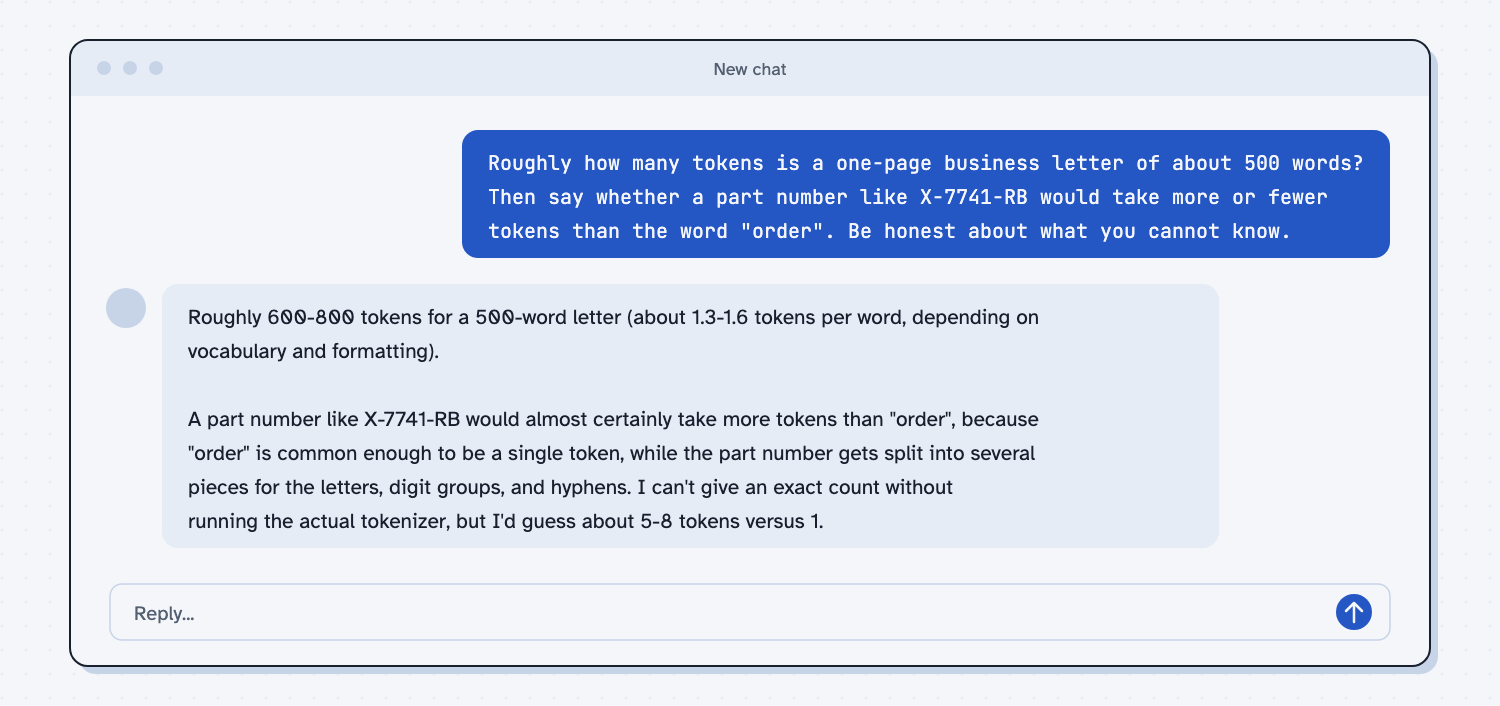
When I tried this, the reply said "Roughly 600-800 tokens" for a 500-word letter. It also said a part number "would almost certainly take more tokens than 'order', because 'order' is common enough to be a single token, while the part number gets split into several pieces." Then it added "I can't give an exact count without running the actual tokenizer."
The honest last line is the lesson. A chat tool is a good guide to rough size, and it is not a ruler, so use the vendor's counter when the number matters.
Frequently asked questions
What is a token in AI?
A token is a small piece of text that an AI reads and writes. It might be a short word, part of a long word, or a punctuation mark. Everything an AI handles is cut into tokens first.
How many tokens are in a page?
A page of about 500 words is roughly 700 to 1,100 tokens. The count varies by tool, and tables and part numbers use more. Treat it as a rough guide.
Why are AI prices counted in tokens?
Tokens measure how much text the AI has to process, and that drives the computing cost. Vendors usually price per million tokens, with the output often costing more than the input.
Is a token the same as a word?
No. Common short words are often one token, but long or unusual words are several. As a loose rule, a token is a bit less than one word.
Use it today
- Clean an ERP export in Excel with Claude: a task where trimming a big export before you paste it saves space.
- Related ideas: what a context window is, what does AI cost, and what an LLM is.
From my training: the site teaches it with the freight bill, so "tokens" stops being mysterious and becomes "the unit AI is measured in."