What Is Multi-Agent AI? A Line of Helpers With One Job Each
With Josh Schultz ·
Answer. Multi-agent AI means you split a job across several AI helpers, called agents, and each one does a single task and hands its result to the next. A person plans the line and checks the results at a few stops. The idea is the same as stations on an assembly line, where every station is simple and the whole line gets complex work done.
The picture
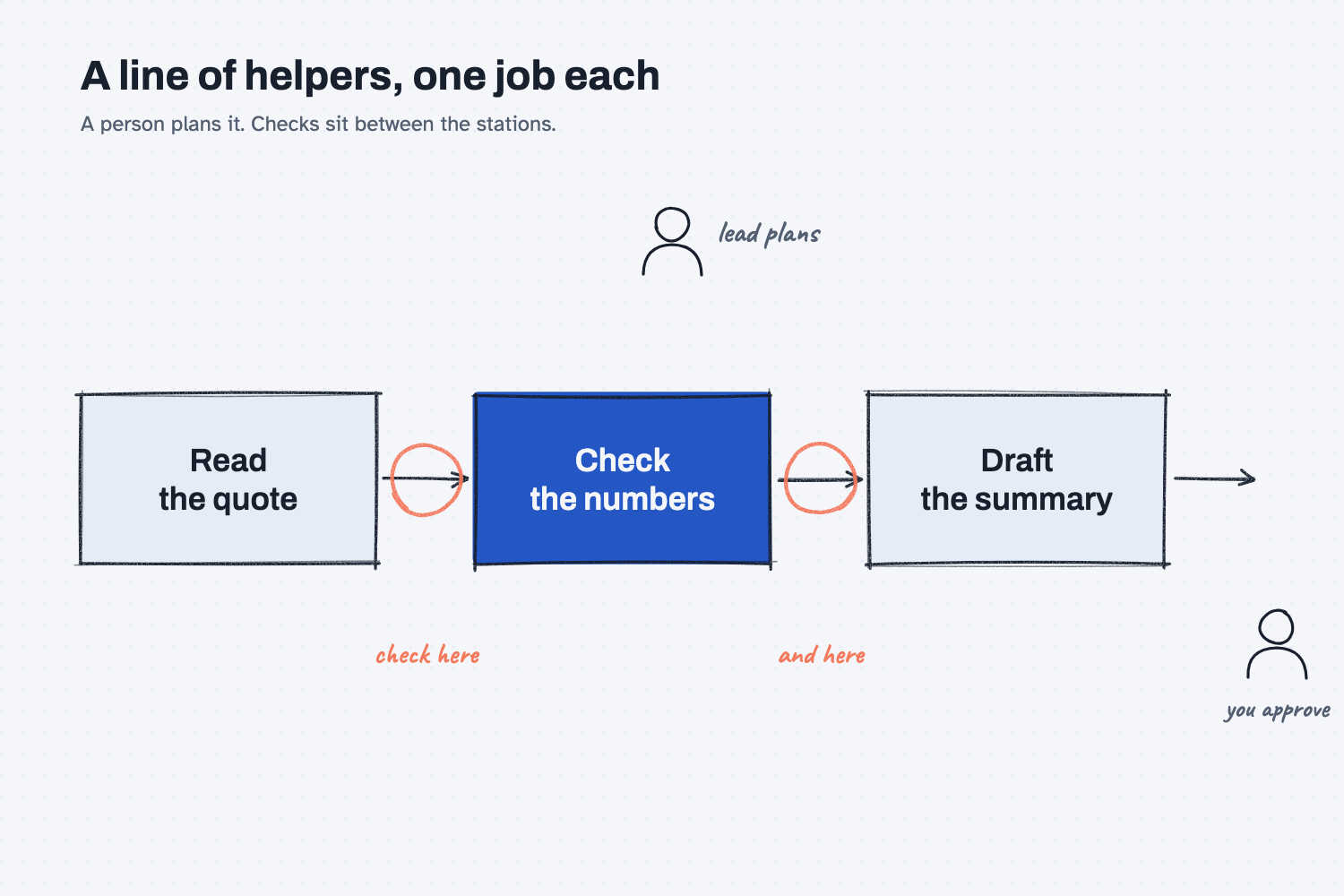
Follow the picture from left to right. A supplier quote enters the first station, which reads it and pulls out the numbers. The second station checks those numbers against what you expected, and the third drafts a short summary. The circled checkpoints between the stations are the places where a person can look at the work before the next station builds on it. The person at the top planned the whole line, and the person at the far right makes the final decision.
Think of it like this
Picture a small assembly line in your plant. One station cuts, the next deburrs, and the next inspects, and a lead person decides the order of the stations, watches the flow, and steps in when something looks wrong.
Nobody expects the cutting station to also deburr, inspect, and pack, because each station does better when it only has one job. It is also easier to find the problem, since a bad part tells you which station to look at. Multi-agent AI works the same way. Each agent has one job and one set of instructions, and the lead person, or sometimes a lead agent, decides who works on what and in which order.
Why does it matter at work?
It matters because one AI chat asked to do a long, many-part job tends to lose track, and a line of small, focused helpers is easier to trust and easier to fix. (The reason long jobs go wrong is in why AI fails on long tasks.)
Here is an example. Dana Ortiz, the senior buyer at Mesquite Ridge Metal Works, gets steel quotes in four different formats. She sets up a three-station line. The first agent reads the quote and puts every line into a table, the second compares each line to the last price paid and flags the differences, and the third drafts questions to send the supplier. She looks at the table after station one and at the flags after station two, and she is the only one who sends anything. Each stop takes her a minute, and she never has to dig through a long chat to find where a number went wrong.
How does it work?
There are four parts: a plan, the stations, the handoffs, and the checkpoints.
A person writes the plan. Someone has to decide what the stations are, what each one must produce, and what counts as done. That is the planning part, and it should stay with a person, as people plan, AI does the work explains.
Each agent gets one job. A narrow job means short instructions and a result that is easy to judge. "Pull every line item into a table" is easy to check, while "handle this quote" is not.
Handoffs carry a result, not a conversation. Each station passes a table or a list to the next one, in the same layout every time, which keeps the line predictable. If the layout of the handoff changes, the next station can misread it.
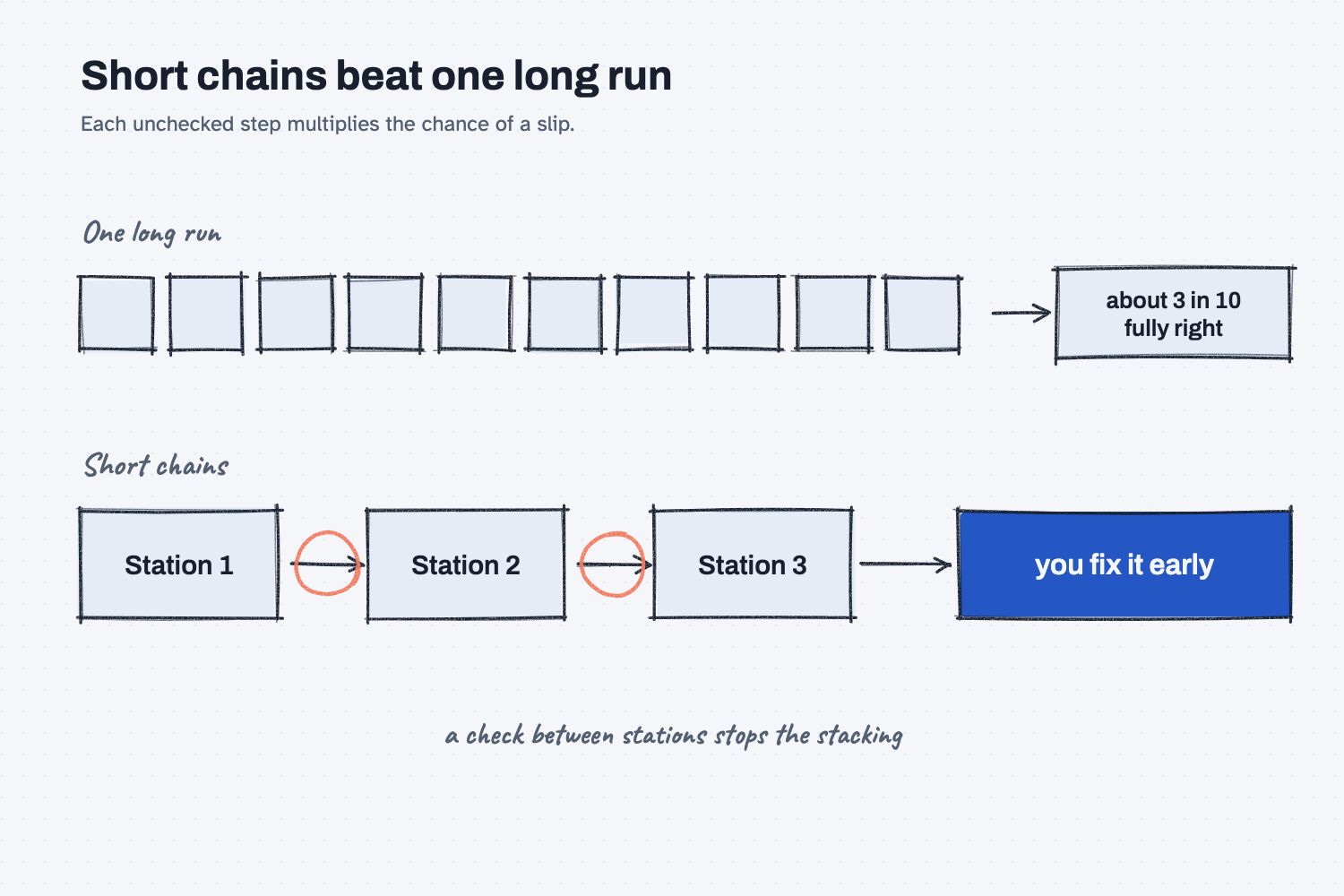
Checkpoints sit between stations. This is where the multiplying of small errors gets stopped. If each step is right nine times out of ten, a ten-step chain with no checks is fully right only about three times out of ten. A checkpoint resets that, because you fix the error before the next step builds on it. In my own words, from my process method: "Short chains with a checkpoint beat one long unattended run."
You should also know what this costs. Systems with several agents generally use much more computing than a single chat, so they pay off on work that is worth the effort, and not on a two-minute question. Anthropic's engineering team has written openly about this trade-off when describing its own multi-agent research tool.
Where do people get it wrong?
Most mistakes come from building a long chain and walking away.
- One long chain, no stops. A slip in station one is silently inherited by every station after it, so put a checkpoint after each station that matters.
- Too many agents. Each extra station adds another handoff that can go wrong, so start with two or three.
- Vague jobs. An agent told to "review and improve" will decide for itself what that means, so name the exact output.
- Letting the last agent send. Anything that leaves the building, such as an email to a supplier, should wait for a person's approval.
Try this in 2 minutes
This test asks an AI to design a three-station line for checking a supplier quote. You can use any chat tool.
- Open a new chat and paste this:
I want to set up several AI helpers to check a supplier quote, each with one job, passing work along like stations on a line. Give me a 3-station chain: for each station, its one job and what it hands to the next. Then say where a person should check. Plain words, short.
- You should see three stations with one job each, a handoff for each, and a list of places where a person checks.
- Look at whether it put a checkpoint after the first station, because that one matters most.
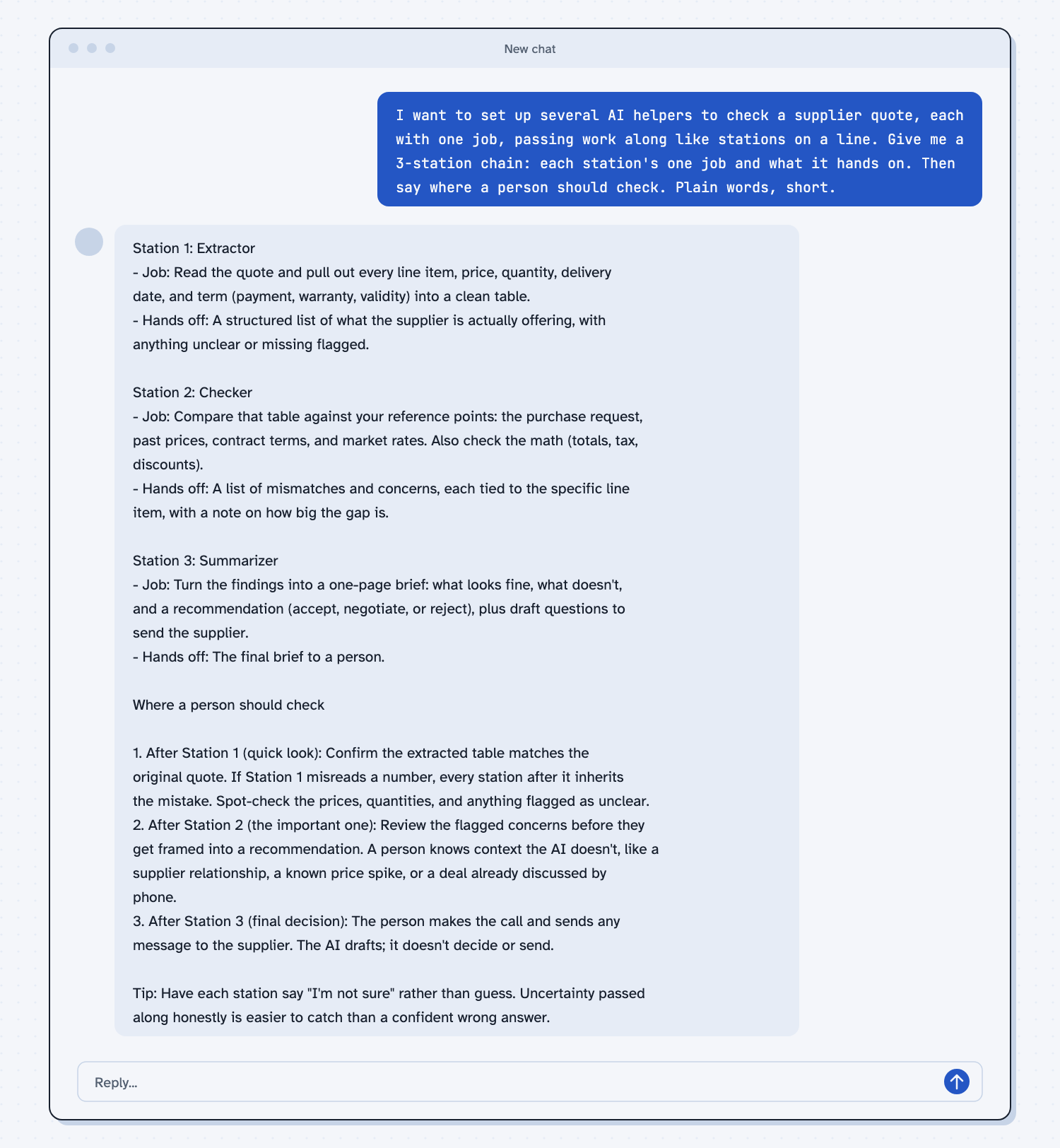
When I tried this, the reply named an Extractor, a Checker, and a Summarizer, and it gave the reason for checking early: "If Station 1 misreads a number, every station after it inherits the mistake." It also ended on the right rule for the last step: "The AI drafts; it doesn't decide or send." That matches the lesson, because the first station is where an error does the most damage, and the last decision stays with a person.
Frequently asked questions
What is an AI agent?
An agent is an AI that can take steps toward a goal, such as reading a file or using a tool, instead of only answering one question. Chat versus agent shows the difference.
Is multi-agent AI better than one AI?
Not always. It helps when a job has distinct parts or is too long for one chat. For a simple task, one chat is cheaper and easier to check.
Do the agents talk to each other freely?
They should not. Give each one a fixed handoff, such as a table, so the next station knows exactly what it receives.
Who is in charge?
A person plans the line and approves the result. In some tools a lead agent assigns the work, but a person still owns the plan and the approval.
Use it today
- Compare supplier quotes every time: a repeatable, step-by-step version of the same quote check.
- Related ideas: AI workflow versus agent, Human in the loop, and what triggers an AI agent.
From my training: we build jobs as short chains with a person at the stops, and we only make the chain longer after the short one works.