Humans Plan, AI Does the Work: How to Split Work With AI
With Josh Schultz ·
Answer. Every job has three parts: plan it, do it, and check it. To split work between humans and AI, people do the planning, AI does the doing, and scripts and people do the checking. When something comes out wrong, you fix the system that made it, not the one result.
The picture
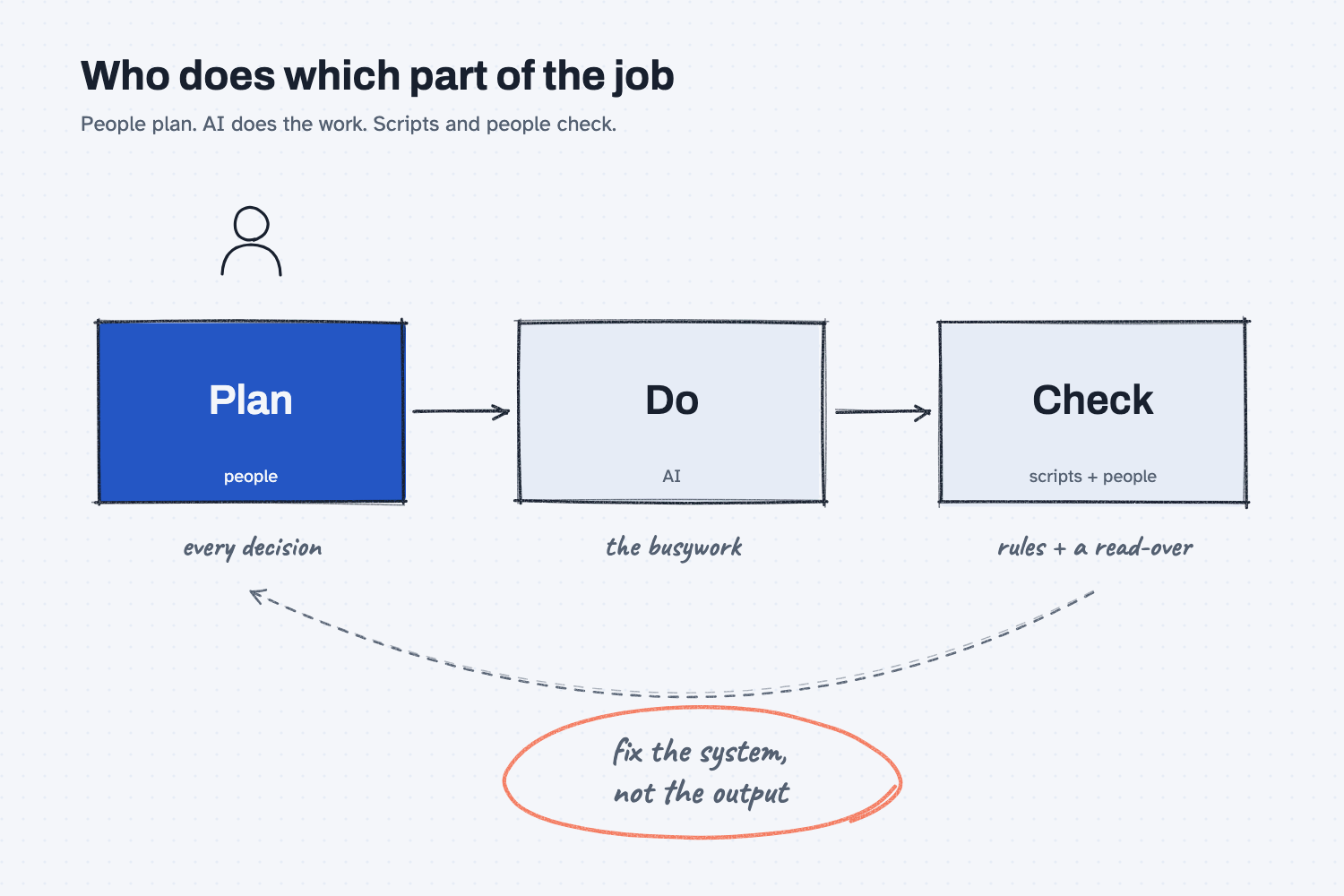
Read the picture from left to right. People own the plan, which holds every decision, AI does the busywork, and simple scripts and a person share the check. The dashed arrow at the bottom matters most, because when the check finds a problem, the fix goes back into the plan instead of into the one bad result.
Think of it like this
Think about the last email you answered. It took you about 30 seconds and felt like one quick task, but you actually did three jobs in a row.
First you planned it, deciding what the answer was, what to say outright and what to only hint at, how it should feel, how long it should be, and what facts to include. Then you typed it, which was quick because the thinking was done. Last, you read it over, fixed a word or two, and hit Send. As I put it: "you're really going through multiple phases in your head and switching."
You hardly notice the planning, which is exactly why people hand it to AI without meaning to. Type "reply to this" under a pasted email, and the AI gets the typing plus all the planning you never wrote down.
Why does it matter at work?
When people tell me AI doesn't work for them, the AI was usually handed the planning along with the doing. As I put it: "anything you don't tell it explicitly or isn't in the skill, the AI will have to decide." That is why I say, "It is a human's job to plan."
Here is how that plays out at Mesquite Ridge Metal Works. Dana Ortiz, the senior buyer, gets an email from Travis Boone at Red Creek Steel Supply. The bar stock on PO 4471 will ship on the 14th instead of the 5th, unless she pays a $180 expedite charge to get half of it on the 5th.
Dana knows things that are not in that email. The machine shop needs the bar on the 5th, this is Red Creek's second late order this quarter, and she likes working with Travis. If she pastes the email and types "write a reply," none of that comes along, so the draft says things she never decided. She rewrites it and decides AI didn't save her any time, but the real problem is that the plan never left her head.
How does it work?
AI doesn't just make the same job faster. In my words, it "changes which parts humans do and which parts are done by computers." The job splits into four parts, and each part has an owner: people plan, AI does, scripts and people check, and every miss goes back into the plan.
People plan, and the plan holds every decision. A full plan says what to do, how, the target, who it is for, what to say, and which tools and information to use. The goal, as I put it, is to "extract all of those decisions up to the planning phase."
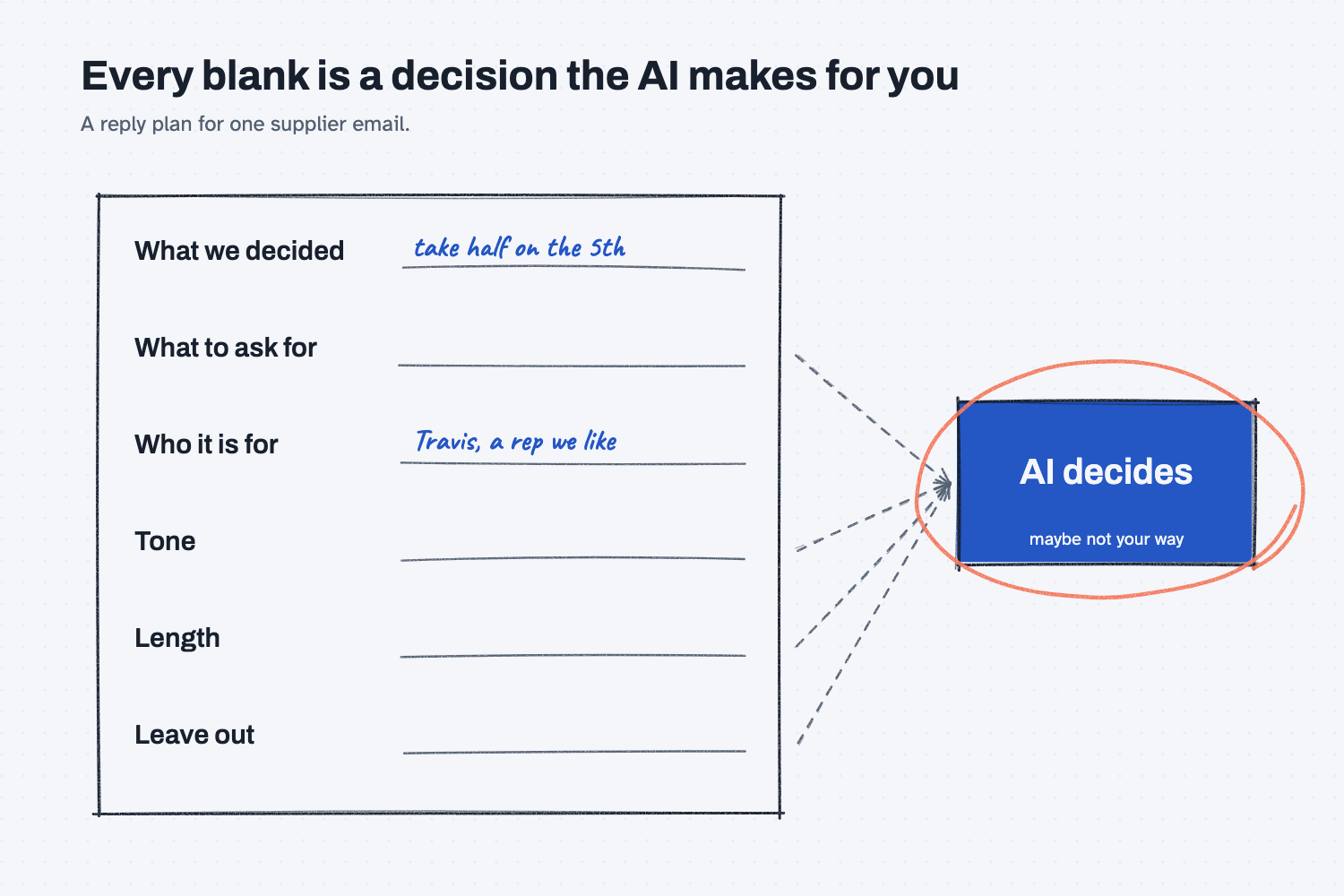
Every blank line on that plan is a decision the AI will make for you. The hardest lines to fill are the reasons behind your calls (see how to teach AI your judgment) and what you protect first when two goods clash (see how to give AI your priorities). It also helps to describe what the finished work should look like and to stack the right files in the right order.
AI does the work. Once the plan is complete and the AI has the tools and information it needs, there is little left to guess, and that is when you can hand the job to an agent, which is an AI that works through the steps on its own. The payoff, in my words, is that "we get rid of all of our busy work," and people keep the part that needs a person, which is to "plan, think, and strategize."
Scripts and people check. Some checks are yes-or-no facts, such as whether the email has the PO number and both dates. A script, which is a small program that follows fixed rules, checks those the same way every time (see what deterministic means). A person checks what needs judgment, such as whether the reply sounds right for Travis (see human in the loop AI), and you can have the AI review its own draft before you read it.
Fix the system, not the output. When a check finds a mistake, don't just fix the email. I say it this way: "we don't fix the output, we go back and we always fix the system itself." The system means the instructions, the saved skill, and the setup the AI works in, so the next job comes out right too (see fix AI mistakes for good).
Where do people get it wrong?
These are the three mistakes I see most often.
- Handing over the plan without noticing. Every decision you leave out still gets made, only now the AI makes it.
- Planning after the draft comes back. Rewriting a draft is planning done late, and it is the slowest way to plan, because you have to read first and then undo.
- Fixing the result and moving on. If you only fix this week's email, next week's will need the same fix.
Try this in 2 minutes
This test shows what an AI decides when the plan is missing. You will ask any chat tool for the same supplier reply twice, once with a thin ask and once with a full plan.
- Open a new chat and paste this thin ask:
Write a reply to this supplier email for me.

From: Travis Boone, Red Creek Steel Supply
To: Dana Ortiz, Mesquite Ridge Metal Works
Subject: PO 4471 - MR-3001 bar stock

Hi Dana,
Bad news on PO 4471. The mill is running behind, so the MR-3001 4140 bar stock will ship on the 14th instead of the 5th. We can ship half of it on the 5th if you want, but that adds a $180 expedite charge. Or we ship it all on the 14th. Let me know which way you want to go.
Thanks,
Travis
- Open a second new chat and paste this plan, followed by the same email from Travis:
Write a reply to this supplier email for me. Here is my plan for the reply.

What we decided: take the half shipment on the 5th. Ask Red Creek to waive the $180 expedite charge, because this is the second late order from them this quarter. If they will not waive it, we still want the half shipment, so say that.
What to ask for: confirm the 5th and the 14th dates in writing by Friday.
Who it is for: Travis, a sales rep we want to keep working with.
Tone: firm but friendly. No blame on Travis himself.
Length: under 100 words.
Do not mention other suppliers or prices.
Sign it: Dana Ortiz, Senior Buyer, Mesquite Ridge Metal Works.
- Compare the two replies, and for each one, note what the AI decided that you never told it.
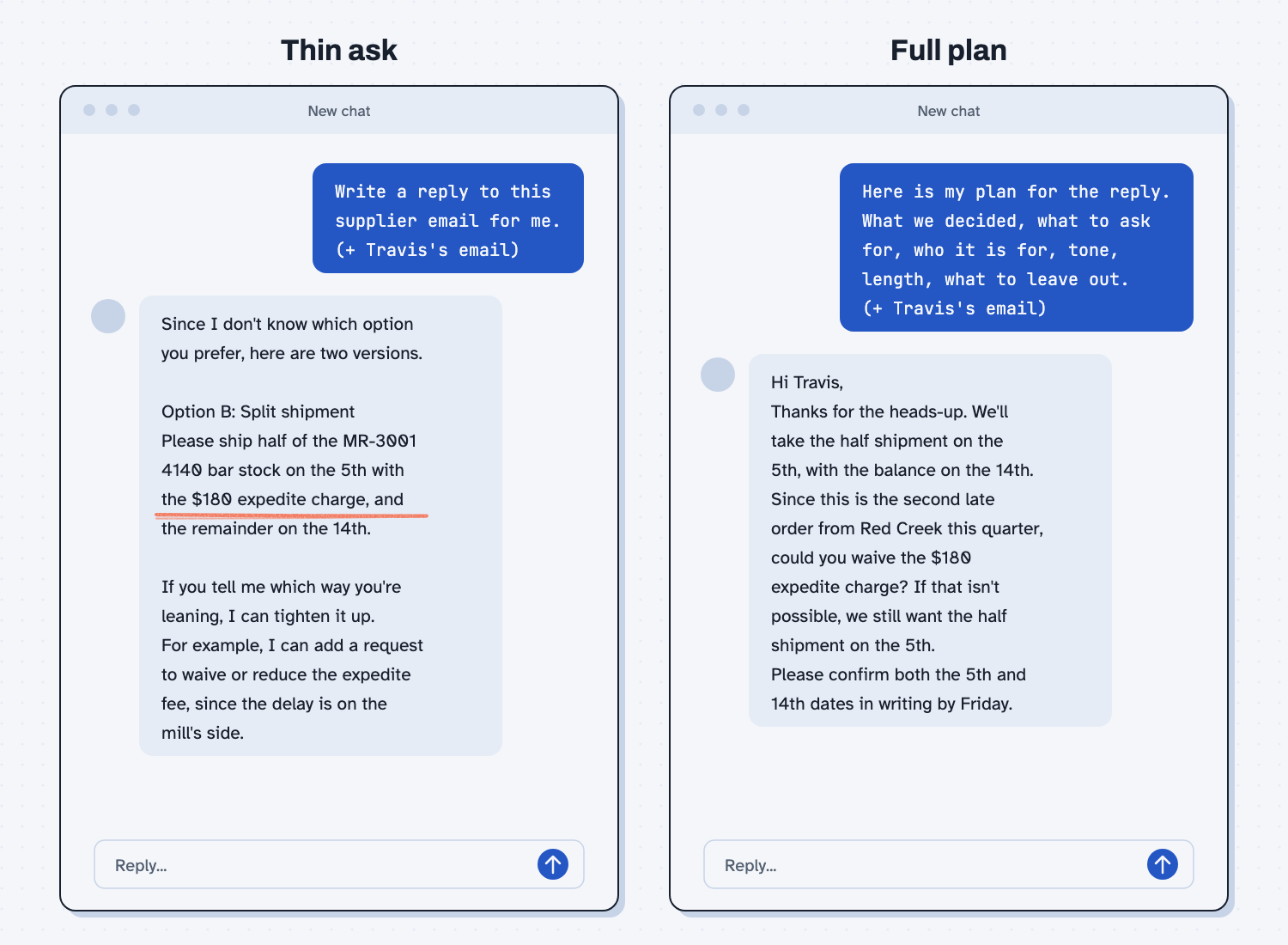
When I tried this, the thin ask came back with two emails, starting with "Since I don't know which option you prefer, here are two versions." It handed the biggest decision back to me, but it made smaller ones on its own. The split shipment version said "Please ship half of the MR-3001 4140 bar stock on the 5th with the $180 expedite charge," so it agreed to pay the fee without asking. Only at the very end did it offer to "add a request to waive or reduce the expedite fee, since the delay is on the mill's side," after I had already read two drafts.
The full plan came back as one email I could send as written. It asked, "Since this is the second late order from Red Creek this quarter, could you waive the $180 expedite charge?" and closed with "Please confirm both the 5th and 14th dates in writing by Friday." Every line traces back to a decision in the plan, which is why there was nothing left to fix.
Frequently asked questions
What does plan, do, check mean with AI?
It means splitting a job into parts with different owners. People make every decision in the plan, AI does the work the plan describes, and scripts and people check the result. When the check finds a problem, you fix the instructions, so the next job comes out right.
Doesn't writing the plan take longer than doing the work?
For one short email, it can. The plan pays off when the same kind of work comes back, because you save it in a skill or template and reuse it. Even for one email, the plan is thinking you would do anyway, just written down before the draft instead of after it.
Can AI help with the planning?
AI can lay out your options, as it did in the test above. Choosing among them is the plan, though, and that stays with you, because you know the supplier, the schedule, and what matters most.
Use it today
- Email suppliers about what's missing from their quotes: a script decides what to ask, a template writes each email, and you read every draft and click Send.
- Related idea: Fix the instructions, not the output, for the last step of the loop.
- Related idea: Let AI clear the easy 80 percent, for how people and scripts share the checking.
From my training: this is the idea I share more than any other. People plan, AI does the work, both of us check, and every miss changes the system.