Who Owns What AI Makes? Treat It Like a Draft You Sign
With Josh Schultz ·
Answer. Who owns what AI makes is really two questions: may you use the text as your own, and who answers if it is wrong. Your company policy and your plan's terms come first on the first one, and the answer to the second is always you. Treat AI output as a draft you sign. I am not a lawyer, and this is not legal advice.
The picture
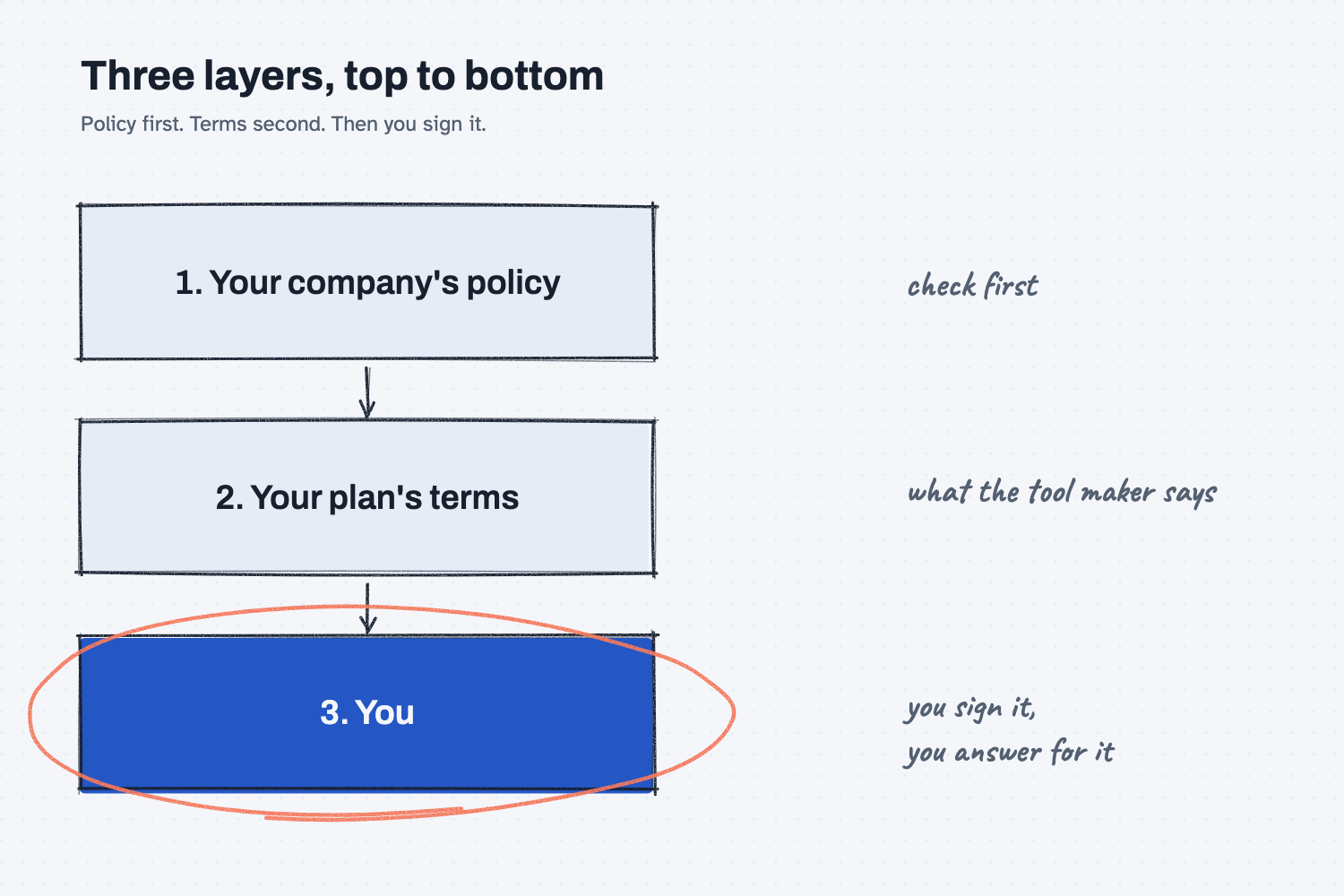
The picture shows three layers, and you work through them from the top. The first layer is your company's policy, because your employer decides what AI use is allowed and what happens to the work you produce. The second is the terms of the plan you are using, which are the tool maker's written promises about your content. The third layer is you, circled, because after the policy and the terms have had their say, you are the one who signs the work and answers for it.
Think of it like this
Suppose a temp at the front office writes a letter for you. The temp is fast, and the draft is good, but it goes out over your signature, so you read every line and fix what is wrong before you sign it.
If something in that letter turns out to be false, nobody says, "The temp wrote it." Your name is on the page, so the problem is yours.
AI output works the same way. It is a draft from a very fast helper that has no signature of its own. Whatever you put your name or your company's name on is yours to stand behind, whoever or whatever wrote the first version.
Why does it matter at work?
The ownership question sounds like a legal puzzle, but at work it shows up as a practical one. People want to know whether they are allowed to use the text, and whether anything about it can come back on them later.
Here is an example. Alicia Reyes runs customer service at Mesquite Ridge Metal Works, and she asks Claude to write a product description for the dealer sheet. Before she uses it, she checks three things. She looks at the company's AI policy to see whether this use is allowed, she looks at the terms of her plan to see what the tool maker says about her content, and she reads the draft against the real spec sheet.
That last check pays off. The draft includes a load rating that is not on the spec sheet, which means a dealer could have read a claim the company never made. She removes it, and the description that goes out is one she can stand behind.
How does it work?
There are three parts, and the order matters.
Your company's policy comes first. Many companies have a rule about which AI tools are approved and what may go into them, and some have a rule about how AI-made work is used or labeled. That rule sits above anything the tool says, so if you are not sure what your company allows, ask before you build something around it. Your manager, IT, or whoever handles contracts will usually know (see is it safe to put company data in AI).
Your plan's terms are the tool maker's side of the deal. Terms of service are the written agreement between you or your company and the tool maker, and they often say who may use the content you create and how your data is handled. Business plans often have different terms than free personal ones, so read the terms for the plan you are actually signed in to, because they can change over time. If your company bought the plan, the contract may say even more.
Treat the output as a draft you are responsible for. Whatever the terms say, a wrong number, a made-up claim, or a sentence copied from somewhere else will land on the person who sent it. That is why human in the loop matters here too, because a person reads it before it leaves the building.
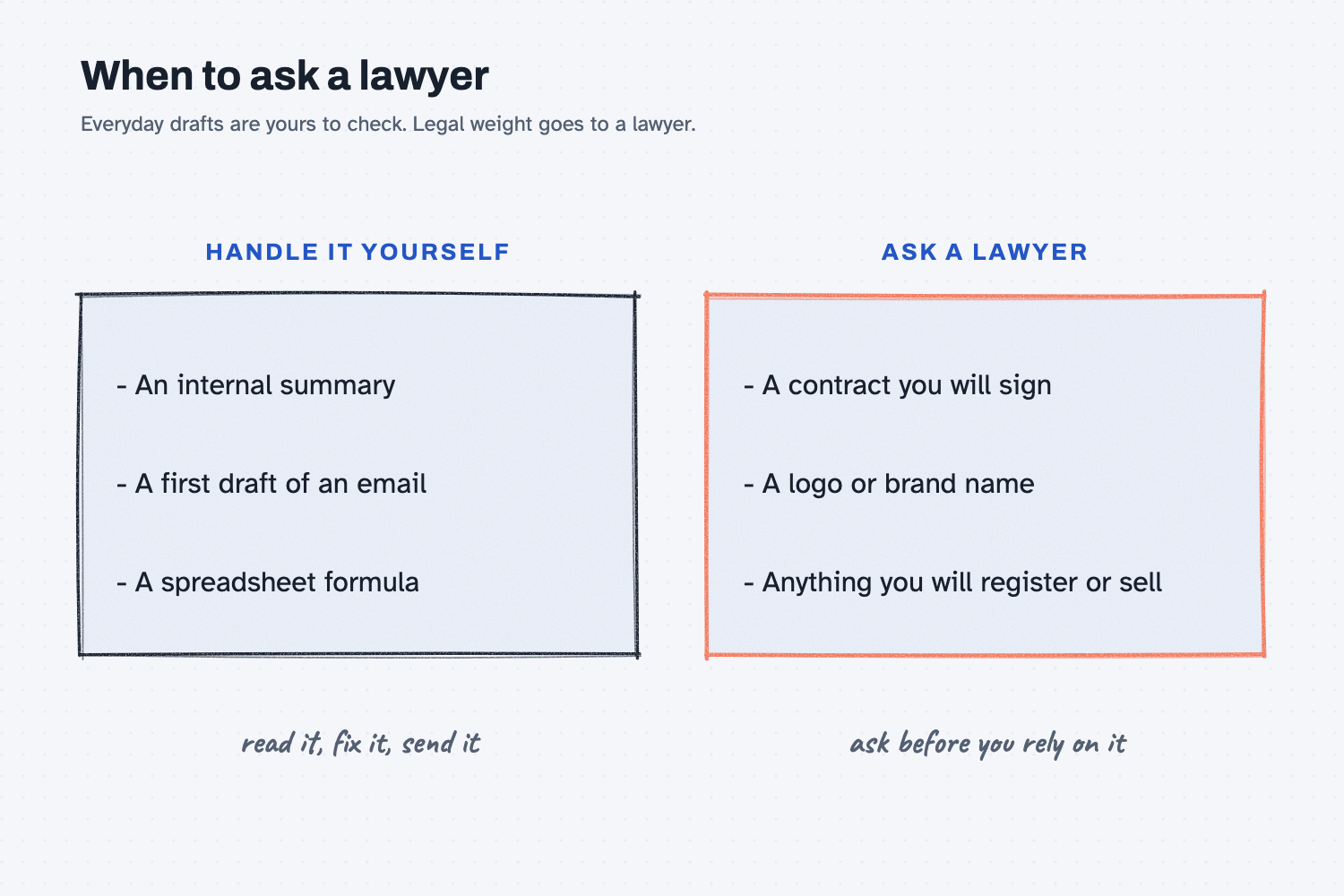
The second picture sorts the work into two piles. Everyday drafting, like an internal summary or an email you will review and send, is something you can handle with the three parts above. Anything with legal weight, such as a contract, a logo, or something you plan to register or sell, should go to a lawyer before you rely on it.
Where do people get it wrong?
Most mistakes come from treating the first draft as finished or from assuming that someone else has already checked it. These are the ones I would watch for.
- Assuming that typing the prompt makes everything yours. Whether and how text written by AI can be protected is a question lawyers are still working through in many places, so do not build anything on that assumption without asking one.
- Skipping the company policy. A tool that is fine for you at home may not be approved at work, so check before you use it for company material.
- Pasting in other people's material. Supplier drawings, customer documents, and other companies' text may carry their own limits, so do not feed them in unless you are allowed to.
- Sending it unchecked. "The AI wrote it" does not protect you if the claim is false, so read every line and compare facts to the source.
Try this in 2 minutes
This test asks the AI the ownership question directly, so you can see what it will and will not claim. Open a new chat in any tool and paste this:
I used you to draft a product description for our website and a paragraph for a supplier agreement. Who owns what you wrote, and what should I do before I use it? I am not asking for legal advice, only what a business user should check. Plain words, under 100 words.
Then look up the terms for your plan, and find your company's AI policy if it has one.
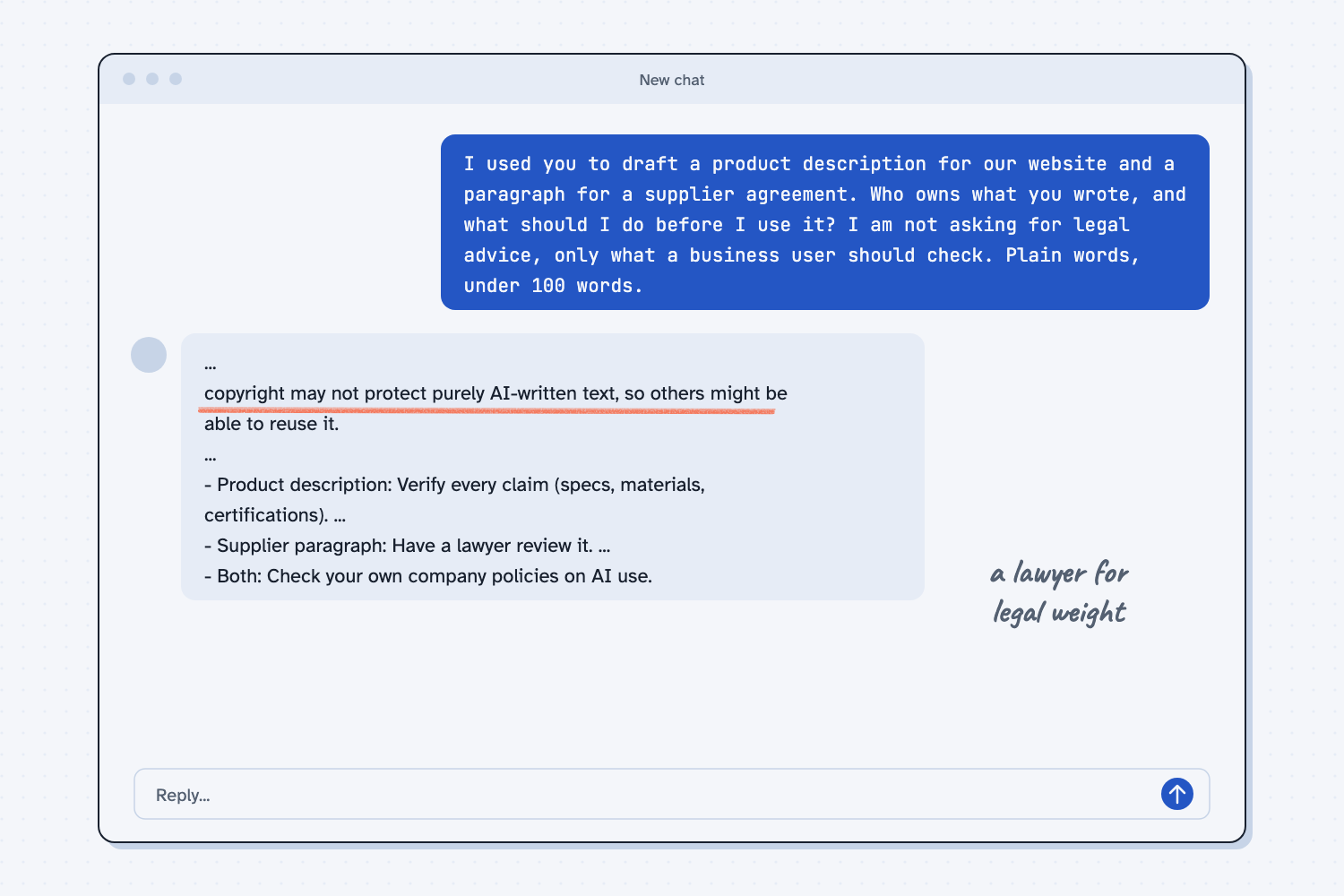
When I tried this, the reply did not claim a simple answer. It said "copyright may not protect purely AI-written text, so others might be able to reuse it." For the product description, it said to "Verify every claim (specs, materials, certifications)," and for the contract paragraph it said "Have a lawyer review it."
It ended with "Check your own company policies on AI use." That is the same order I gave you above, with the company policy first, and with a lawyer for anything that carries legal weight. Treat the reply as a reminder of what to check, because it is not a legal answer, and the rules differ from country to country.
Frequently asked questions
Can I use what AI writes for my business?
Usually, yes, as long as your company policy allows it and your plan's terms do not say otherwise. Read the output as a draft, check the facts, and remember that you answer for whatever you send.
Does AI-written text have a copyright?
That is a legal question that varies by country and is still being worked out. If it matters, for a logo, a published work, or something you plan to sell, ask a lawyer.
Who is responsible if AI gets something wrong?
You are, if you sent it. The AI has no signature, so the person or company whose name is on the work answers for it.
When should I ask a lawyer?
Ask before you rely on AI output for a contract, a logo or brand name, anything you will register or sell, or anything that looks copied from another source.
Use it today
- Safe use at work: the short list of what to check before you paste or send.
- Related ideas: is it safe to put company data in AI and human in the loop AI.
From my training: we treat every AI draft as ours to check and sign before it leaves the building.