How to Give AI a Pick List So Counts Add Up
With Josh Schultz ·
Answer. To give AI a pick list, you write down the exact names or causes you want and tell the AI to choose only from that list instead of making up its own labels. A pick list is a fixed set of allowed answers, like a drop-down menu, and it makes every row land in a bucket you named, so your counts add up.
The picture
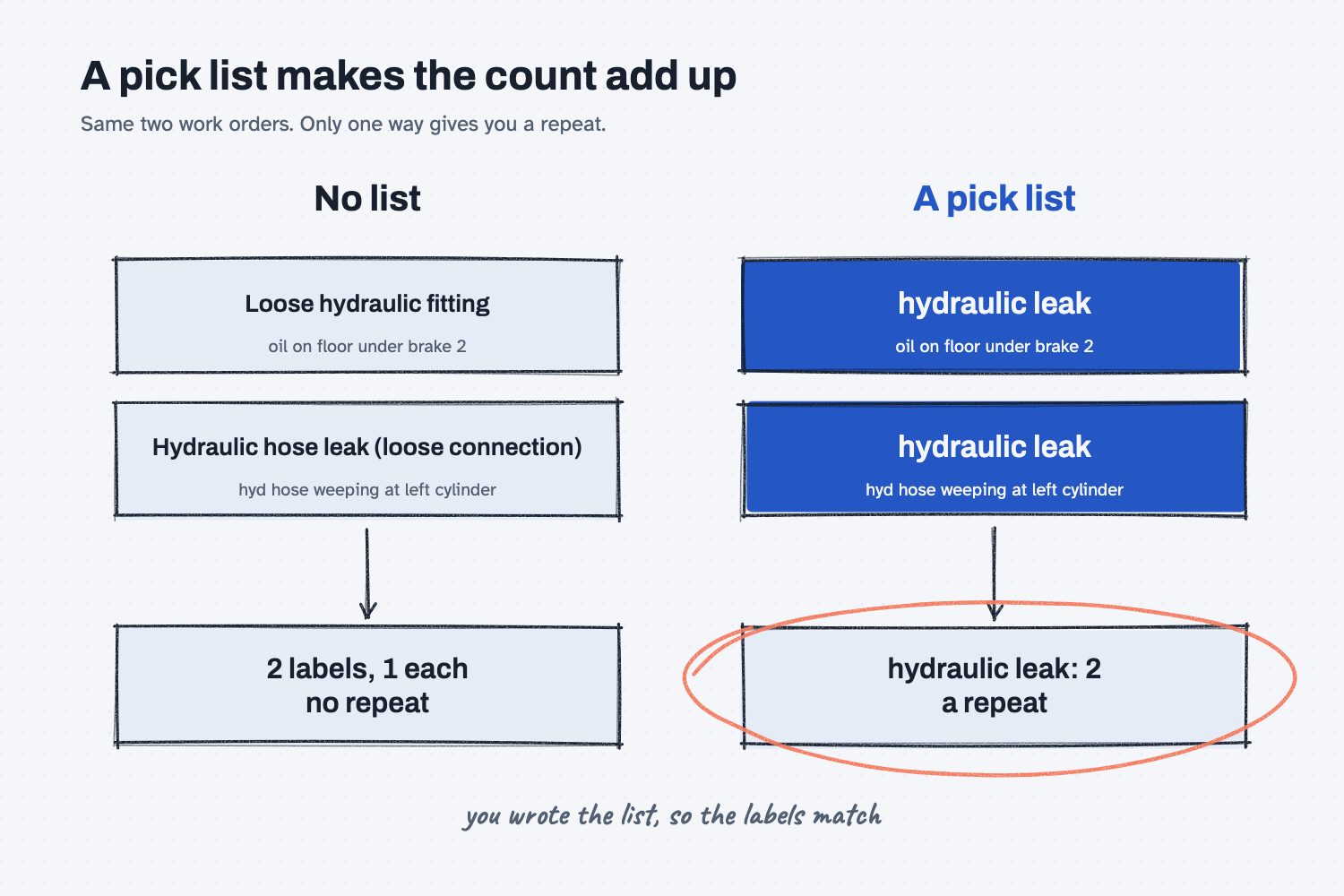
Both columns hold the same two work orders. On the left, no one gave the AI a list, so it described each job in its own words, and the two labels sound alike to a person but look different to a spreadsheet. On the right, the AI had to choose from a list you wrote, so both jobs come back as "hydraulic leak" and the count says two. Only the labels changed, and that is the difference between seeing a repeat and missing it.
Think of it like this
Picture the paper work order form in a maintenance shop. Near the top there is a line that says "Describe the problem," and farther down there is a row of check boxes: hydraulic, electrical, coolant, belt or chain, other. People who write on the blank line give you "leaking," "oil on floor," "hyd issue," and "weeping hose" for the same problem, while people who tick a box give you one word you can count at the end of the month.
Without a list, an AI works like the blank line, and it is very good at it, because it reads the note and writes a sensible description. With a pick list, you hand it the check boxes instead, and it ticks one.
Why does it matter at work?
It matters because a count is only as good as its labels. If the AI writes its own name for each cause, one problem gets several names, and something that repeated five times looks like five separate one-time events. A pick list prevents that split.
Mesquite Ridge Metal Works has six months of work orders from two plants, and the same press brake shows up as "PB2," "brake 2," and "Press Brake #2." With no list, the AI spells it a different way every few rows, and a count of those tags tells you very little. When the maintenance lead gives it the machine IDs and a short list of causes, every press brake job lands under the same machine and cause, and the ranking shows that press brake 2 had five hydraulic leaks and about 14 hours of downtime. That is an answer you can act on. The full method is in the repeat failures guide.
How does it work?
There are four parts: you write the list, you give the AI a way out, you tell it to copy the words exactly, and you check the "other" pile. Together they turn a free-writing job into a choosing job.
You write the list from your own words. Use the machine IDs from your asset list and the six to twelve causes your team already says out loud. The AI can suggest a first draft from a sample of your log, but you should edit it, because you know that "the muller" is the sand mixer and the AI does not.
You give it a way out. Add "other" and "no fault found," and tell the AI to flag a row when it is unsure, because otherwise it must force every row into a box and a forced fit hides the rows that most need a person. This is the same habit behind keeping a person in the loop, where the routine rows pass and the unsure ones come to you.
You tell it to copy the words exactly. Say "word for word" in the prompt. If the list says "belt or chain," you want exactly that back, not "belts" or "Belt/Chain," because a spreadsheet counts those as three different things. This is a small case of structured output, which means answers that come back in the same shape every time.
You check the "other" pile. When many rows land in "other," the list is usually missing a cause or has worded one too narrowly, so fix the list and run it again.
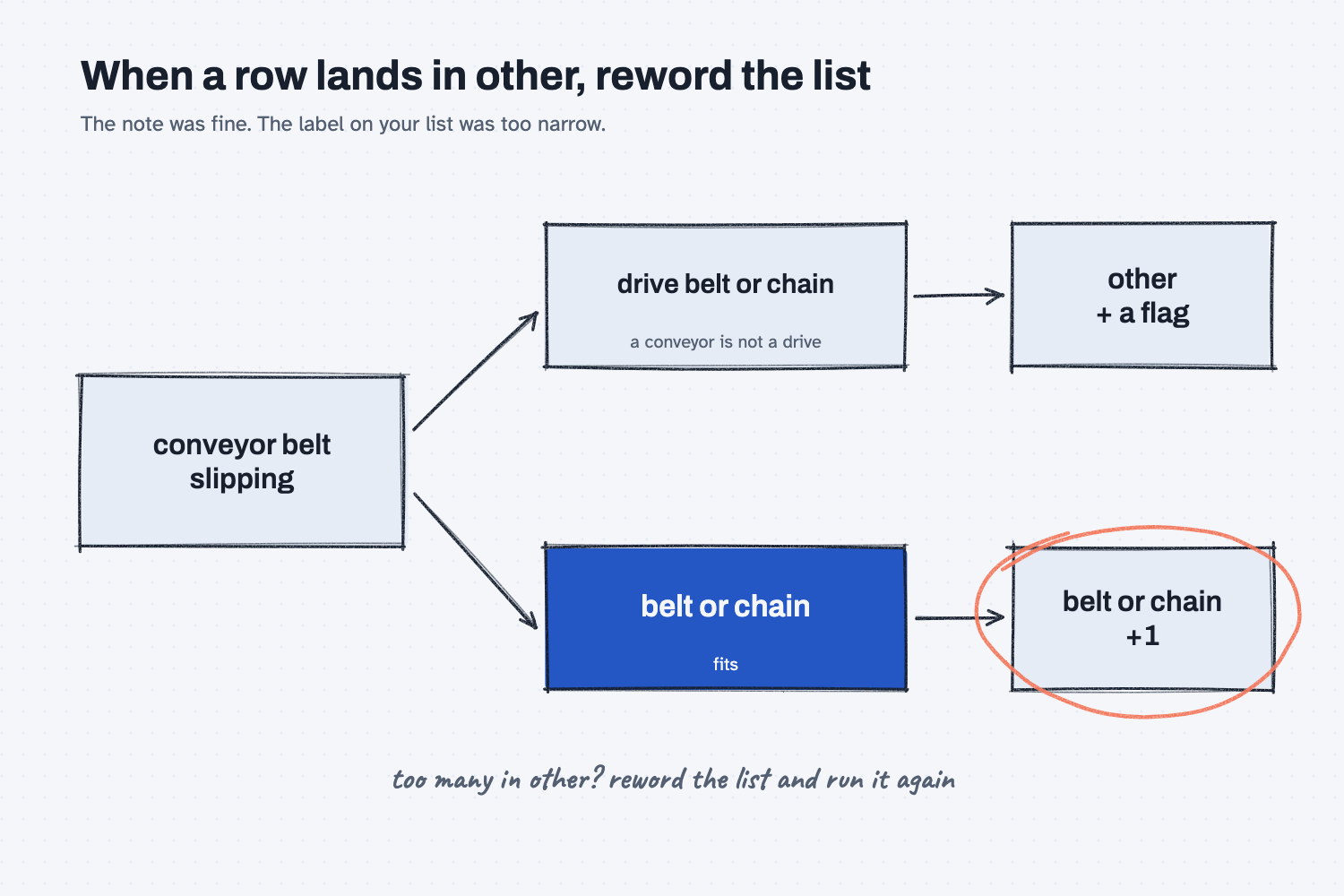
The second picture shows the fix. The note about a slipping conveyor belt was fine, but the list said "drive belt or chain," and a conveyor belt is not a drive belt. Rewording the label to "belt or chain" gave the note a home, so sometimes the fix is in the list, not in the AI.
Where do people get it wrong?
Most mistakes come from a list that is too loose, too tight, or trusted too much.
- The list is too long. Thirty overlapping causes bring back the same coin-flip, so keep it to a dozen or fewer and make each one clearly different.
- There is no "other." Strange rows then get forced into wrong boxes, and you never learn the list has a gap.
- A label is worded too narrowly. In the repeat failures guide, the list said "drive belt or chain," and Claude chose "other" and flagged a shot blast conveyor belt. In a quick test for this lesson, Claude instead stretched that label over a conveyor belt with no flag. Either way, a narrow label makes the answer depend on how generous the AI feels that day.
- People treat the list as proof. A pick list makes labels consistent, not correct, so check a few rows you already know before you trust the count.
Try this in 2 minutes
This test uses eight made-up work orders from Mesquite Ridge. You will run it in two new chats, once with no list and once with a list, and compare the labels. Any chat tool works.
- Open a new chat and paste this:
Give each work order below a short cause label. One line each: WO number, then your label.
WO-5201, PB-02: oil on floor under brake 2, tightened fitting
WO-5202, PB-02: hyd hose weeping at left cylinder, retorqued
WO-5203, SB-01: conveyor belt slipping, adjusted tension
WO-5204, MIX-01: muller drive chain loose, tightened and lubed
WO-5205, MILL-07: coolant pump no flow, chip screen packed
WO-5206, COMP-01: high temp trip, cleaned cooler fins
WO-5207, LASER-01: chiller alarm, restarted, no fault found
WO-5208, RWC-01: wire feeder sensor flaky, replaced cable
- Read the labels. Look at WO-5201 and WO-5202, which are both hydraulic leaks, and see if they got the same label.
- Open a second new chat and paste the same eight work orders with this instruction on top:
Give each work order below one cause. Pick only from this list, word for word. If none fits, pick "other". Do not make up new causes.
List: hydraulic leak, coolant system, electrical or sensor, belt or chain, overheating, no fault found, other
One line each: WO number, then the cause.
- Here is what I expect: WO-5201 and WO-5202 both come back as "hydraulic leak," WO-5203 and WO-5204 as "belt or chain," and every label is one of the seven on your list.
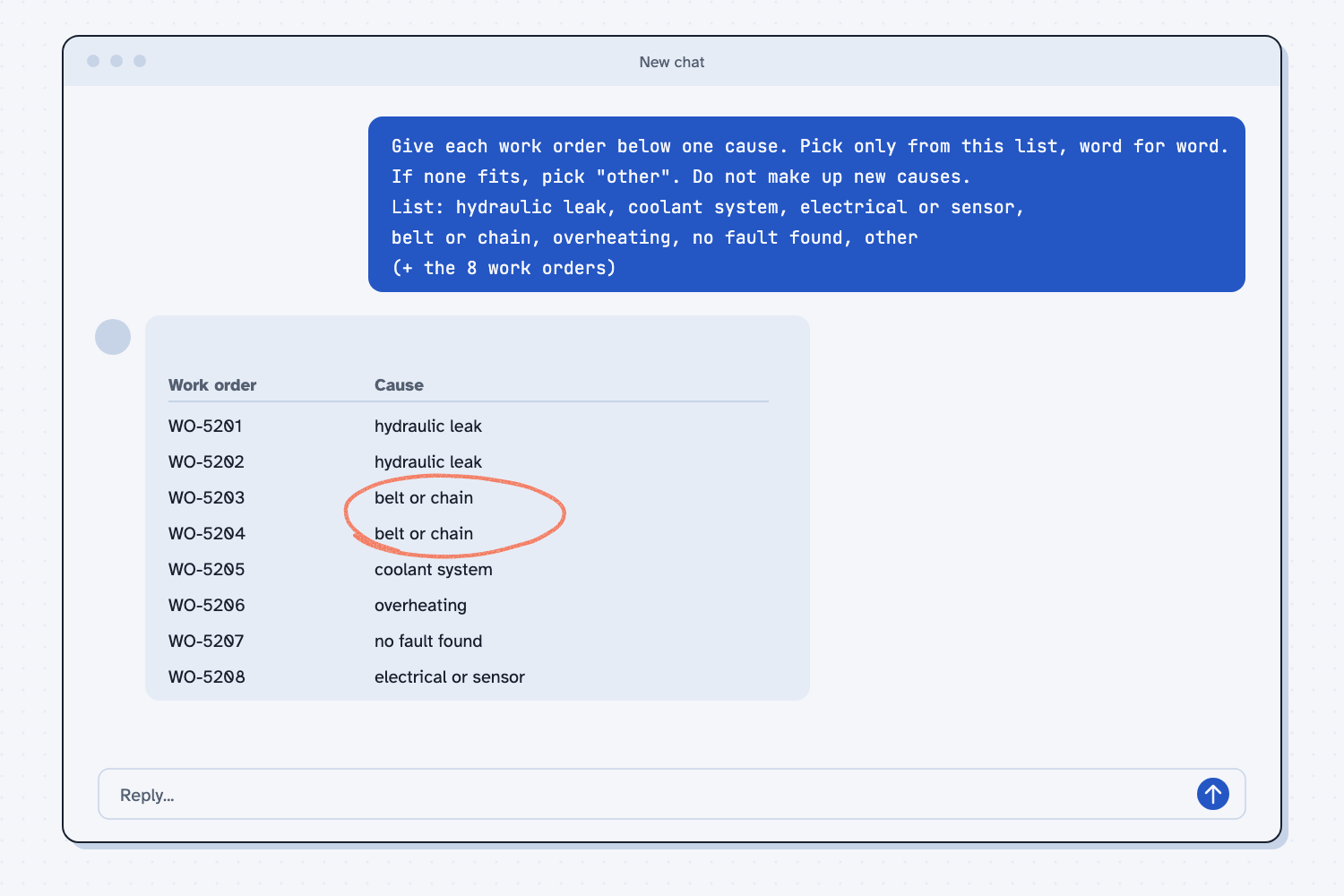
When I asked with no list, the two hydraulic jobs came back as "Loose hydraulic fitting" and "Hydraulic hose leak (loose connection)." Those labels read fine, but they count as two different causes. The coolant job came back as "Clogged chip screen," which names a part, so it would never line up with other coolant jobs. With the list, both hydraulic jobs came back as "hydraulic leak," the coolant job as "coolant system," and the two belt jobs as "belt or chain." Same notes, same AI, and a list that decides whether the count works.
Frequently asked questions
What is a pick list in AI?
It is a fixed list of allowed answers that you write and the AI must choose from. It works like a drop-down menu on a form, which keeps every answer in the same words so that you can count them.
Does a pick list stop AI from making things up?
It stops the AI from inventing labels, but it cannot stop a wrong choice from your list, so spot-check a few rows. (Why AI makes things up.)
How long should the list be?
Six to twelve choices works for most jobs. If you need more, split the job first, for example by department, and use one short list for each part.
Can AI help me write the list?
Yes. Show it a sample of your log and ask it to suggest names, then edit the result yourself, because the list should use your own words.
Use it today
- Find repeat failures in a maintenance log: write a machine list and a cause list, and have Claude tag 45 work orders from them.
- Related idea: Show the rows behind the count.
- Related idea: Make bad data stop the script.
From my training: giving AI a fixed list to pick from is the second of five methods in my repeat failures workflow, and the list always gets written before the AI reads a single row.