How Claude Marks AI Content: What the Marks Prove and Do Not
With Josh Schultz ·
Answer. Claude marks what it makes in two ways. It weaves an invisible watermark into text it writes, and it attaches signed credentials to files such as images. A mark is a useful clue but not proof of who wrote something, and a missing mark does not prove that no AI was used.
The picture
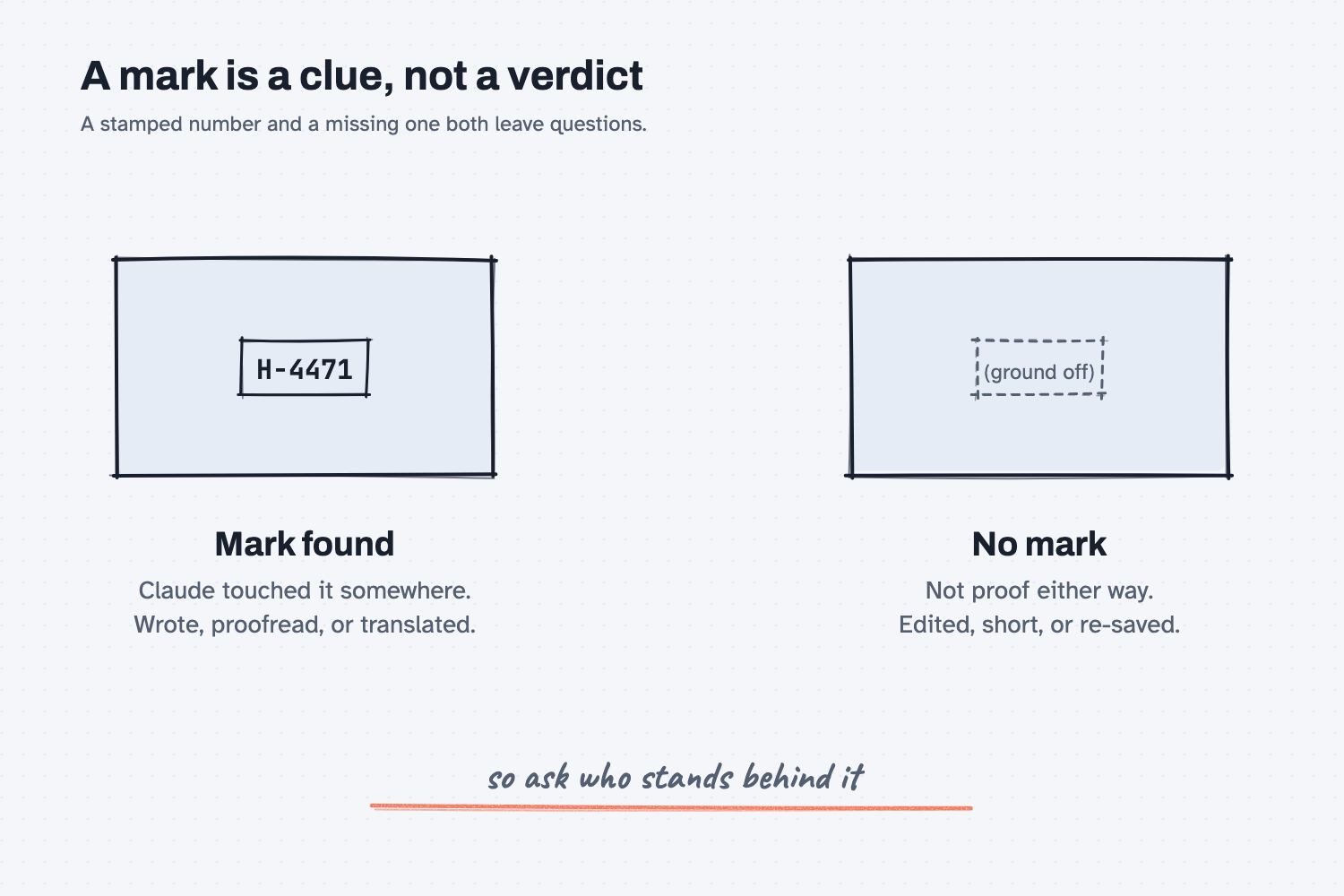
The left side shows a part with its number still stamped, which tells you the part passed through a certain shop, and nothing more. The right side shows a part whose number has been ground off, which tells you nothing either way, because there are many reasons a number goes missing. In the same way, finding a mark says Claude was involved somewhere, and not finding one cannot clear the content.
Think of it like this
Foundries stamp a heat number into a casting, and a mill sends a certificate with the steel. If you have bought castings, you know both of these.
The stamped number is part of the metal itself, so it stays on the part wherever the part goes. The certificate is paper that travels with the part, and paper can be lost, copied, or left behind when the part is moved. Neither one tells you who designed the part. A stamp tells you the part passed through a shop, which might have poured it or might only have machined it.
Claude's marks work the same way. The text watermark is the number cast into the metal, and the credentials on a file are the certificate stapled to it.
Why does it matter at work?
It matters because you will be asked, or you will want to ask, whether something was written by AI, and marks give a tempting yes or no that they cannot fully give.
Gloria Benitez, the quality manager at Mesquite Ridge Metal Works, receives a corrective-action report from a supplier. The writing is polished, and she wonders whether a person actually did the root-cause work. A mark, if one could be read, would say Claude touched the text. It could not say whether the supplier used Claude to translate and tidy their own findings, which would be fine, or to invent the findings, which would not.
So Gloria asks what she always asks, which is who stands behind these findings and what evidence supports them. That question works whether or not there is a mark.
How does it work?
There are two marks, and each has its own limits. Anthropic's help page describes them, and you should check it for changes because this area is moving.
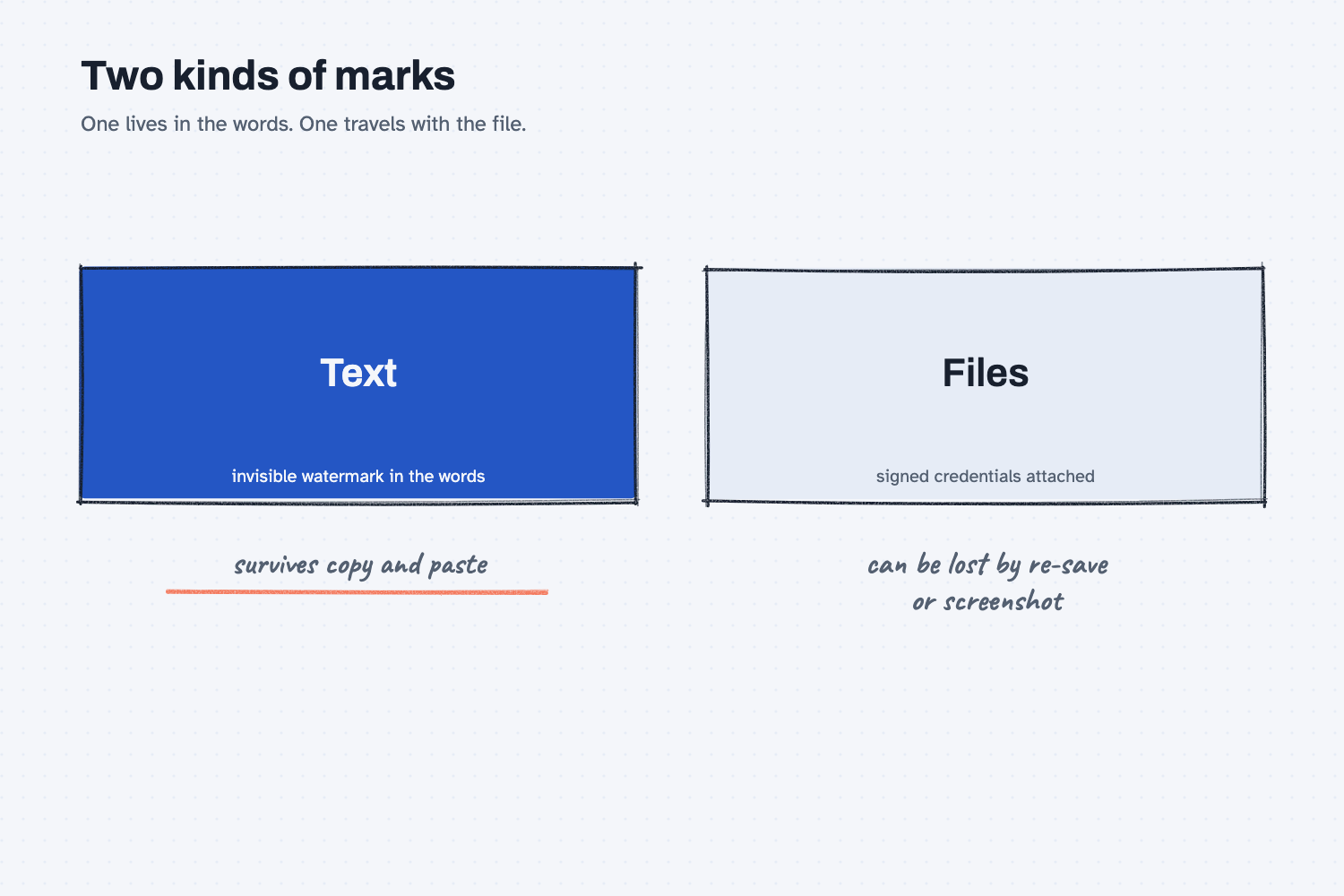
Text carries an invisible watermark. The page says supported Claude models weave "an imperceptible watermark directly into the text itself." It does not change how the text reads, and because it lives in the words, it should survive a copy and paste.
Files carry signed credentials. For supported file types such as PNG and JPEG, Claude attaches signed Content Credentials, which are labels that record where a file came from. Anthropic offers a free Content Checker for these. Credentials can be lost when a file is converted, re-saved, or captured as a screenshot.
Checking text is not open to everyone yet. At the time of writing, Anthropic says watermark detection for text is in private preview for eligible organizations such as regulators, researchers, and media, so most offices cannot test a paragraph themselves.
A mark is a signal, not proof. In Anthropic's words, a detected mark "is not fully conclusive," because Claude may only have proofread, translated, or summarized something a person wrote. A missing mark does not rule Claude out either, since heavy editing, paraphrasing, very short text, or stripped file data can leave no mark.
Marks also cover only Claude. Other tools may mark their output differently or not at all, so a missing Claude mark says nothing about them.
Where do people get it wrong?
Most mistakes come from treating a clue as a verdict.
- Reading a mark as "AI wrote it." It may mean Claude only translated or proofread a person's work.
- Reading no mark as "a person wrote it." Editing, short length, or a screenshot can leave no mark.
- Relying on marks to catch cheating. They were not built to be a lie detector, so they are weak ground for blaming someone.
- Forgetting other tools. A Claude mark says nothing about content from other AI tools.
- Skipping the real question. Who owns the content and can show the evidence matters more than which tool touched it. (See who owns what AI makes.)
Try this in 2 minutes
This test gives Claude the facts from the help page and asks how an office should treat a mark and a missing mark. You can use any chat tool.
- Open a new chat and paste this:
Here are facts from Claude's help page about how Claude marks content: Claude can embed an invisible watermark in text it writes, and attaches signed Content Credentials to files such as PNG and JPEG. A detected mark is a signal, not proof, because Claude may only have proofread, translated, or summarized something a person wrote. A missing mark does not rule out AI, because heavy editing, paraphrasing, very short text, or a screenshot or re-save can leave no mark. I am an office manager. In 4 plain sentences, tell me how to treat a mark, and how to treat a missing mark, when someone hands me a supplier report. Then give me one sentence I can use as a company rule.
- Read the four sentences and check that none of them says a mark proves who wrote the report.
- Compare the company rule to your own policy, and change the words until it fits how your office works.
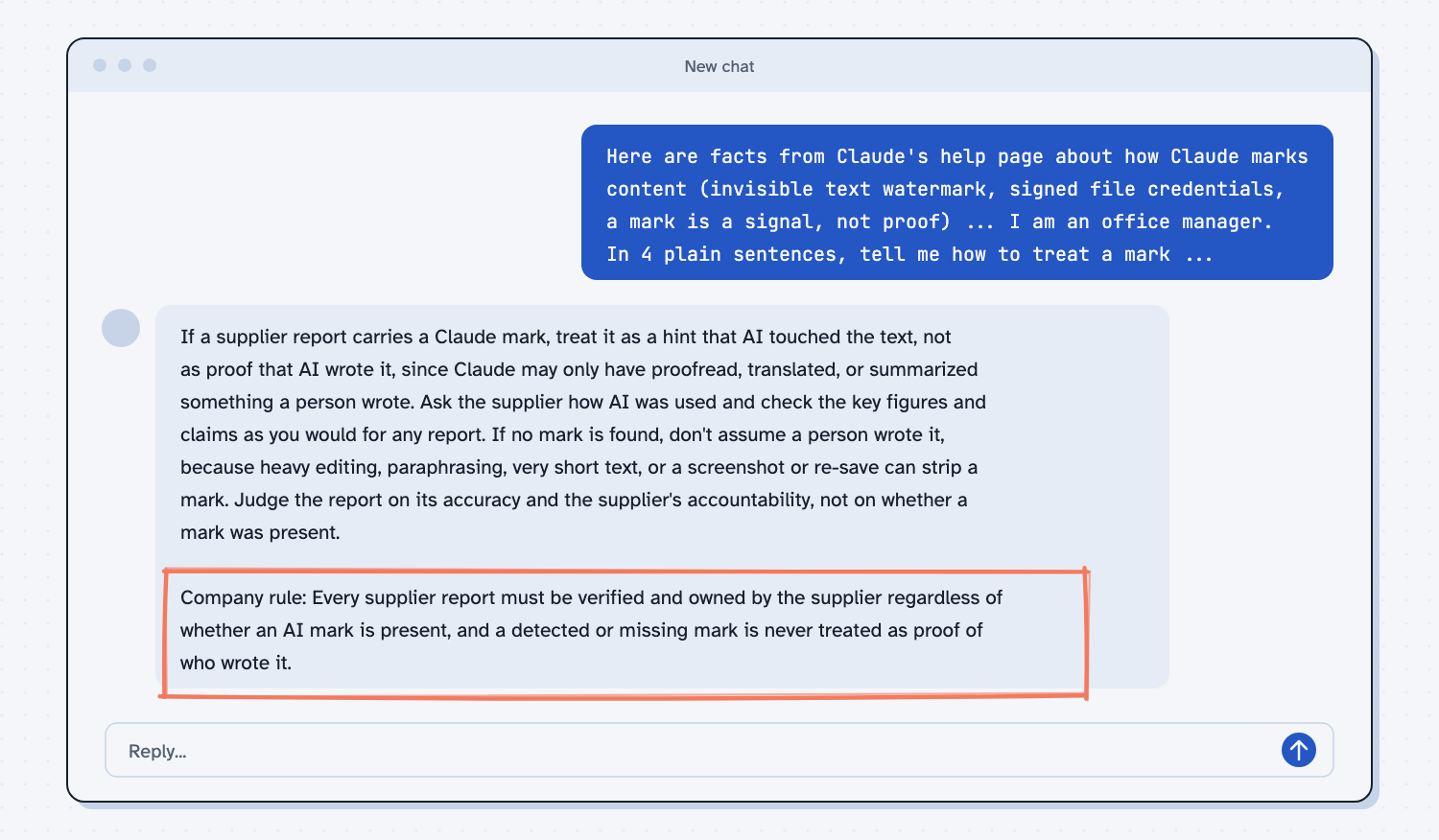
When I tried this, Claude said to "treat it as a hint that AI touched the text, not as proof that AI wrote it," and to "judge the report on its accuracy and the supplier's accountability, not on whether a mark was present." Its company rule was "Every supplier report must be verified and owned by the supplier regardless of whether an AI mark is present, and a detected or missing mark is never treated as proof of who wrote it." That keeps the focus on who answers for the content.
Frequently asked questions
Can I tell if a report was written by AI?
Not reliably. A mark can be a clue, and tools that guess from writing style make mistakes. The better question is who stands behind the content and what evidence supports it.
Can I see Claude's watermark in text?
No, because it is invisible and does not change how the text reads. Detection is limited to eligible organizations for now, so most people cannot test text themselves.
Does a mark mean the content is wrong?
No. A mark only says Claude was involved, and AI-assisted work can be good or bad. Check the facts as you would for any report.
Do other AI tools mark their output?
Some do, in different ways, and many do not. This lesson covers Claude, so check each tool's own help page before you depend on a mark.
Use it today
- Safe use of AI at work: a short guide for using AI openly and carefully.
- Related idea: Should I tell people I used AI.
- Related idea: The AI audit trail.
From my training: this site teaches a mark as a stamp in the casting, a clue about where something has been, and never a verdict about who made it.