Should I Tell People I Used AI? A Simple Rule of Thumb
With Josh Schultz ·
Answer. Should I tell people I used AI? Your company's policy comes first, and after that a simple rule works well: if the other person would feel misled when they found out, tell them. You are responsible for whatever you send, whether you used AI or not, so the real question is what the other person would expect.
The picture
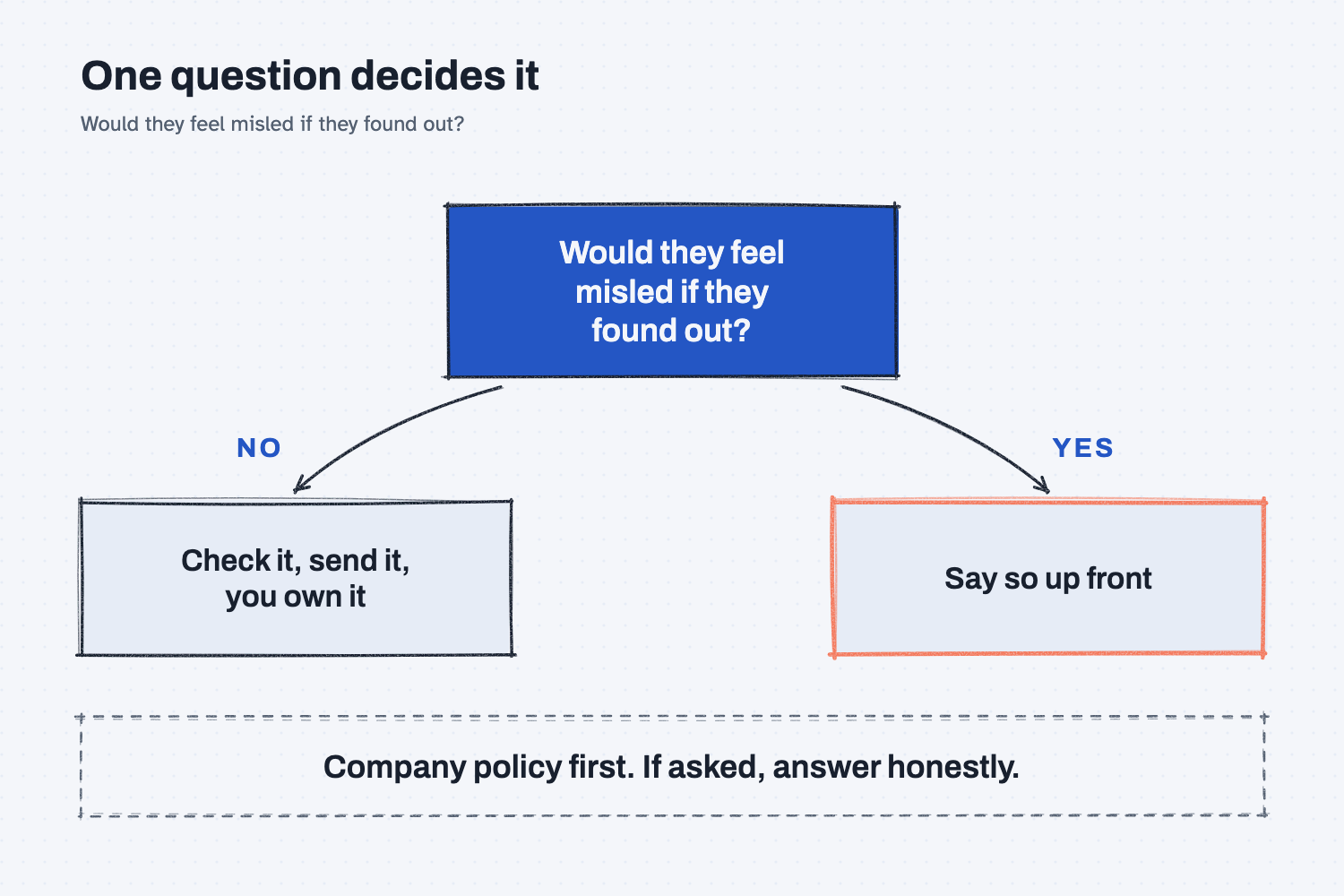
The question in the middle is the whole rule, and the two arrows show the two answers. If the other person would not feel misled, which is the usual case for a message you wrote with help and checked yourself, you read it, send it, and own it. If they would feel misled, you say so up front. The bar at the bottom applies to both paths, because your company's policy comes first, and an honest question always gets an honest answer.
Think of it like this
Picture how you handle tools and subcontractors in the shop. You never tell a customer that you used a calculator to work out a price or a spell-checker to fix a typo, because those are tools, and you stand behind the result.
You would tell them, though, if a subcontractor made their part, because they might care who made it and where. The question that separates the two is whether the customer would feel misled if they found out later.
AI sits closer to the calculator when you use it to draft a message that you then read, correct, and send as yourself. It moves toward the subcontractor when it does the whole job, or when the other person believes they are dealing with a human being and they are not.
Why does it matter at work?
People worry about this in both directions. Some hide their AI use because they fear it looks like cheating, and others announce it on everything, which adds noise without helping anyone. A clear rule lets you skip both worries and spend the time checking the work.
Here is an example. Alicia Reyes runs customer service at Mesquite Ridge Metal Works, and she has Claude draft an email to a dealer about a late order. She reads it, fixes one date, and sends it under her own name. She does not add a note about AI, because the message is accurate and she stands behind it.
The dealer writes back and asks, "Did a person write this?" Alicia answers honestly that she drafted it with an AI tool and checked every line. Nothing was hidden, so the conversation goes on as before. She has also already told her manager that she uses the tool for drafts, so there is nothing to explain there either.
How does it work?
The rule changes a little depending on who is on the other end, so I will take them one at a time.
Customers. For an email or a quote that you reviewed and sent as yourself, you do not need to add a label. Tell them if they ask, if your agreement with them or your company policy says to, or if they might think they are chatting with a person when they are not. That last case matters most for chat windows and automated replies.
Suppliers. The same rule applies, with one extra point. Some supplier and customer agreements, and some industries, have their own rules about AI use or about what may be shared with outside tools, so check your contracts. Keep their confidential drawings and prices out of any tool your company has not approved (see is it safe to put company data in AI).
Your boss. Tell your boss, and tell them early. Your manager owns the company's rules and its risk, and nobody likes learning about AI use from someone else. When you bring it up first, you can ask what is approved, and that protects you if a question comes up later.
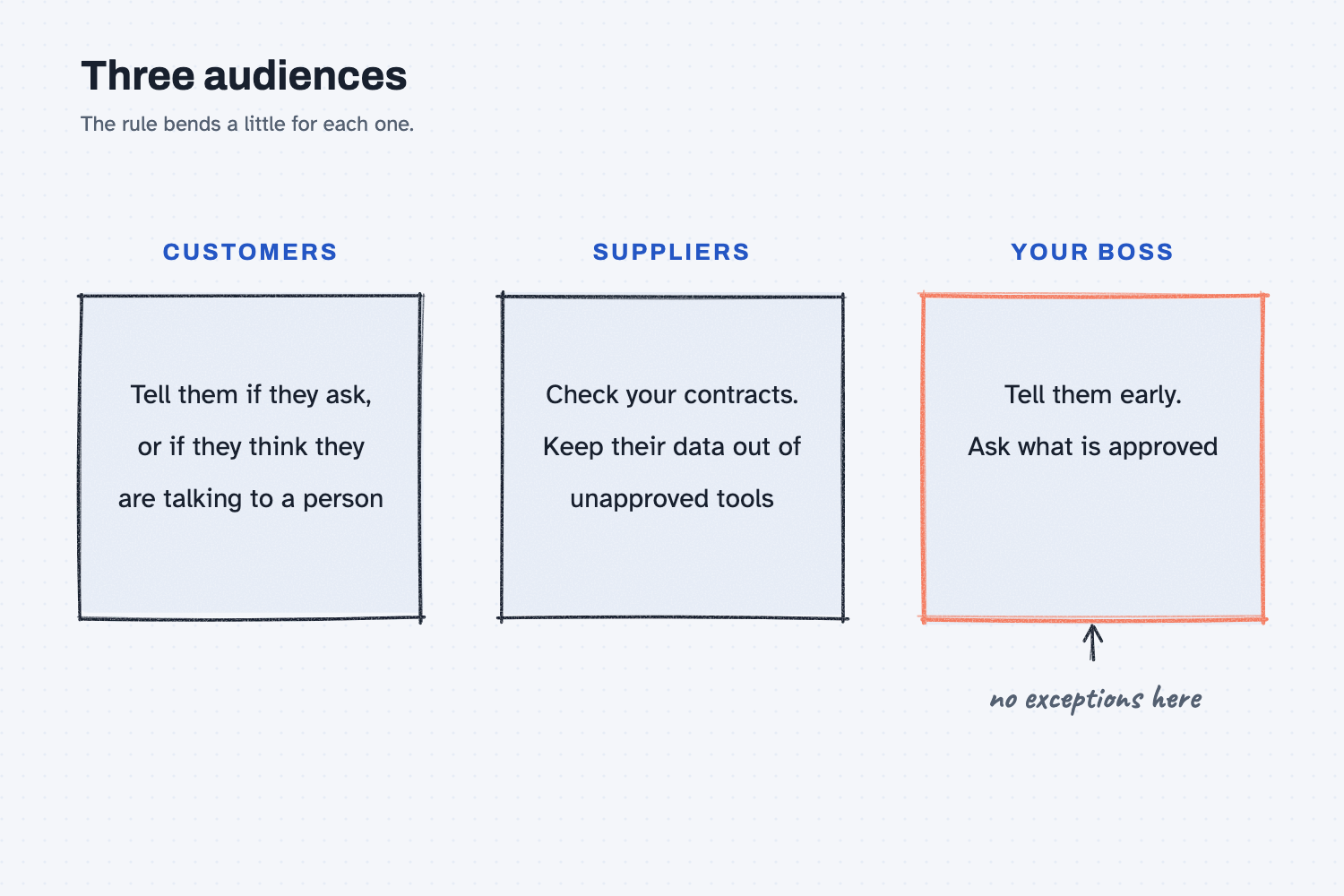
The three cards sum it up. The customer and supplier cards depend on what the other person would expect, while the boss card has no exceptions, because telling your boss is how you find out what the rules are.
Where do people get it wrong?
Most mistakes come from either hiding something that matters or skipping the review that makes it safe to send. These are the ones I would watch for.
- Sending it without reading it. You are responsible for every line, so the reading is the part you can never skip (see human in the loop AI).
- Letting a chat or auto-reply pass as a person. If someone could reasonably think they are talking to a human, tell them they are not.
- Denying it when asked. An honest answer costs very little, while a denial that comes out later costs trust.
- Not asking about policy. Your company may already have a rule, so ask before you guess.
Try this in 2 minutes
This test asks the AI for its own rule of thumb, so you can compare it to mine. Open a new chat in any tool and paste this:
I used AI to draft an email to a customer about a late order. Do I need to tell the customer I used AI? Give me one simple rule of thumb. Plain words, under 90 words.
Then ask your manager one question: "Do we have a rule about using AI for customer emails?" Write down the answer, because that rule beats any rule of thumb.
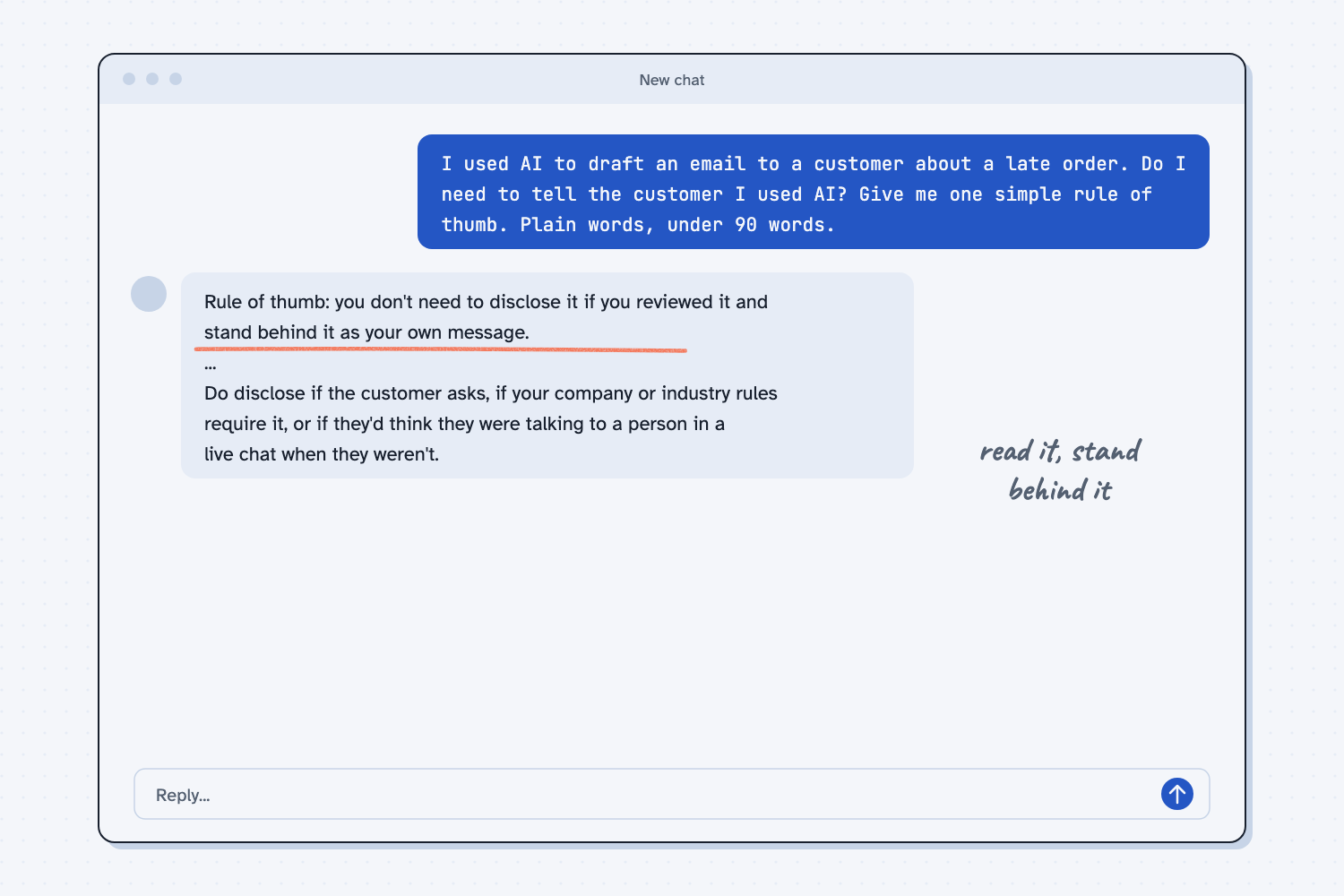
When I tried this, the reply gave a rule close to mine: "you don't need to disclose it if you reviewed it and stand behind it as your own message." It also named the cases where you should speak up: "Do disclose if the customer asks, if your company or industry rules require it, or if they'd think they were talking to a person in a live chat when they weren't."
It compared AI drafting to "a spell-checker or a template," and then added the point that matters most: "What matters is that you read it, made sure the facts are right (dates, order details, promises), and you take responsibility for it."
A chat tool cannot know your company's policy or your customer agreements, so treat this as a starting point and your manager's answer as the final word.
Frequently asked questions
Do I have to tell customers I used AI?
Not always. If you reviewed the message and stand behind it as your own, many workplaces treat it like any other drafting tool. Tell them if they ask, if a rule or contract requires it, or if they might think they are talking to a person.
Should I tell my boss I use AI at work?
Yes, tell them early. Your manager owns the company's rules and risks, and you can ask what is approved at the same time.
What if someone asks me directly?
Answer honestly. A short, plain answer such as "I drafted it with an AI tool and checked it myself" is enough.
Am I responsible if the AI made a mistake?
Yes, if you sent it. The message goes out under your name, so read it and check the facts before you send it.
Use it today
- Email suppliers about what's missing from their quotes: the AI drafts the email, and you read it and press Send.
- Related ideas: who owns what AI makes and human in the loop AI.
From my training: the rule we use is simple: you send it, you own it.