Search, Research, or Just Ask? Pick the Right Way to Ask Claude
With Josh Schultz ·
Answer. Claude can answer in three ways. A plain answer comes from what it learned in training, which stops at a cutoff date. Web search looks up current facts in seconds. Research runs many searches for a few minutes and writes a longer report with sources. Pick the lightest way that fits, because the heavier ways take longer and use more of your usage limit.
The picture
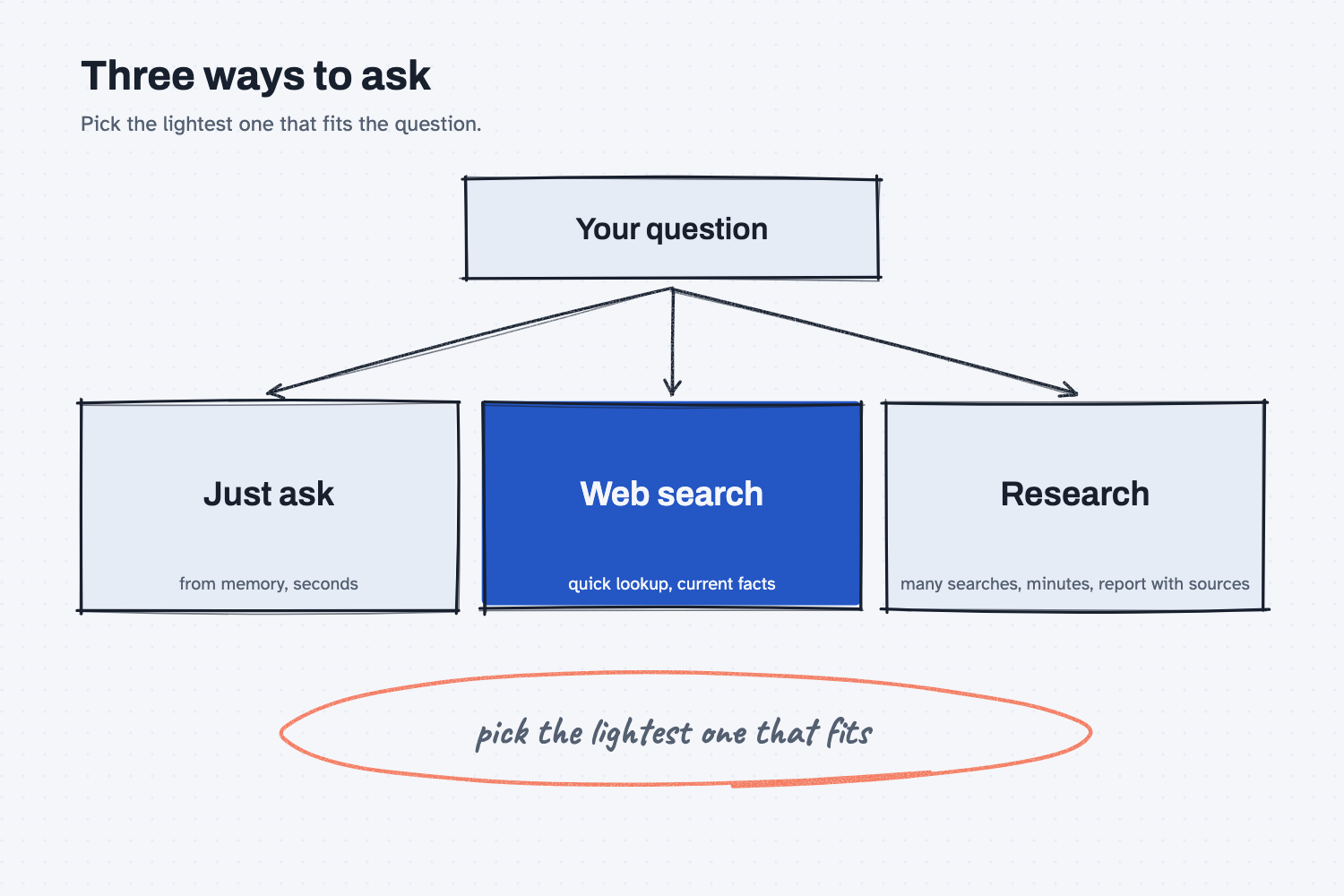
The picture shows one question splitting into three paths, from lightest on the left to heaviest on the right. The left path answers right away but only knows what Claude learned before its cutoff date. The middle path adds a quick lookup so the answer can include today's facts. The right path sends Claude off for a whole round of reading, and it comes back with a report you can check. The circled line is the habit worth keeping, because most questions belong on the left or in the middle.
Think of it like this
When you need an answer at work, you have three choices. You can ask the person at the next desk, who answers from memory and is usually right about things they have known for years. You can ask that person to make a quick call, such as checking whether a supplier has changed a price. Or you can send someone to the library for the afternoon to come back with a written report and a list of where each fact came from.
Nobody sends a person to the library to ask what "net 30" means, and nobody trusts memory alone for this week's steel price. Plain Claude is the person at the next desk, web search is the quick call, and Research is the library trip.
Why does it matter at work?
It decides whether you get a trustworthy answer or a confident guess. Each version of Claude has a knowledge cutoff, which is the date after which it has learned nothing. Anthropic's help pages say plainly that Claude may not know about events after that date.
For a question about a definition or a general method, that rarely matters. For a question about a price, a lead time, a new rule, or a supplier's current terms, it matters a great deal.
Here is an example. The purchasing lead at Mesquite Ridge Metal Works wants to know why her freight costs went up this month. If she asks plain Claude, it can explain the usual reasons, but it cannot know what her carriers announced last week. With web search on, it can look up the carriers' published notices. If she needs a comparison of how three carriers handle fuel surcharges, with a source for every claim, that is a job for Research, because it needs many searches that build on one another.
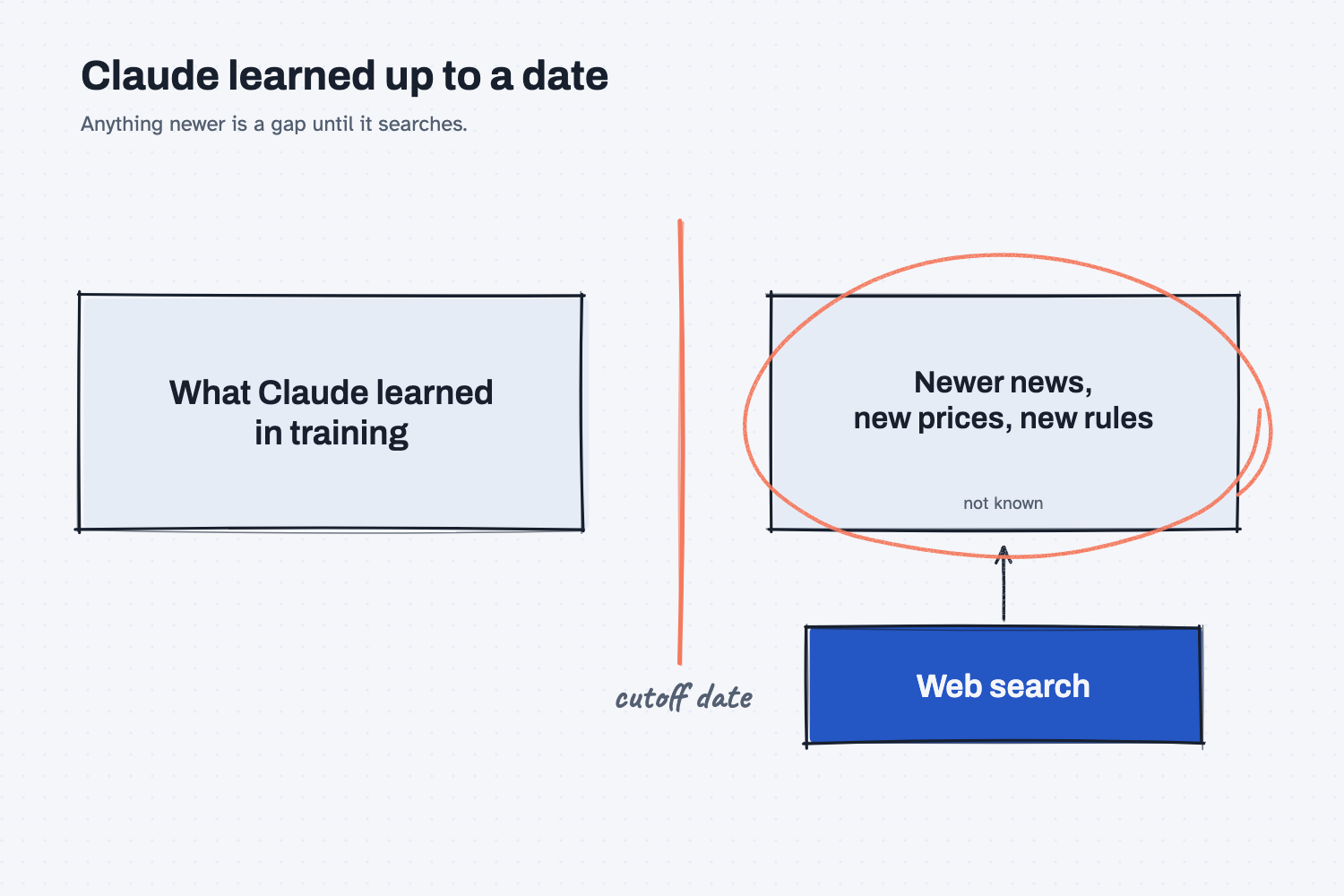
The second picture shows why the cutoff matters. Everything Claude learned sits to the left of the line, and anything newer falls in the gap, which is where a search has to fill in.
There is a second reason to care, which is cost, because the help pages say Research can use up your limits faster than a normal chat. What is a usage limit explains how that works.
How does it work?
There are three parts, and you can think of them as three speeds.
Just ask. Claude answers from training alone. It is fast and good for explaining ideas, drafting, summarizing something you paste in, and working through a method. Because it cannot see today, it is the wrong choice for anything that changes, and when it lacks the facts it may still write a smooth answer, which why AI makes things up explains.
Web search. Claude runs a search, reads the results, and answers with current facts. The help pages describe it as best for straightforward questions that take one or two lookups, like company details or recent news. You can also tell it generally what to look for, and it does the searching and sums up what it finds.
Research. Claude runs a series of connected searches, using each result to decide the next one, and writes a longer report. The help pages describe it as meant for jobs that take five or more tool calls over a few minutes, such as comparing competitors. It needs web search to be turned on, and it is usually on paid plans, so check your own. In the app you choose Research from the plus menu in the chat box, or you can ask Claude to research the question. If you have not set Claude up yet, start with set up Claude.
One more point matters for a business. Research can also use your connected tools, such as email or documents, and the help page says it can do so automatically without asking for approval each time. So before you run Research, check which connections are switched on for that chat.
Where do people get it wrong?
Most mistakes come from using the wrong speed, or from trusting the result without a check. These are the four I would watch for.
- Asking a plain chat for current facts. A price, a date, or a rule that changes should come from a search or from a document you paste in.
- Using Research for a quick fact. It is slower and uses more of your limit, so a normal search is the better choice.
- Not opening the sources. A report with citations is only as good as the pages behind them, so open the two or three that matter most and read the line that supports the claim.
- Forgetting what is connected. Research can reach connected accounts on its own, so switch off anything the question does not need.
Try this in 2 minutes
This test shows what plain Claude does when you ask it for something it cannot know. Open a new chat where web search is off, or use any plain chat, and paste this:
What is the going price per ton for hot-rolled steel coil this week, and did anything change since last month?
Here is what to look for. A good answer admits that it has no live data, and it does not make up a number. You should also see whether it tells you where to look.
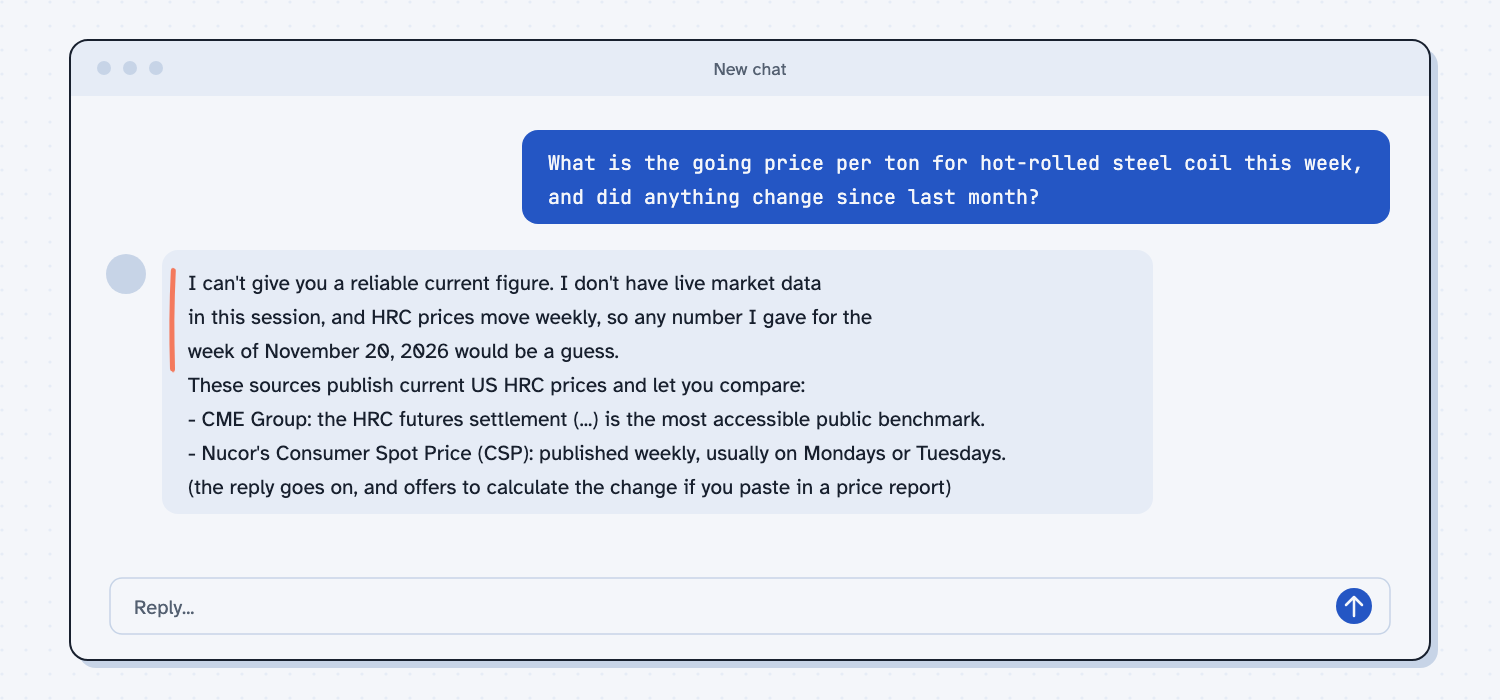
When I tried it in a blank chat with no search, the reply opened with "I can't give you a reliable current figure. I don't have live market data in this session, and HRC prices move weekly, so any number I gave for the week of November 20, 2026 would be a guess." It then listed places that publish steel prices and offered to calculate the change if I pasted in a recent price report.
That is the right behavior, and it shows that a plain chat works from memory. Now ask the same question in a chat where web search is on and compare the two answers. The second one should name a source and a date, and your job is to open that source and check it.
Frequently asked questions
Does Claude know today's news?
Not from training alone, because every version has a knowledge cutoff after which it has learned nothing. With web search on, it can look up recent items and answer from what it finds.
When should I use Research instead of web search?
Use Research when the answer needs many searches that build on each other, such as a comparison with sources. Use web search when one or two lookups would settle it.
Can I trust the sources in a Research report?
Treat them as leads to check, not as proof. Open the pages behind the claims that matter, and confirm the date and the exact wording.
Does Research cost more?
It can use your limits faster than a normal chat, because it reads many sources and writes a fuller answer. Your Usage page in settings shows where you stand.
Use it today
- Read safe use of AI at work before you turn on connections for a Research run.
- Related ideas: what tasks can AI do, why AI makes things up, and AI limitations, explained.
From my training: before anyone trusts a number from AI, we ask where it came from and how old it is.