What Are Embeddings? How AI Finds Text That Means the Same Thing
With Josh Schultz ·
Answer. An embedding is a way of turning a piece of text into a list of numbers, so that a computer can tell which pieces of text mean similar things, even when they share no words. This is how a search can find "spindle seized" when you type "bearing failure." Many tools that search your files use embeddings to do it.
The picture
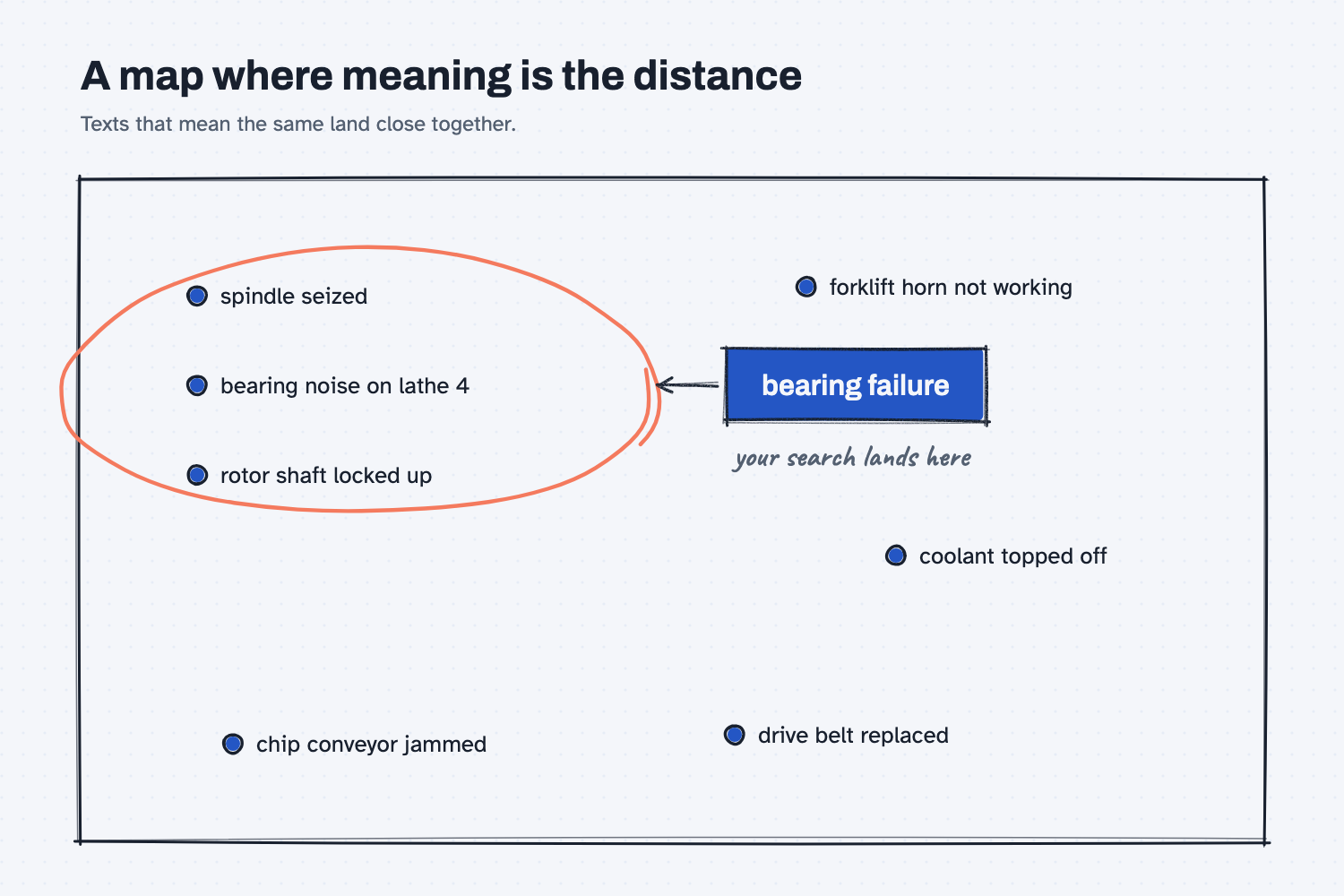
Think of the picture as a map where every sentence in your files has been given a spot. Sentences about the same kind of problem end up near each other, so the three that describe a seized or noisy bearing sit together in one corner. When you search for "bearing failure," your question gets its own spot on the map, shown as the star, and the search simply returns whatever is closest. The forklift horn and the coolant top-off are far away, so they do not come up.
Think of it like this
Look at how a good plant layout works. Machines that do similar work sit in the same bay, so the lathes are together, the welders are together, and the paint booth is by itself. If you want to know where to put a new machine, you do not read a list of names, you just look at what is nearby.
An embedding gives every piece of text an address on a map like that, except that the "bays" are based on meaning instead of floor space. The address is a list of numbers, a bit like the coordinates on a map grid, and a real embedding uses hundreds or even thousands of numbers instead of the two or three we can draw. The AI company or tool maker builds a special model that decides where each piece of text lands, and its training is what makes texts with a similar meaning land close together. You do not need to know how that works, only that closeness on the map means closeness in meaning.
Why does it matter at work?
It matters because the words people write are rarely the words you search for. The operator who logs a problem writes "spindle seized," your maintenance planner searches for "bearing failure," and a plain word search finds nothing, so the pattern stays hidden in the log. The same gap shows up in supplier emails ("will slip" and "running behind"), in complaints, and in procedures.
Here is an example. The maintenance planner at Mesquite Ridge Metal Works has two years of downtime notes written by different operators on different shifts. She wants every entry about bearings, and the entries use a mix of "seized," "locked up," "noisy," "grinding," and "overheating." A search tool that uses embeddings can pull those entries together even though the wording differs, and then she, or an AI, can read them and look for repeat failures.
If your company is buying or building a tool that searches documents, the questions to ask are: "Does the search match meaning or only exact words?" and "Can I see which passages it found before the AI answers?" The second question matters because the search is the step that can miss things, which how AI answers from your files covers in detail.
How does it work?
The search has four steps, and the first happens once, ahead of time.
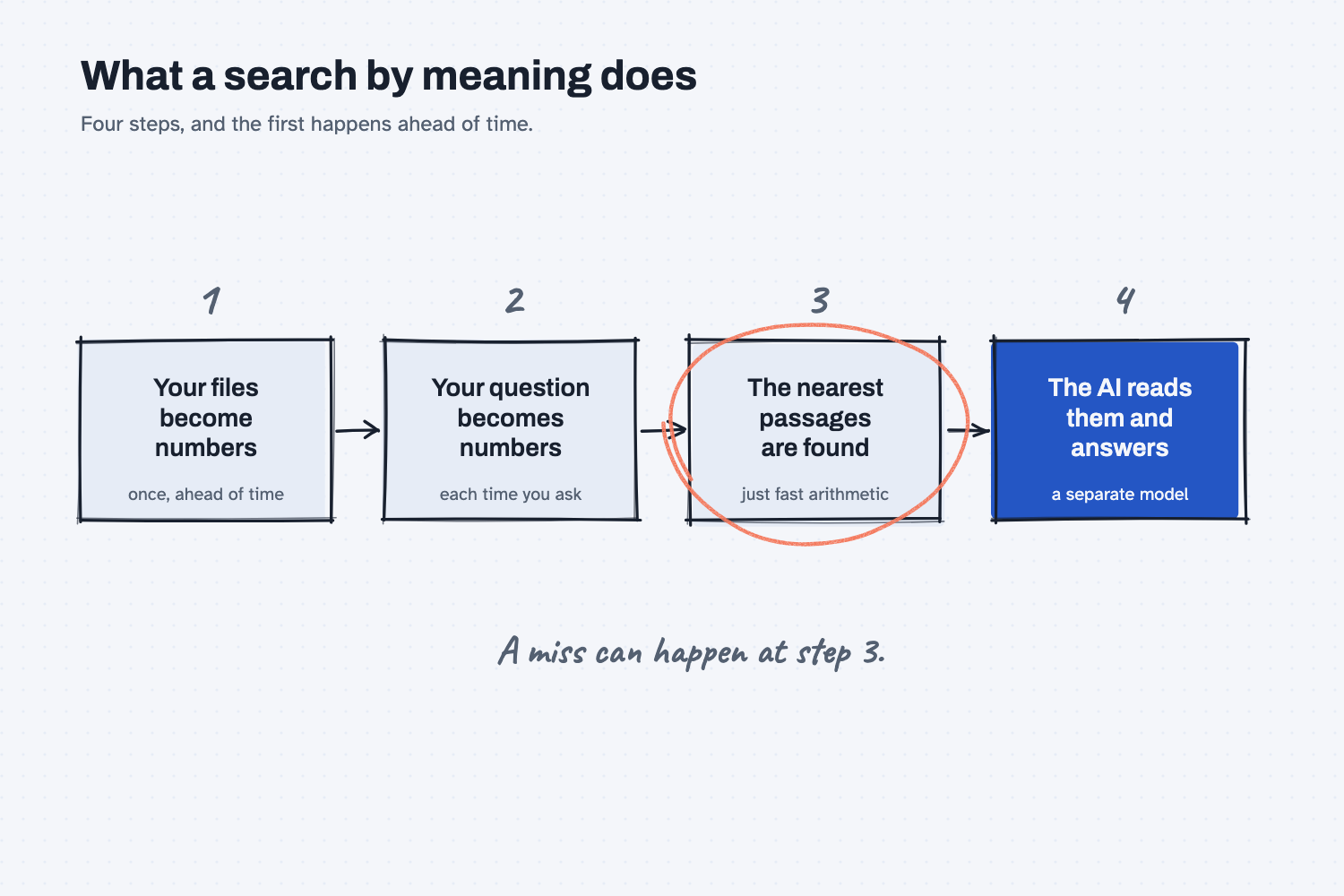
The picture puts the four steps in order, and the circle on step three marks where a good passage can get left behind.
Every piece of your text gets an address. The tool cuts your files into passages, such as a paragraph or a log entry, and the embedding model turns each passage into its list of numbers. The tool stores those numbers, usually in a database built for the job. This happens once for each file, and again when a file changes.
Your question gets an address too. When you type a question, the same model turns it into numbers, so that the question and the passages sit on the same map.
The tool returns the nearest passages. It compares your question's numbers with the stored ones and picks the closest few. This comparison is fast, because it is only arithmetic on numbers, which is why a tool can do it across thousands of passages in a moment.
The AI reads what was found. In many "chat with your documents" tools, the nearest passages are then handed to the AI model along with your question, and the AI writes the answer from them. The model that writes the answer is a separate piece from the model that makes the addresses.
Where do people get it wrong?
Embeddings are useful, but they are not magic, and these are the mistakes that cost people time.
- They assume it never misses. Closeness in meaning is a good guess, not a guarantee, so a passage can land far from your question and be left out. Ask for the passages the tool used, and check them.
- They expect it to be good at exact codes. For a part number like RL-235, an exact match is better than a meaning match. Many tools combine both kinds of search, so ask whether yours does.
- They treat it as the same thing as the AI. The embedding model only finds and ranks text. It does not read, reason, or answer, which is the job of the AI model that comes after it.
- They never test the search. Write ten questions where you know which passage is right, and see whether the search finds it. That is a small eval, and it works for search just as it does for answers.
Try this in 2 minutes
You can see the idea at work in a chat. A real search tool uses numbers for this, while here the AI does the same job by reading, but the result is the same kind of result: it finds what means the same without matching the words.
- Open a new chat and paste this:
Here is a list of maintenance log entries:
A. Spindle seized on CNC mill 3 during second shift
B. Coolant tank topped off, no leak found
C. Replaced worn drive belt on conveyor 3
D. Bearing noise on lathe 4, shut down for inspection
E. Forklift 2 horn not working
F. Axis motor overheating, tripped breaker twice
G. Chip conveyor jammed, cleared by operator
H. Rotor shaft locked up on press 7
I need to find entries about "bearing failure". Pick the entries that describe the same kind of problem, even if they do not use those words. List the letters with a few words on why. Then say whether any entry contains the exact words "bearing failure".
- Look for entries A, D, and H. None of them contains the phrase "bearing failure," so a plain word search would return nothing.
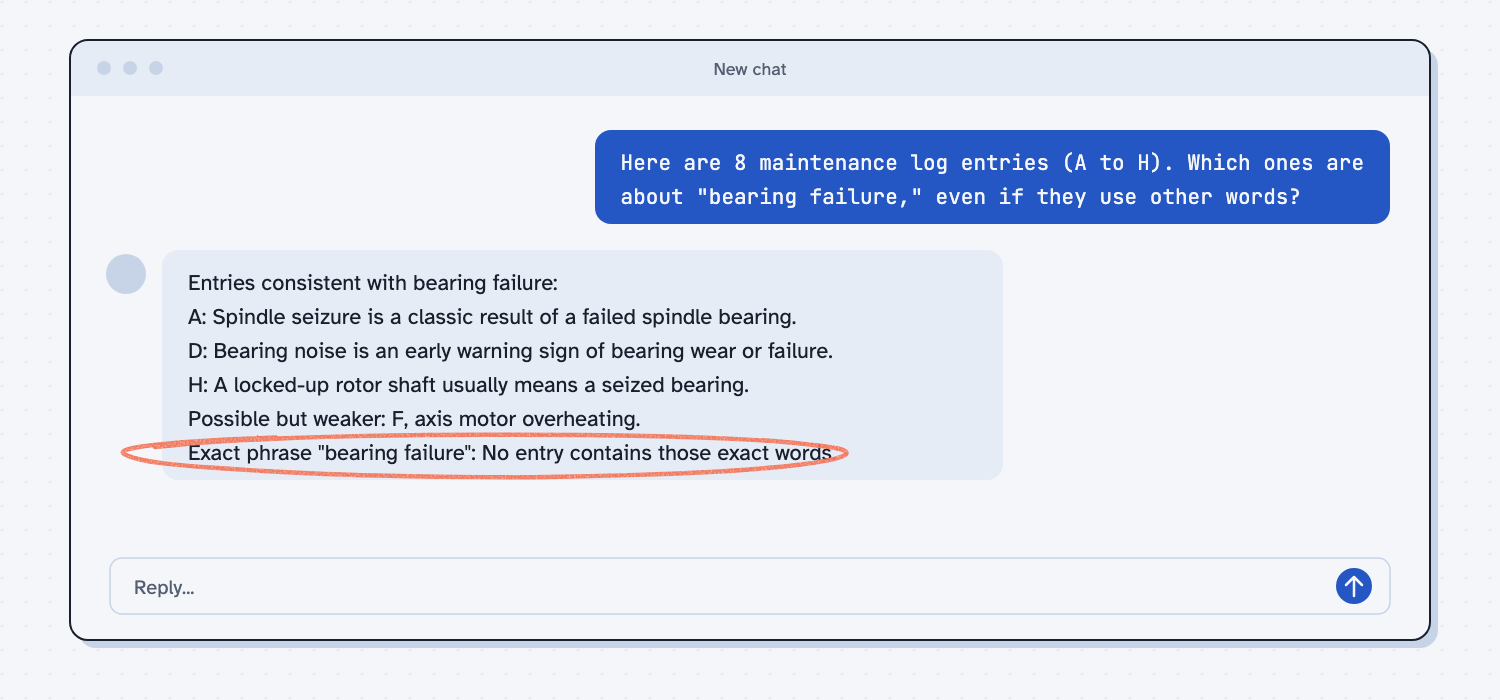
When I tried this, the reply picked A, D, and H, and gave a reason for each, such as "Spindle seizure is a classic result of a failed spindle bearing" and "A locked-up rotor shaft usually means a seized bearing." It also flagged F, the overheating motor, as "possible but weaker," which is a sensible call. Then it said, "No entry contains those exact words," which is the point. A word search would have found zero matches, and a search by meaning found three, plus one worth a look.
Frequently asked questions
What is an embedding in simple terms?
It is a list of numbers that stands for the meaning of a piece of text. Texts with similar meanings get similar numbers, so a computer can find them by comparing the numbers.
What is semantic search?
Semantic search is search by meaning instead of by exact words. Embeddings are the usual way to do it, which is why a search for "late delivery" can find "shipment delayed."
Do I need to build embeddings myself?
No. If you use a tool that searches your files, it handles this for you. You only need to know it exists, so you can ask good questions about how the search works.
Is an embedding the same as an AI model?
It comes from a model, but a different one. An embedding model makes the addresses, and the chat model reads the passages and writes the answer.
Are my files safe if they get turned into embeddings?
The numbers are made from your text, so treat them as company data. Check where the tool stores them and what the tool's data settings say, as is it safe to put company data in AI explains.
Use it today
- Find repeat failures in a maintenance log: the same wording problem, solved on a real log.
- Related idea: How AI answers from your files.
- Related idea: What is a context window.
From my training: when we set up search over a company's files, we first write ten test questions with known answers, because the search step is where a good answer gets lost.