Will AI Take My Job? AI Takes Tasks, Not Judgment
With Josh Schultz ·
Answer. AI is much better at taking tasks than at taking whole jobs. A job is a bundle of tasks plus judgment, responsibility, and relationships, and AI mostly takes the typing, drafting, and scanning. Nobody can promise what will happen at your company, but the people who learn to use AI well tend to move toward the work that needs judgment.
The picture
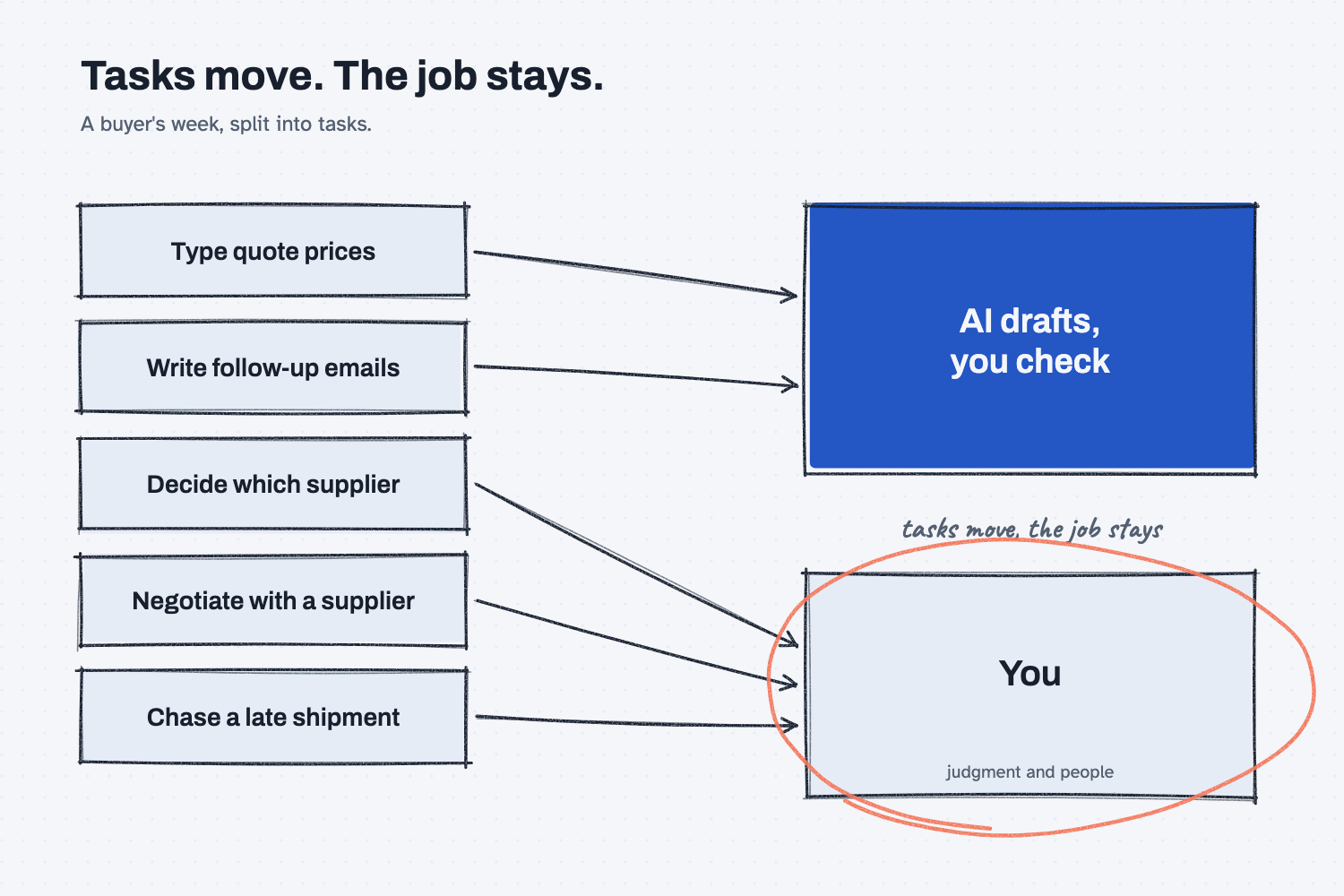
The picture shows a buyer's job on the left, broken into the separate tasks that fill her week. A few of those tasks, such as typing quote prices into a sheet and writing routine follow-up emails, slide over to the AI box, where AI drafts them and she checks them. The tasks that depend on judgment and on knowing people, such as choosing the supplier and negotiating the price, stay with her. The job is still there at the end, but it is shaped differently, because the tasks that moved were the ones that used the least of her.
Think of it like this
Think about what happened in a machine shop when the first CNC mill arrived, which is a machine that cuts metal by following a program. Nobody needed to turn the hand cranks anymore, so that task largely disappeared. The shop still needed someone who could read the drawing, set up the part, notice when a cut sounded wrong, and decide whether a part was good enough to ship.
In many shops, the people who learned the new machine ended up running more of the shop than before. AI is arriving on the office desk in a similar way. The hand-cranking tasks, like retyping numbers and writing the fifth copy of the same email, are the ones it takes first, and the knowing and deciding stay with the person at the machine.
Why does it matter at work?
It matters because the worry is real, and a vague "don't worry" does not help. The more useful question is which parts of your week are tasks that AI can take and which parts are judgment that only you can do.
Here is an example. Dana Ortiz is the senior buyer at Mesquite Ridge Metal Works, and every Monday she spends hours typing quote prices into a comparison sheet and writing follow-up emails. AI can take both of those tasks, so her Monday gets shorter. What she cannot hand over is deciding which casting supplier gets the order, because that call depends on ten years of knowing who delivers late and who fixes problems quickly. If her whole job had been the typing, it would be at risk, and she should know that. Because her job also includes the decisions, the typing leaving makes more room for the part that matters. Some jobs that are mostly one repeated task will change a great deal, and it is better to see that early than to be told it is all fine.
How does it work?
There are three parts to the answer: what AI takes, what stays with a person, and what you can do about it this month.
AI takes tasks that follow a pattern. Reading a document, pulling out the numbers, sorting items into piles, and drafting a first version are all tasks, and they follow patterns that AI handles well. The lesson on what tasks AI can do names ten of them, and most desk jobs use only a few.
A person keeps the judgment and the responsibility. AI can rank three suppliers, but it cannot be held accountable when the choice goes wrong, so someone with authority still has to make the call and stand behind it. Judgment also depends on things that never appear in a file, like how a supplier behaved during the last shortage. Writing down why you made a call helps AI draft the next one, as in write down why you made the call.
What to learn first. Start by naming the tasks in your own week, so you know which ones are patterns. Next, learn to give AI a clear job and check its answer against the source, because the person who checks becomes the one the team relies on. Finally, learn to say what a good result looks like, since AI multiplies what you already know and does little for someone who cannot tell a good answer from a bad one.
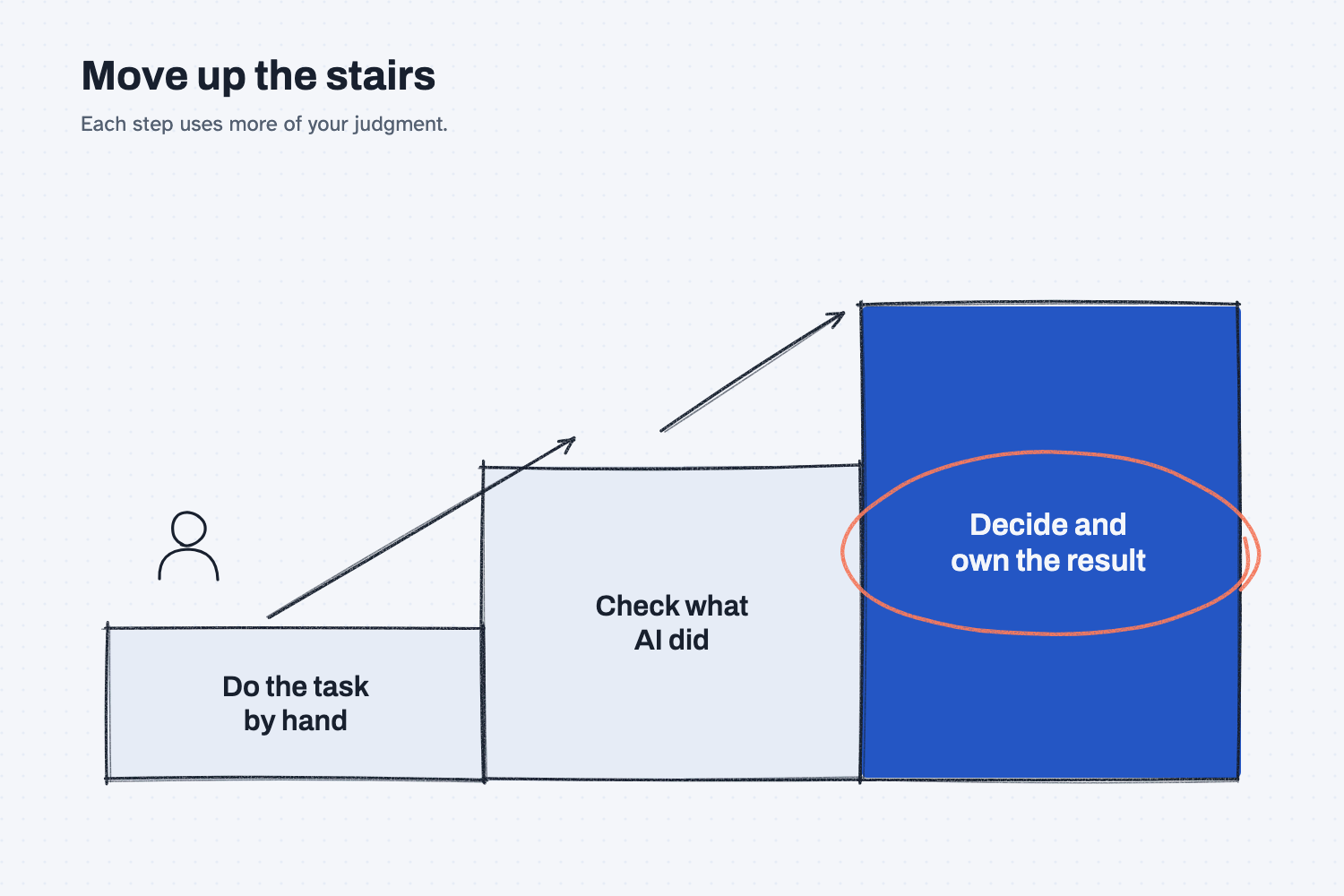
The second picture shows the path as a staircase. At the bottom step you do the task by hand, and on the middle step AI does the task while you check it. The top step is deciding what to do and owning the result, which is where your time goes once the first two steps are covered.
Where do people get it wrong?
Most mistakes come from treating this as an all-or-nothing question. These are the three I see most often.
- Waiting to see what happens. It is natural to hold back until things are clearer, but the people who start early with small, safe tasks learn what AI is good at before the rest of the team does.
- Hiding that you use it. Using AI quietly makes it look like a shortcut, and using it openly, with your checking visible, shows that you are doing more with your judgment, not less.
- Believing either loud story. One story says every job disappears next year, and the other says nothing will change. Neither is based on your actual week, so look at your own tasks and decide from that.
Try this in 2 minutes
This test sorts a buyer's week into tasks AI can take and judgment that stays with a person. You can use any chat tool, and you can swap in the tasks from your own week.
- Open a new chat and paste this:
Here are six things a buyer at a small manufacturer does in a normal week: 1) type quote prices into a comparison sheet, 2) write follow-up emails to suppliers, 3) decide which supplier gets the order, 4) read long supplier contracts for odd terms, 5) negotiate a price with a supplier she has worked with for ten years, 6) chase a late shipment by phone. For each one, say in one short line whether AI could take the task, help with part of it, or should stay with the buyer, and why. Then give two sentences on what this means for the buyer's job.
- Read the six lines, and notice which ones need the buyer to know a person or carry a risk.
- Replace the six tasks with six from your own week and run it again.
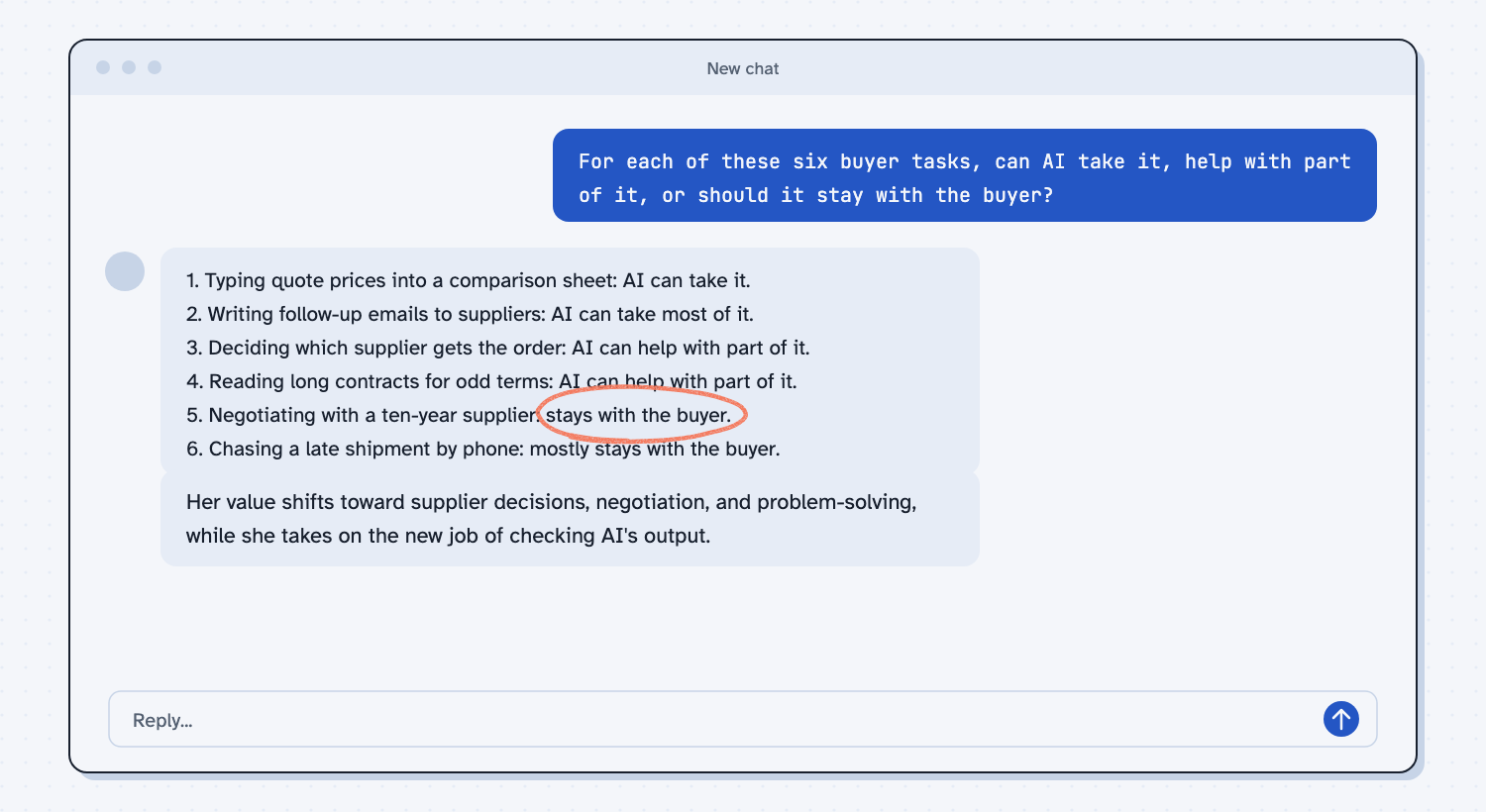
When I tried this, the reply put typing the quotes at "AI can take it" and the follow-up emails at "AI can take most of it." It put the supplier decision at "AI can help with part of it," and it said the negotiation "stays with the buyer" because "the leverage is the relationship, history, and read of the other person." Its closing lines on the job were: "Her value shifts toward supplier decisions, negotiation, and problem-solving, while she takes on the new job of checking AI's output."
Notice that the tasks that moved were the ones with the least judgment in them. When you run it on your own week, the tasks it hands to you are the ones to protect and get better at.
Frequently asked questions
Will AI replace buyers and planners?
It will take some of their tasks, mainly data entry, drafting, and document scanning. Buying and planning also involve judgment, supplier relationships, and responsibility, which stay with people. Nobody can promise the future, so watch how your own tasks change.
Which jobs are most at risk?
Jobs that consist mostly of one repeated, pattern-based task change the most. Jobs that mix tasks with judgment, people skills, and accountability change less, because only part of the work moves.
What should I learn first?
Learn to name your tasks, give AI one clear job, and check its answer against the source. Those three habits make you the person who can use AI well, and that is the person teams rely on.
Should I tell my boss I use AI?
Yes, once you know your company's rules. Using an approved tool openly, with your checking visible, shows good judgment and invites the team to learn with you.
Use it today
- Compare supplier quotes every time: hand the typing and comparing to Claude, and keep the decision.
- Related idea: Ten verbs AI can do.
- Related idea: Sort each step: rule, judgment, or person.
From my training: we start by listing the tasks in your own week, because that list shows what AI can take and what you should keep.