Hard Rules and Wishes in Scheduling: Tell the Solver Which
With Josh Schultz ·
Answer. Before any planning tool builds a schedule, write your rules on one page in two lists. Hard rules can never be broken, and wishes are things you would like, in order of importance. The tool keeps every hard rule and scores the wishes, so the page you wrote is the plan's real boss.
The picture
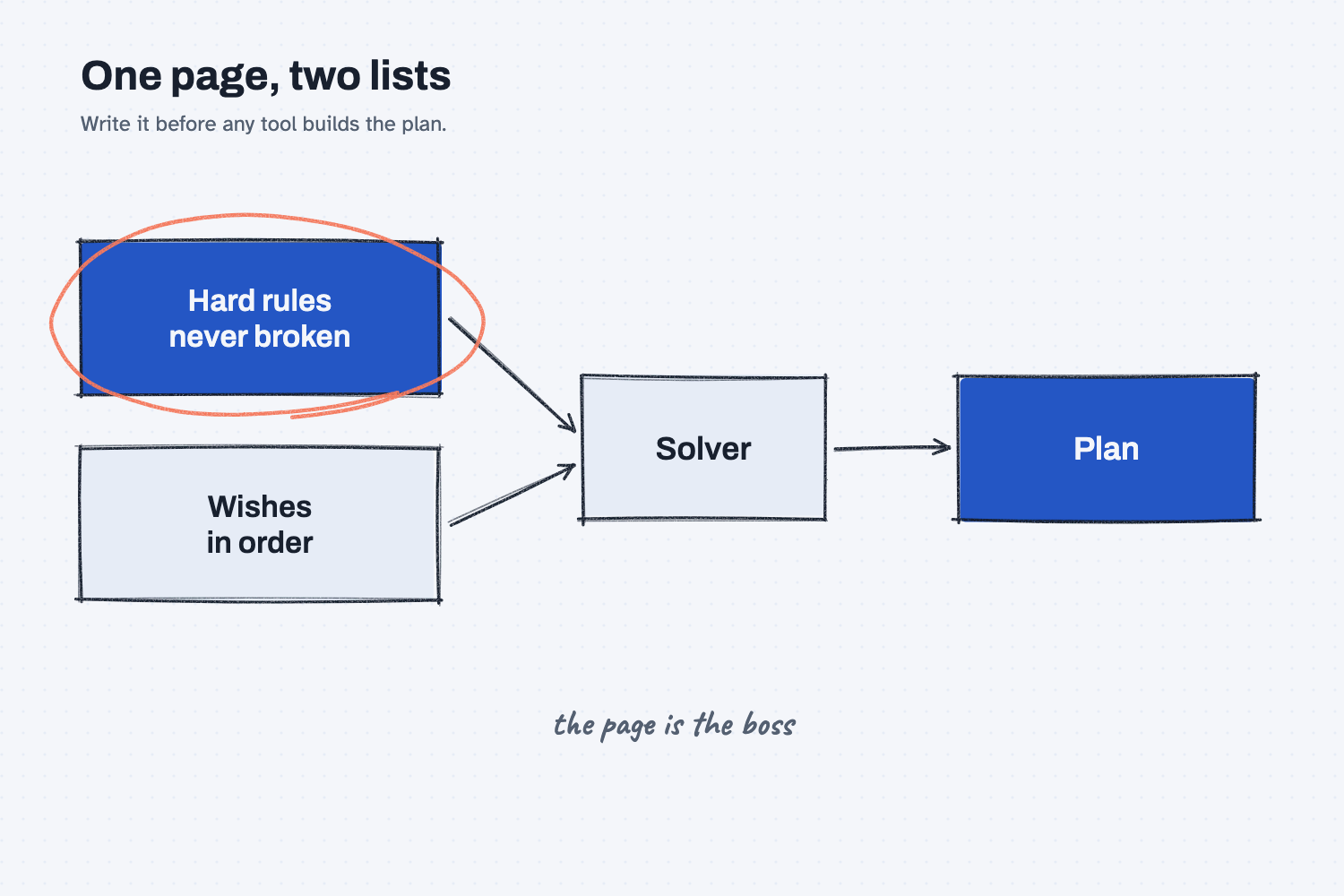
The picture shows one page with two lists. The top list holds the hard rules, and the bottom list holds the wishes, in order. Both feed the solver, which is the search engine inside a planning tool, and the solver hands back a plan. The note says the page is the boss, because the plan can only be as good as what the page says.
Think of it like this
Think about a manager leaving a note for a new supervisor who will build next week's shift schedule. A good note has two parts. The first says what cannot happen under any condition, such as nobody working without their safety card and never fewer than the minimum crew on the floor. The second says what the manager would like, such as giving people the days off they asked for, in the order that matters most.
With that note, the supervisor knows that wishes bend first and rules never bend. Without it, the supervisor has to guess which items were sacred, and a wrong guess can hurt someone. A planning tool is that new supervisor, and it follows the note exactly, so the note has to be right.
Why does it matter at work?
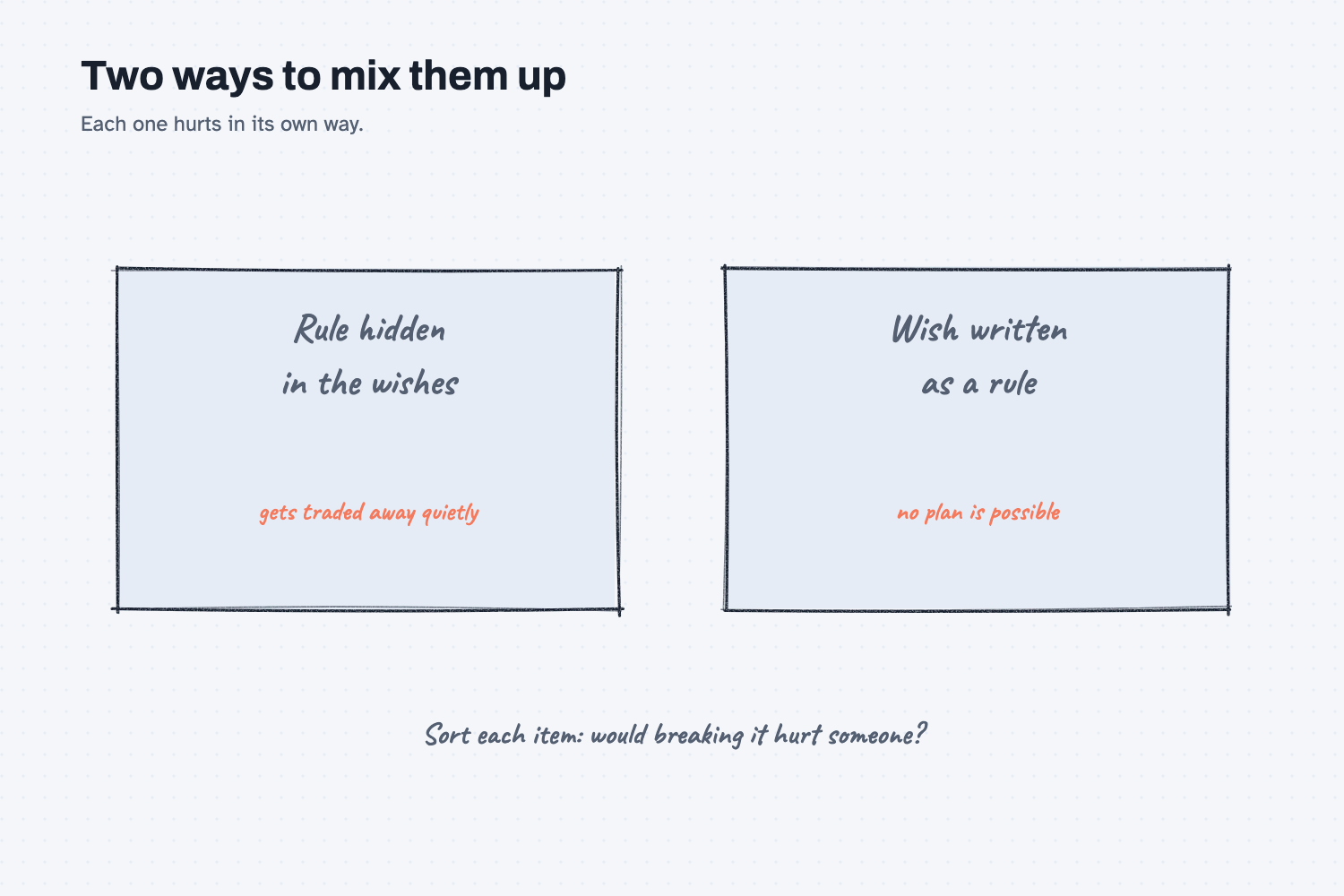
It matters because a tool cannot tell how serious you meant a line to be. A serious rule left in the wish list gets traded away whenever that scores better. A wish written as a rule can leave the tool with no plan at all.
Here is an example. Mesquite Ridge Metal Works is planning Plant 1 Safety and Skills Day for Friday, 2026-12-11. There are 3 time slots and 2 rooms. The plant keeps running that day, so a minimum crew has to stay on the floor in every slot. Anyone whose forklift cert expires before year end must attend recert, and everyone filled in a survey about which sessions they want.
Written down properly, the page has two lists. The hard rules are that nobody can be in two places at once, no room can hold more than its seats, the minimum crew stays on the floor in every slot, and every person with an expiring forklift cert gets the recert session. The wishes, in order, are to honor the survey picks, then to fit people to the right roles, and then to balance the two rooms.
Now picture what goes wrong without that split. If "minimum crew on the floor" is a wish, a plan that honors every survey pick might pull too many people off the line in slot two, and the tool would call that a fair trade. If "honor every survey pick" is a rule, the first time two people want sessions at the same hour, the tool reports that no schedule exists.
How does it work?
There are three parts. You write the page, the solver builds the plan, and the solver explains what it could not do.
You write the page. Put each item on one list by asking one question: if this broke, would someone be hurt, fined, or unable to do their job? If yes, it is a hard rule, and if the answer is "it would be a shame," it is a wish. Then put the wishes in order, because when two wishes collide the tool needs to know which wins, as described in how to give AI your priorities.
The solver builds the plan. A solver, the search engine described in what is an optimizer, only looks at plans that keep every hard rule. Among those plans it picks the one that scores best on your wishes, with the first wish counting for more than the second.
The solver explains the misses. Because the rules are written down, every missed wish has a reason you can read. One person used Claude Code to schedule breakout sessions for 89 people at an event. The hard rules were no time conflicts, no more than 60 in a room, at least 5 in every session, and presenters locked into their own sessions. The wishes were to honor survey picks first and to match department second. The plan honored 108 of the 126 picks, and it could explain every miss: either two of a person's picks fell in the same time slot, or the person was presenting at that hour.
Where do people get it wrong?
Most mistakes come from putting an item on the wrong list, or from never making the lists at all.
- Mixing a hard rule into the wishes. The tool trades it away quietly, and nobody notices until the plan is already posted.
- Writing every wish as a rule. This is the safe-feeling choice, and it often makes the problem impossible, so the tool returns nothing useful.
- Leaving the wishes unranked. When two wishes collide, an unranked list means the tool picks by accident instead of by your order.
- Forgetting a rule that everyone knows. A rule that lives in people's heads, such as a machine being down on Wednesday, does not exist for the tool, so write it on the page.
Try this in 2 minutes
This test gives an AI a mixed list for the training day and asks it to sort the list into hard rules and wishes. You can use any chat tool.
- Open a new chat and paste this:
Sort this list for a training day schedule into two lists. HARD RULES can never be broken. WISHES are in priority order, most important first. Add one short line after each item saying why. Keep it under 120 words, no other text.

- Nobody can be in two sessions at the same time
- Each room seats 30
- Honor people's survey picks
- Anyone whose forklift cert expires before year end must attend recert
- At least 8 people stay on the floor each slot so the plant keeps running
- Put people in sessions that fit their role
- Spread people evenly across the two rooms
- You should see four hard rules and three wishes, each with a short reason.
- Read the order of the wishes, and change it if it is not the order your plant would choose.
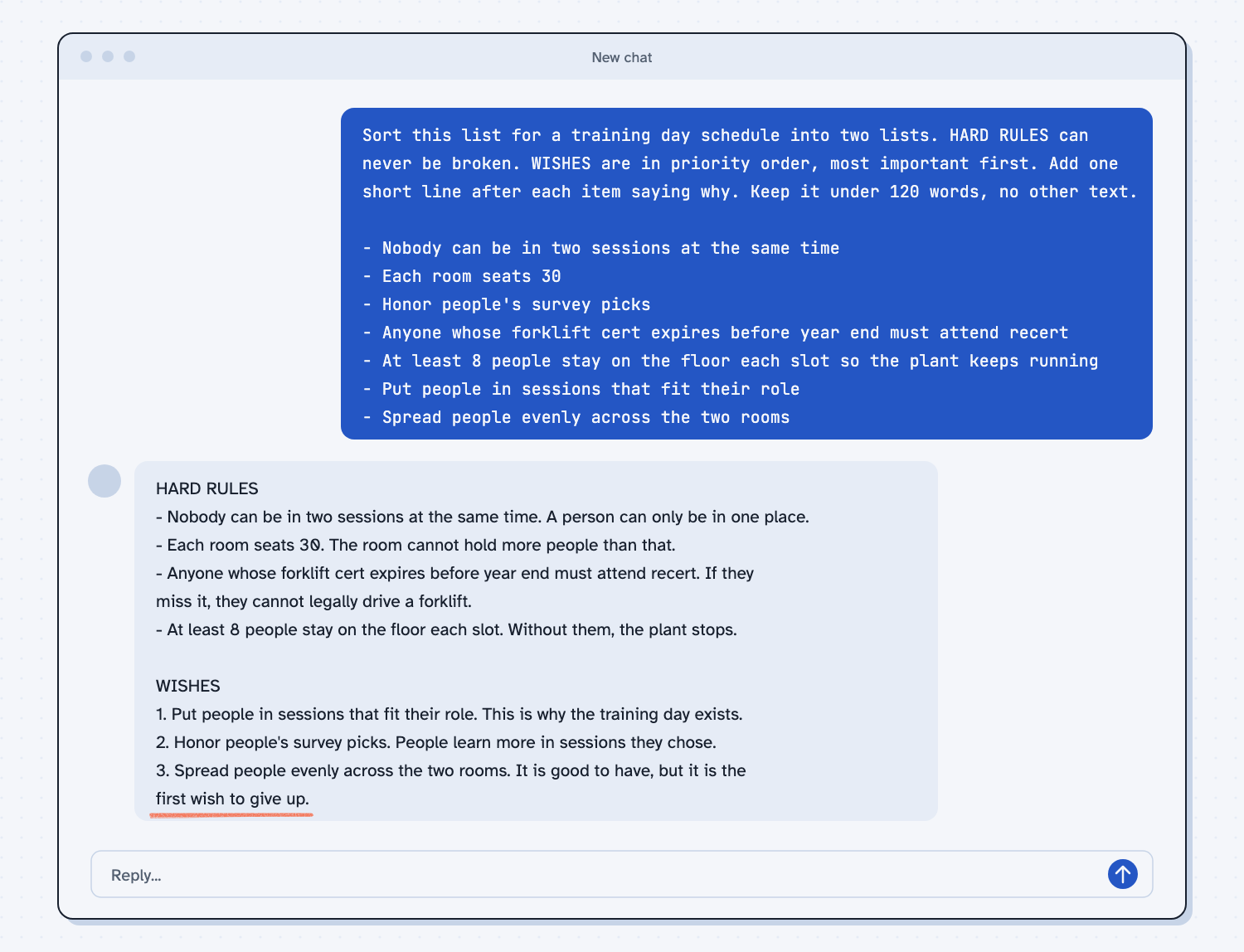
When I tried this, all four rules landed on the hard list, and the forklift line came with the reason "If they miss it, they cannot legally drive a forklift." The wish list was where the order mattered. The AI put role fit first and survey picks second, and it noted that balancing the rooms "is good to have, but it is the first wish to give up." That is a sensible order, but it is not the one I typed, so read the order yourself. It is yours to set.
Frequently asked questions
What is the difference between a hard rule and a wish?
A hard rule can never be broken, and a plan that breaks it is not allowed. A wish is something you would like, and the tool tries to grant it as far as the hard rules allow. People in planning often call these hard and soft constraints.
What if the tool says no plan fits?
Usually two hard rules cannot both be kept, or a wish was written as a rule. Find the item that is really a wish, move it down, and run the plan again.
Does this work with a chat AI and not just a solver?
Yes, a chat AI follows clear lists better too, but it may bend a rule without telling you, so check its plan against the hard list. A solver will not bend one.
Use it today
- Schedule a training day so nobody is double-booked: write the two lists, build the schedule, and see every miss explained.
- Related ideas: What is an optimizer? and How to give AI your priorities.
From my training: someone scheduled 89 people into breakout sessions with Claude Code, and the plan honored 108 of 126 picks and could explain every miss, because the rules were written down before it started.