What Is an Optimizer? Software That Searches for the Best Plan
With Josh Schultz ·
Answer. An optimizer is math software that searches through the possible plans, such as every way to order a set of jobs, and picks the best one that follows your rules. The search engine inside is called a solver. It does not write or guess, so it is a different tool from a chat AI.
The picture
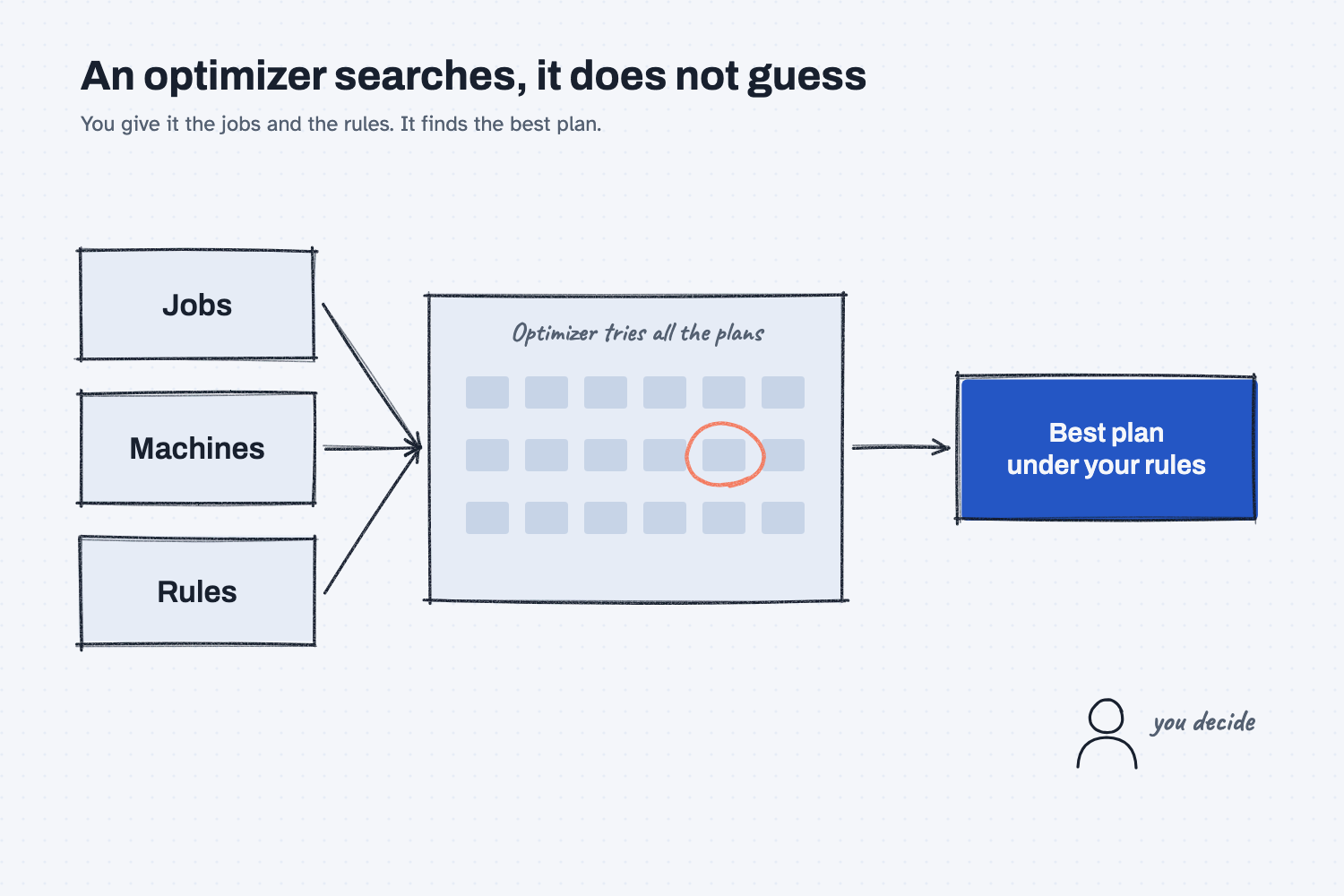
The picture shows three kinds of inputs on the left: the jobs you have, the machines you have, and the rules you must follow, such as due dates and one job per machine at a time. They go into the optimizer, where the faint cloud stands for all the plans that obey your rules, and the circled one is the best of them. A person looks at the result at the far right, because the optimizer only knows the rules you gave it.
Think of it like this
Think of a planner at a whiteboard working out which jobs go on which machine this week. A good planner tries an arrangement, spots a problem, shuffles two jobs, and tries again, and after enough tries settles on something that works.
Now picture a planner who never gets tired and can try millions of arrangements an hour, and who only keeps the ones that follow every rule. That is an optimizer. It does not have a hunch about which job should go first. It works through the options in an organized way and keeps the best one, which is why it can often tell you whether a plan is the best possible, or whether no plan fits your rules at all.
Why does it matter at work?
It matters because many of the hardest planning problems in a plant are not writing problems. They are searching problems, with so many possible combinations that no person can check them all and a chat AI cannot be trusted to.
Here is an example. Hector Lee plans production at Mesquite Ridge Metal Works. He has 12 jobs, 3 machines, due dates, and setup times that change depending on which job ran before. A schedule that looks fine can still waste hours in changeovers, and it can miss a due date without anyone noticing. An optimizer takes his jobs and rules and searches for the order with the least total time that still meets the dates. Companies use the same kind of tool for delivery routes, order quantities, and cutting stock with the least scrap. Google's open-source OR-Tools project, for example, describes software for routing, scheduling, and similar problems.
How does it work?
There are three parts. You describe the problem, the solver searches, and you check that the answer makes sense.
You describe the problem. You list what you can change, such as the order of jobs or how much to buy, what you want to be as small or as large as possible, such as total time or cost, and the rules that cannot be broken. The most important step is writing down the rules, because the optimizer follows them exactly and will not guess at the ones you forgot.
The solver searches. The solver works through the options using math instead of language. For many kinds of problems it can tell you the result is the best possible, and when no plan can meet all the rules it can say so. A chat AI cannot promise either of those things.
You check the answer. The best plan under your rules is only as good as the rules. If Hector forgot that one machine is down for maintenance on Wednesday, the optimizer will happily use it, so a person reads the result before it is released.
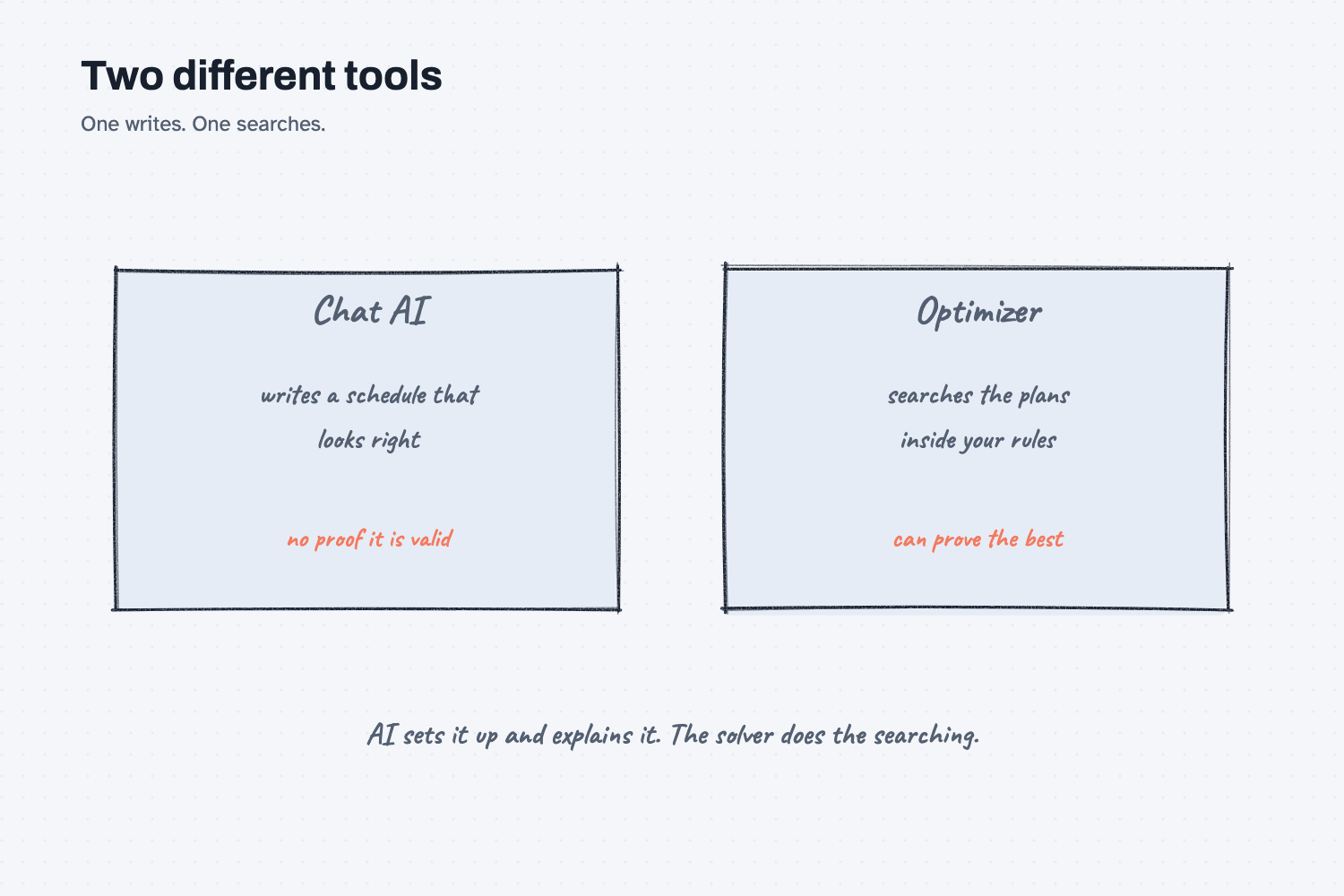
This is where AI helps. Setting up the problem is a language job, and a chat AI is good at turning a messy description of your shop into a clear list of jobs, machines, and rules. It is also good at explaining the optimizer's result in plain words afterward. So the two work well together, which is the same split described in types of AI explained, where each kind of AI has its own strength.
Where do people get it wrong?
Most mistakes come from expecting the wrong tool to do the job.
- Asking a chat AI to be the optimizer. A chat AI writes a schedule that looks right, but it may double-book a machine, and as can AI do math explains, it is not built to search every option.
- Missing rules. The optimizer cannot follow a rule it was never told, such as a machine that is down on Wednesday, so list every constraint.
- Treating "best" as final. Best means best for the goal you set, so if you ask for the shortest time, you may get a plan that is hard on one operator.
- Using it on a problem that is not that big. If you have 3 jobs and 2 machines, a spreadsheet and a good planner will do.
Try this in 2 minutes
This test asks an AI to explain the difference between a chat AI and an optimizer on a shop example. You can use any chat tool.
- Open a new chat and paste this:
In plain words, in 4 short lines: what is the difference between asking a chat AI to schedule 12 jobs on 3 machines and using an optimizer (solver) for the same job? Use a shop example.
- You should see that the chat AI writes a plausible schedule and the solver searches against rules.
- Look at the last line, which should say how the two work together.
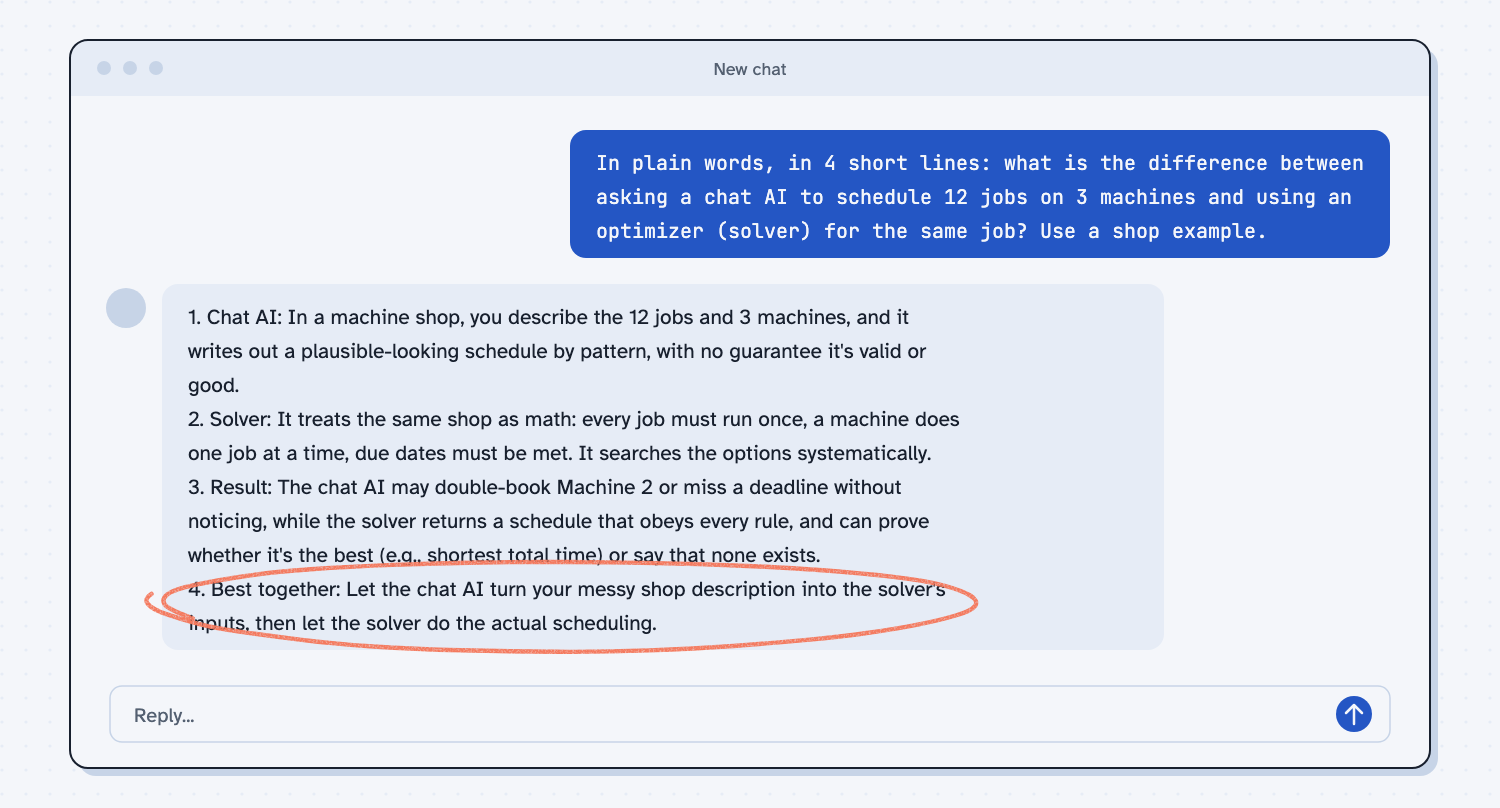
When I tried this, the reply said the chat AI "writes out a plausible-looking schedule by pattern, with no guarantee it's valid or good," while the solver "returns a schedule that obeys every rule, and can prove whether it's the best." Its last line is the one to remember: "Let the chat AI turn your messy shop description into the solver's inputs, then let the solver do the actual scheduling." That matches the lesson, because AI sets up the problem and explains the result, while the solver does the searching.
Frequently asked questions
Is an optimizer a kind of AI?
It is closer to math software than to chat AI. People sometimes call it AI because it makes decisions, but it does not learn from text. It searches for the best answer to a problem you define.
What is a solver?
A solver is the search engine inside an optimizer. You give it a goal and rules, and it looks for the best plan. Some are free and open source, and others are sold by software companies.
Do I need to code to use one?
Often yes, or you need a tool that has one built in. A chat AI can help set up the problem and write the code, but you check the rules yourself.
How is this different from a digital twin?
A digital twin plays out a plan to show what would happen. An optimizer searches for the plan itself. Used together, the optimizer proposes and the twin tests.
Use it today
- Ask a sample shop twin "what if": test a plan on a practice copy, the natural partner to an optimizer.
- Related ideas: What does deterministic mean?, Find the bottleneck first, and what is machine learning.
From my training: we ask people to write down the goal and the rules first, because an optimizer, like any helper, can only follow what you tell it.