Find the Bottleneck First: Speeding Up Any Other Step Does Nothing
With Josh Schultz ·
Answer. The bottleneck is the one step that sets the pace for the whole shop, because nothing can leave faster than that step lets it through. Speeding up any other step changes nothing, so find the bottleneck first and spend your time and money there.
The picture
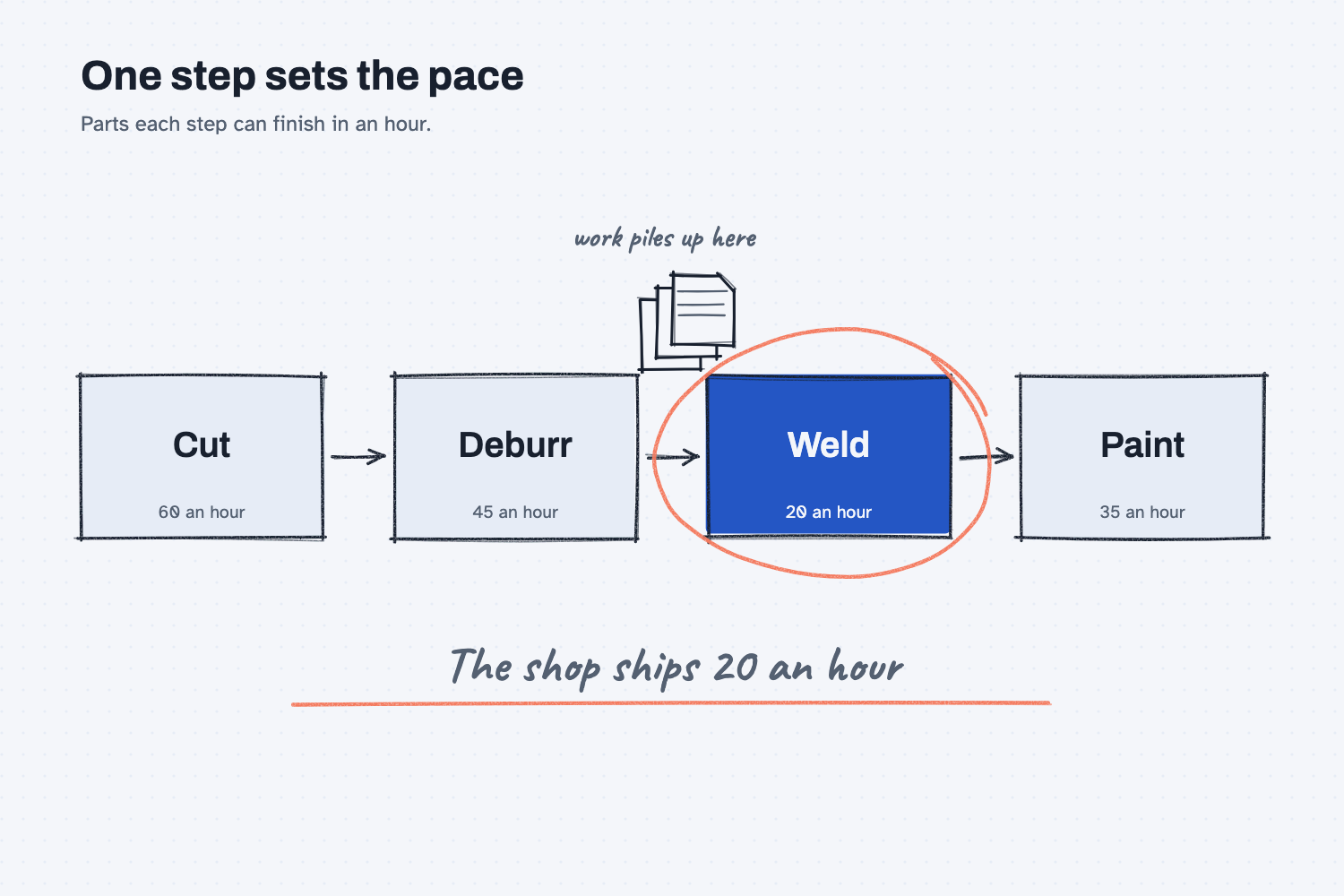
Follow the work from left to right through the four steps, where each box shows how many parts that step can finish in an hour. Cutting can do 60, deburring can do 45, welding can do 20, and painting can do 35. The welding box is circled and has a pile of parts waiting in front of it, because the steps before it send parts faster than it can take them. The shop ships 20 an hour no matter how fast the other steps run, since every part has to pass through welding.
Think of it like this
Hold a bottle upside down and the water comes out at the speed the narrow neck allows. It does not matter how wide the body of the bottle is, and making the body wider does not make the water leave any faster.
That is why people call the slowest step the bottleneck. The shop is the bottle, the parts are the water, and the weld cell is the neck. If you want more to come out, only the neck matters.
Why does it matter at work?
Most people want to speed up the step they can see, or the step that annoys them, and that is rarely the slowest one. The result is a lot of effort that never shows up in the number of parts shipped.
Here is an example. At Mesquite Ridge Metal Works, Walt, the VP of Operations, asks about buying a faster saw, because cutting looks like it takes forever when you stand next to it. Hector Lee, the planner, writes each step's hourly rate on a sheet and finds that the weld cell is the lowest number by a wide margin. A faster saw would cut parts sooner, but those parts would only join the pile waiting for the welders. Walt would pay for a new saw and ship exactly as many parts as before, with a bigger pile of unfinished parts tying up cash on the floor.
Hector points the money at the weld cell instead, because that is the only change that would raise the number of parts shipped.
How does it work?
You find the bottleneck by looking at where the work waits, then you fix that step and look again. It takes three moves.
Look for the pile. Work stacks up in front of the bottleneck, because the steps before it send parts faster than it can take them. The steps after it often stand half empty, waiting for something to arrive. If you can walk the floor, the pile is usually easy to see, and in an office the same pile shows up as a stack of quotes waiting for the one person who approves them.
Check which step stays busy. The bottleneck runs all day while other steps have gaps. If you have the numbers, write down how much each step can finish in an hour, and the lowest number sets the pace for everything. Notice that being busy is not the same thing as setting the pace, because a step can look busy while redoing work, so trust the pile and the numbers more than how hectic a step looks.
Speed up that step, then look again. When the bottleneck gets faster, the pace rises until some other step becomes the slowest, and that one is the new bottleneck. In the picture, if welding went up to 30, the shop would ship 30 an hour. If welding went above 35, painting would take over as the limit. So the job is never finished, but each round raises the whole shop's output.
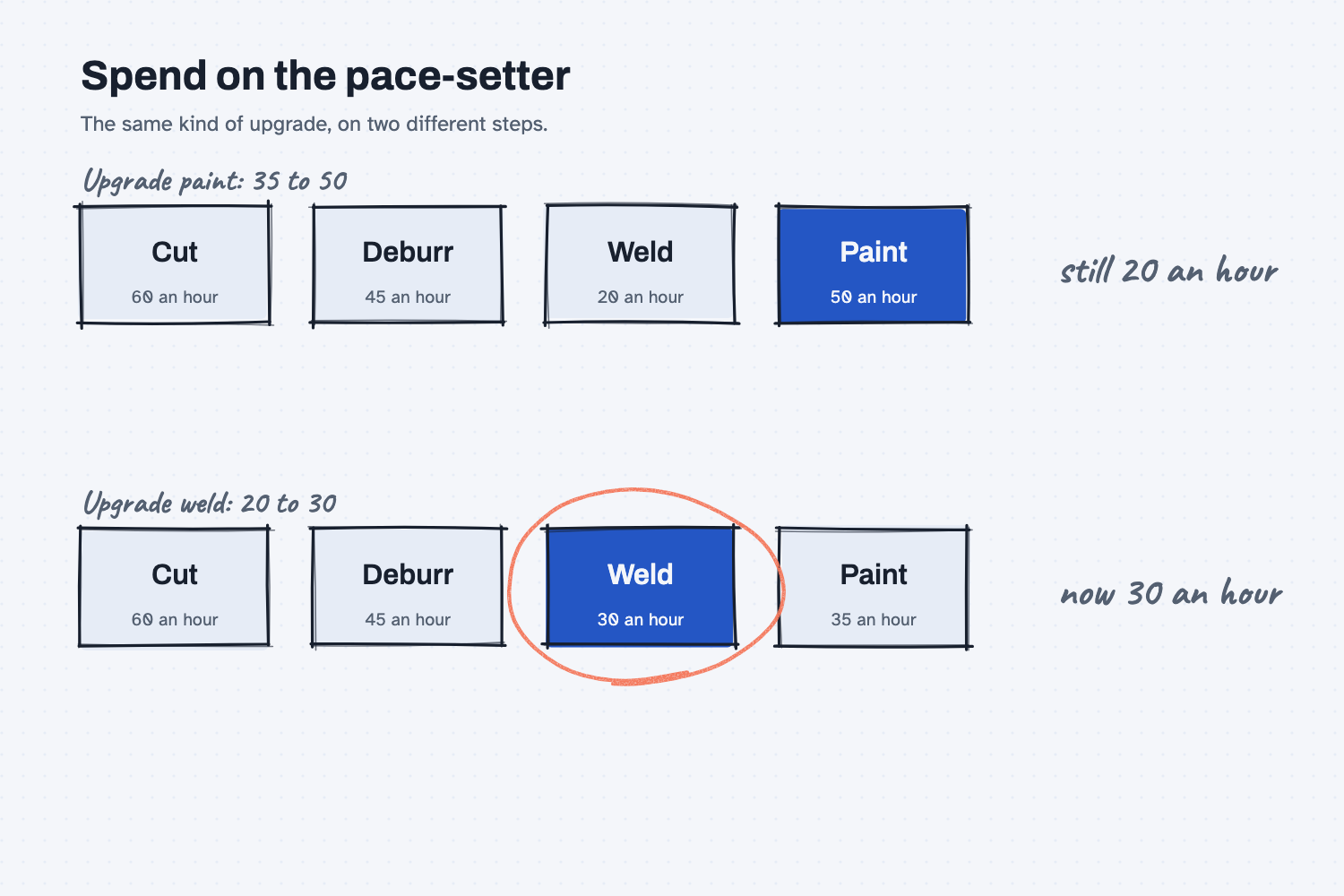
The top row shows money spent on the wrong step, where paint gets faster and the shop still ships 20 an hour. The bottom row shows the same kind of money spent on welding, and the whole shop moves to 30 an hour because welding was the limit.
This also matters for AI. When you use AI to speed up a step in the office, such as drafting emails or sorting invoices, it only helps the shop if that step is the one holding things back. A digital twin is one way to find that step, because it plays out the weeks and shows which step the work waits on.
Where do people get it wrong?
Most mistakes come from fixing what is easy to see instead of what is slow. These are the four I see most often.
- Speeding up the loudest step. The step that annoys everyone is often not the one limiting output, so check the numbers before you spend.
- Judging by who looks busy. People rush around steps that are full of rework, and that tells you about quality, not about pace.
- Fixing it once and stopping. After you fix one bottleneck another step takes over, so look again after every change (use the habit from change one thing at a time).
- Automating before you look. Automating a step feels like progress, but a faster step that is not the bottleneck only builds a bigger pile (see clean up before you automate).
Try this in 2 minutes
This test gives AI four steps and asks which one is worth speeding up. You can use any chat tool.
- Open a new chat and paste this:
Our part goes through four steps, and each step can finish this many parts per hour: cutting 60, deburring 45, welding 20, painting 35. Work is piling up in front of welding. If we buy a faster paint booth that does 50 parts per hour, how many more parts will we ship per hour? Answer in 3 short lines and name the step that sets the pace.
- Here is what I expect: welding sets the pace, and a faster paint booth adds nothing.
- Now swap in the four steps from your own shop and see which one it names.
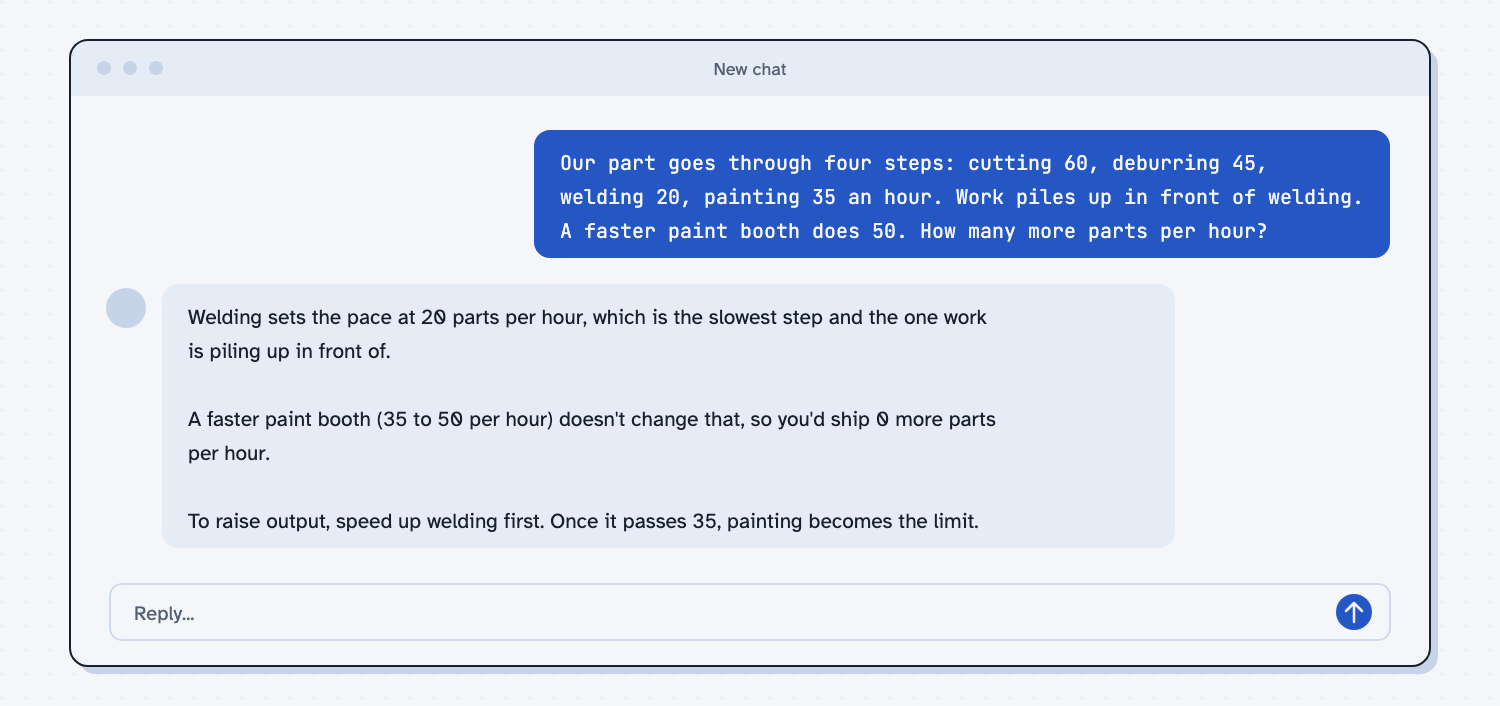
When I tried this, the reply opened with "Welding sets the pace at 20 parts per hour, which is the slowest step and the one work is piling up in front of." On the paint booth it said, "A faster paint booth (35 to 50 per hour) doesn't change that, so you'd ship 0 more parts per hour." It ended with a note about what happens next: "To raise output, speed up welding first. Once it passes 35, painting becomes the limit."
That last line is the part to remember, because it shows that the bottleneck moves once you fix it, so the work is to keep looking.
Frequently asked questions
What is a bottleneck in simple terms?
It is the slowest step in a chain of steps. Because every job has to pass through it, it sets how much the whole shop can finish, no matter how fast the other steps are.
Can a shop have more than one bottleneck?
Only one step sets the pace at a time, but a second step is often close behind. When you speed up the first, the second takes over, which is why you look again after each change.
What if the bottleneck is a person?
The idea is the same. You can take easy tasks off that person's plate, cross-train someone to share the work, or move the step so it never waits on one set of hands.
Does this apply to office work?
Yes. A stack of quotes waiting for one approver, or a weekly report only one person knows how to build, is a bottleneck. The pile in front of that step is how you spot it.
Use it today
- Ask a sample shop twin "what if?": find the bottleneck in a sample shop and test a fix.
- Find repeat failures in a maintenance log: AI tags each work order from your own lists, a script counts and ranks them.
- Browse the guides for a step-by-step way to try this in your own shop.
- Related idea: What is a digital twin?
- Related idea: Clean up before you automate.
- Related idea: Humans plan, AI does.
From my training: before you speed up a step, find out whether the work is waiting on it.