What Is a Digital Twin? A Practice Copy of Your Shop
With Josh Schultz ·
Answer. A digital twin is a software copy of your shop that you can run experiments on before you spend any money. You describe your machines, people, and open orders, and the copy plays out the coming weeks many times, so you can see what a change would do.
The picture
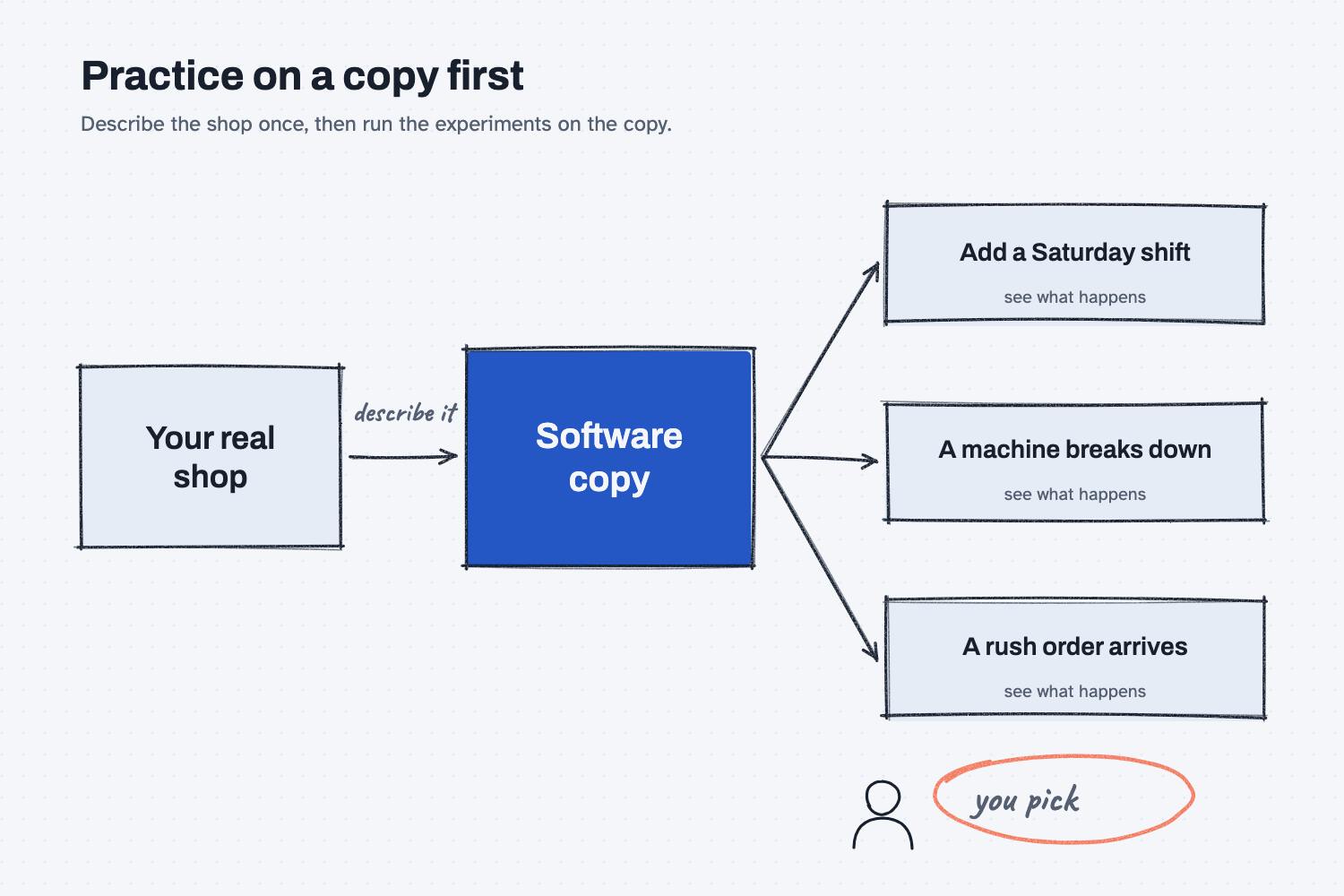
Start on the left, where your real shop gets described to a software copy, with its machines, its shifts, and its open orders. Then follow the arrows to the three tests on the right, where each one is a change you might make or a bad week you might face. The copy shows what happens in each case, and the circled words at the bottom are the important part, because the copy only reports results and a person still makes the choice.
Think of it like this
Before moving a heavy machine, some shops lay out its new spot on the floor with tape or cardboard, so people can walk around the space and see whether the aisle is still wide enough. It costs almost nothing, and it catches mistakes before anyone rents a forklift.
A digital twin is the same idea, except that it practices time instead of space. The tape shows where things would go. The twin shows what would happen over the next few weeks, such as which orders would go late and which machine would be holding everything up, if you made the change.
Why does it matter at work?
Most big shop decisions are made on a guess, because the real test is too expensive. A second shift, a new machine, or a Saturday crew costs real money, and you only learn whether it worked after you have paid for it.
Here is an example. At Mesquite Ridge Metal Works, Walt, the VP of Operations, has orders running late and two ideas in front of him. He could add a Saturday shift, or he could buy a second mill. Each one costs a lot and takes months to undo.
With a twin, Hector Lee, the planner, describes the shop and loads the open orders. The copy plays out the next three weeks and shows which orders go late and which machine they were waiting on. Then Hector tries the Saturday shift on the copy, and later the second mill, and compares them side by side. For example, the copy might show that every late order was waiting on one machine, which would mean a Saturday shift for everyone else would barely help. Walt would learn that before spending anything, which is the whole point.
How does it work?
There are four parts. You describe the shop, the copy plays out the weeks many times, it does the math the same way every time, and you decide.
You describe the shop. The copy only knows what you tell it, so you give it the facts a planner already carries in their head. When I asked Claude what the copy would need for a shop with 6 machines and 2 shifts, the list opened with "What each of the 6 machines is (type, capability) and how reliable it is (breakdown frequency, repair time)." It also asked for the routing, meaning the steps each part goes through, along with the shift hours and the open orders.
It plays out the weeks many times. A real week never goes exactly as planned, because jobs run a little long, a machine goes down, and someone is out sick. So the copy adds normal variation and plays the same weeks over and over, which turns a single guess into a pattern. Instead of "this order will be late," you learn that it was late in most of the plays, and that is much more useful when you are quoting a date.
It does the math the same way every time. The copy follows fixed rules, which means the same facts give the same results (the idea behind what deterministic means). That matters because when two tests give different answers, you know the difference came from your change and not from the copy changing its mind.
It doesn't pick a winner. You do. The copy scores each test and shows you the numbers, but it does not know what your customers expect or what your budget can take. An AI assistant can help here by suggesting changes to try and by explaining the results in plain words. That is the same split described in humans plan, AI does, where people make the decisions and the tools carry them out.
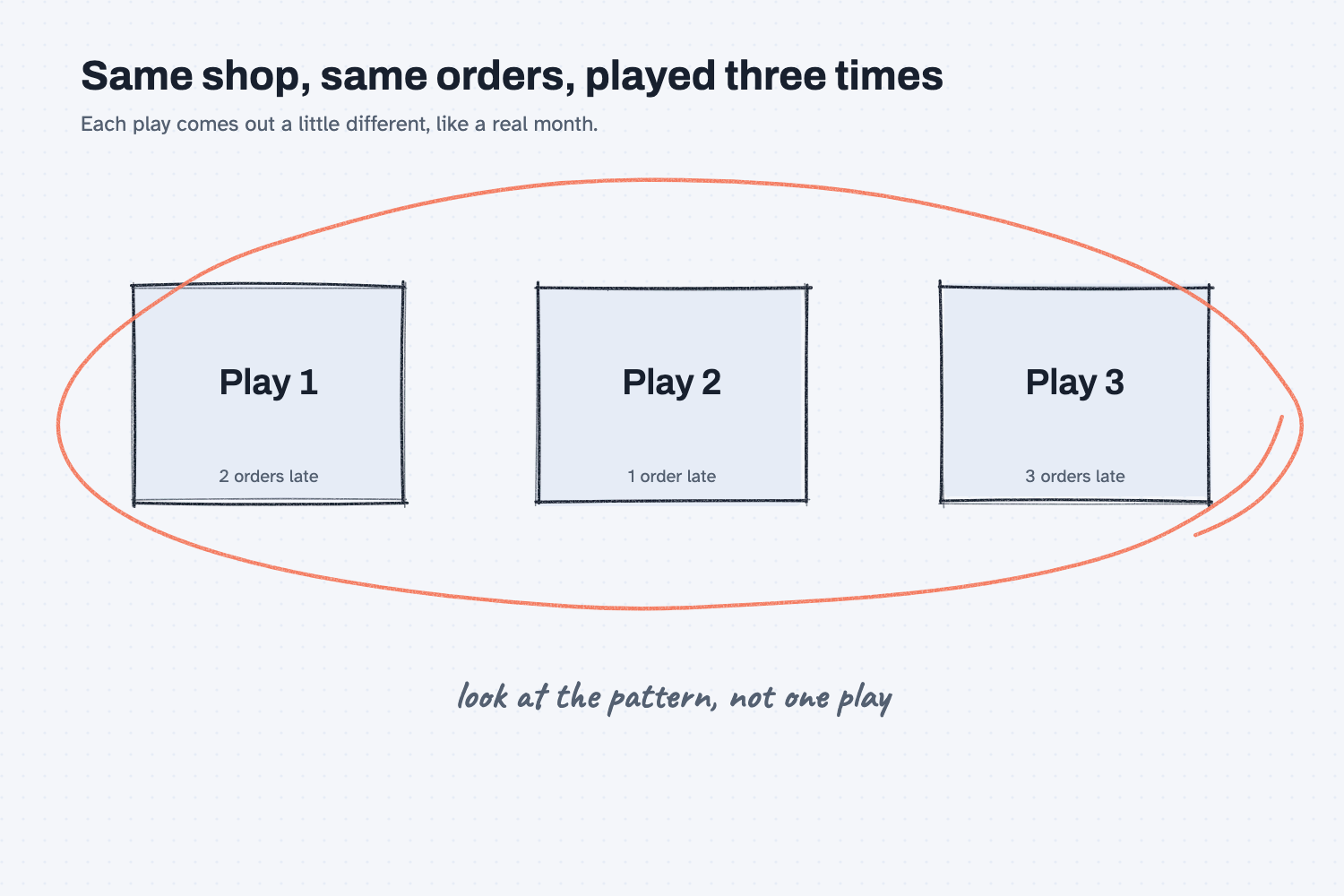
The three plays in the diagram use the same shop and the same orders, yet each one comes out a little differently, which is how a real month behaves. The pattern across many plays is what you read, not any single one.
Where do people get it wrong?
Most mistakes come from expecting the copy to be more than it is. These are the four I would watch for.
- Treating it like a crystal ball. The copy shows what is likely given what you told it, so read the results as ranges and not promises.
- Feeding it wrong numbers. If the ERP says a step takes 5 days and it really takes 12, the copy will be confidently wrong, so fix the inputs first (see clean your data before AI).
- Testing five changes at once. If you change the shifts, the machines, and the rules together, you cannot tell which one helped, so use the habit from change one thing at a time.
- Building it before finding the slow step. Start with the machine that holds everything up (see find the bottleneck first), because a copy of that one area is easier to build and answers the most important question.
Try this in 2 minutes
This test shows what a copy of your shop would need to know. You can use any chat tool.
- Open a new chat and paste this:
I run a small machine shop with 6 machines and 2 shifts. I want to build a software copy of my shop so I can test adding a Saturday shift before I spend money. In plain words, what facts about my shop would the copy need? Give me a short list of 6 items, one line each.
- Read the six items and mark the ones you could answer today from memory.
- Pick one item you could not answer, and find out where that number lives in your shop.
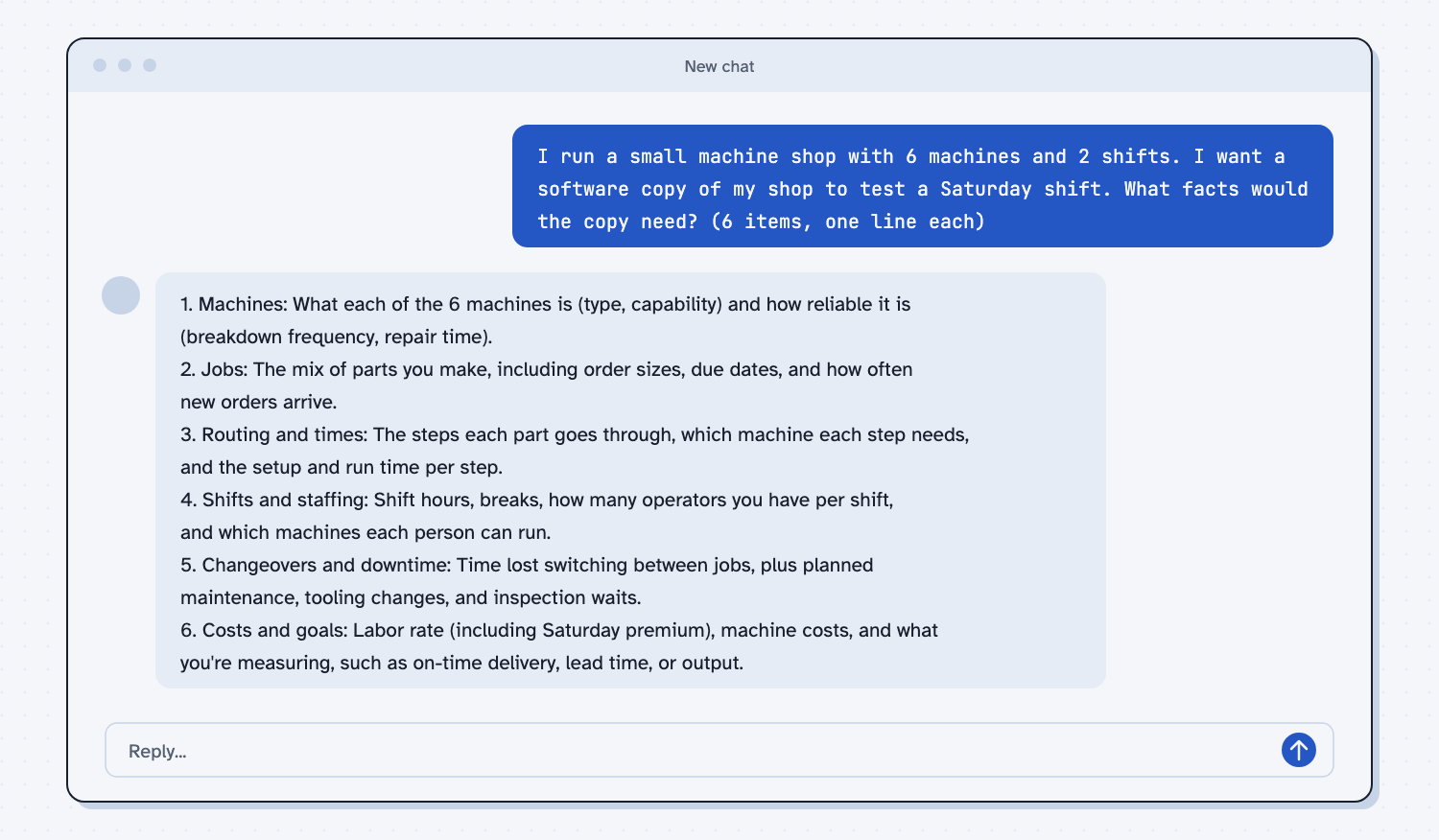
When I tried this, the reply covered machines, jobs, routing and times, shifts and staffing, changeovers and downtime, and costs and goals. The fourth item read "Shift hours, breaks, how many operators you have per shift, and which machines each person can run." The fifth was "Time lost switching between jobs, plus planned maintenance, tooling changes, and inspection waits."
Most shops can answer the first few items right away and get stuck on the setup and changeover times, which is normal. That gap is useful, because those are the numbers a copy cannot work without, and they are also the ones that quoting and scheduling guess at today.
Frequently asked questions
What is a digital twin in manufacturing?
It is a software copy of a machine, a line, or a whole shop that behaves like the real thing. You use it to test changes safely, such as a new shift or a rush order, and the real shop is never touched.
Does a digital twin use AI?
Not for the copy itself, which runs on fixed rules and plain math, so the same facts give the same results. AI is useful around it, because it can help you set the copy up, suggest changes to test, and explain the results.
How accurate is it?
It is only as accurate as the numbers you give it. Start rough, compare what it said against what really happened, and fix the numbers that were off, so it gets better over time.
Can a spreadsheet do the same thing?
A spreadsheet handles simple what-ifs well. It struggles once jobs wait on each other and times vary, because then the answer depends on how a whole month plays out, not on one row.
Use it today
- Ask a sample shop twin "what if?": run a sample shop twin with Claude and test two fixes.
- Browse the guides for a step-by-step way to try this in your own shop.
- Related idea: Find the bottleneck first.
- Related idea: Humans plan, AI does.
From my training: a twin is a way to practice a decision, and the decision itself stays with the people.