What Is Machine Learning? Software That Learns From Your Past Data
With Josh Schultz ·
Answer. Machine learning is software that finds patterns in your past records and uses them to predict what will probably happen next, such as next month's demand, which machine is likely to fail, or which jobs will scrap. Nobody writes the rules by hand. The software works them out from the examples in your history.
The picture
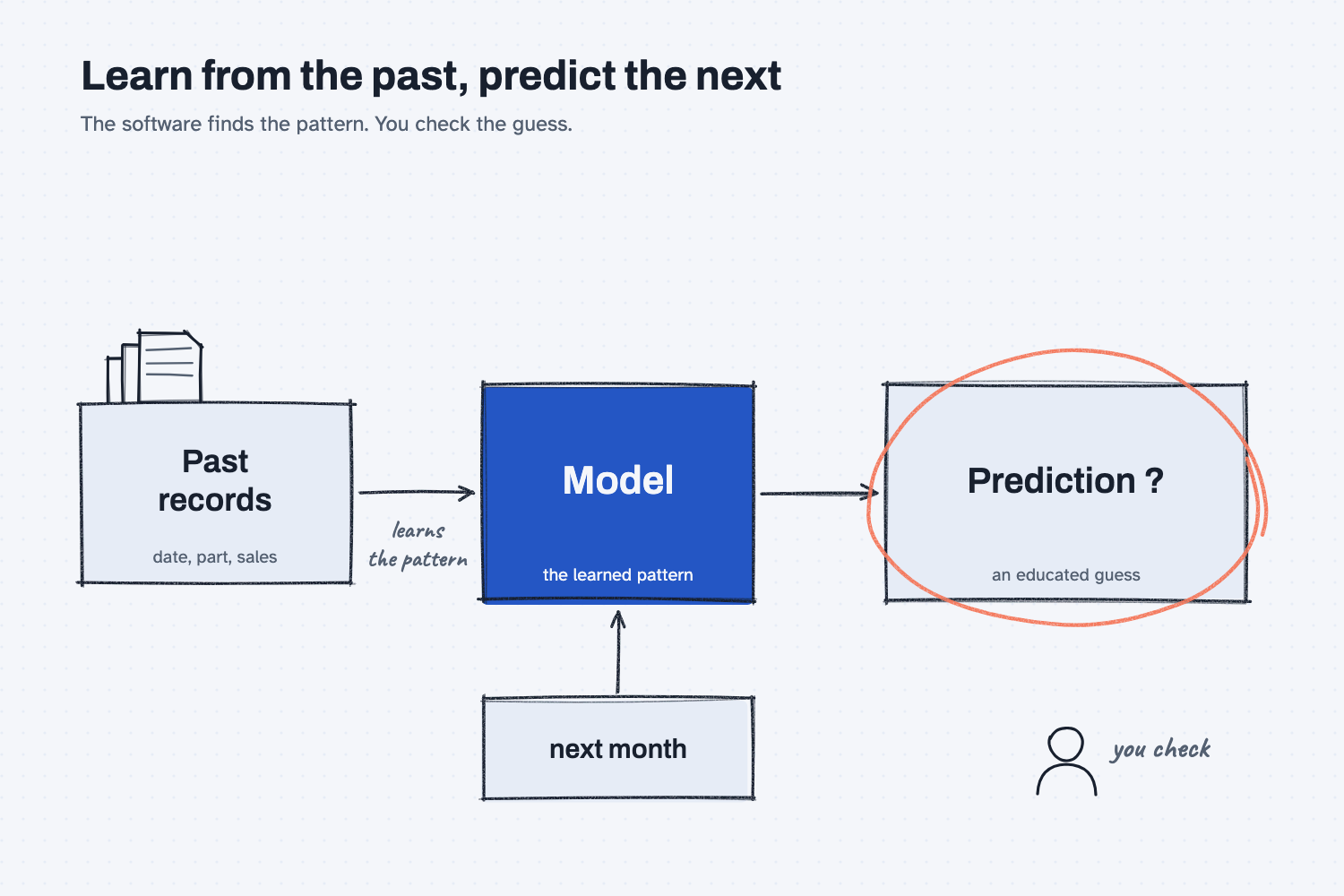
The picture reads left to right. Past records go into the software, which learns the pattern and builds what people call a model, meaning the learned pattern itself. Then you give the model a new situation, such as next month, and it gives back a prediction. The question mark is there on purpose, because a prediction is an educated guess that a person still checks.
Think of it like this
Think of an experienced scheduler who has watched the shop for twenty years. Nobody gave them a rulebook, but they know that a certain casting runs scrap when the foundry is humid, and that orders spike every spring. They learned it from seeing it happen many times.
Machine learning is that kind of learning, done by software. Instead of someone writing "if humidity is over this number, expect more scrap," you show the software years of records and it finds the connections itself. The more clean examples it sees, the better its guesses get, and just like the scheduler, it can be fooled by something it has never seen before.
Why does it matter at work?
It matters because plants already sit on years of records that hold patterns nobody has time to dig out. Machine learning turns those records into forecasts, and a forecast lets you act early.
Here is an example. Hector Lee plans production at Mesquite Ridge Metal Works, and he keeps three years of monthly sales for each part. A machine learning tool can read that history and forecast next quarter's demand for every part number, noticing seasons and trends he could only track for a few parts by eye. The same kind of tool is used to predict which machines are likely to need maintenance and which jobs are likely to scrap, as long as there are enough past examples of those events. scikit-learn, a widely used open-source library for this work, describes two common jobs: predicting a category, such as pass or fail, and predicting a number, such as units sold.
How does it work?
There are three parts: the history, the learning, and the checking.
The history. The software can only learn from what you give it, so the records need to be consistent and complete. If part numbers were typed three different ways, or a stockout made sales look low, the software learns the wrong lesson. This is why cleaning your data before AI comes first.
The learning. The software looks through the examples and adjusts itself until its guesses on the past records are close to what really happened. You do not read the rules it ends up with, and for some kinds of models they are hard to explain even for experts.
The checking. A good test is to hide the last few months from the software, let it predict them, and compare its guesses to what actually happened. If the guesses are poor, the model is not ready to trust. The checking never fully ends, because the shop keeps changing, and a pattern that held for three years can break when you add a new customer.
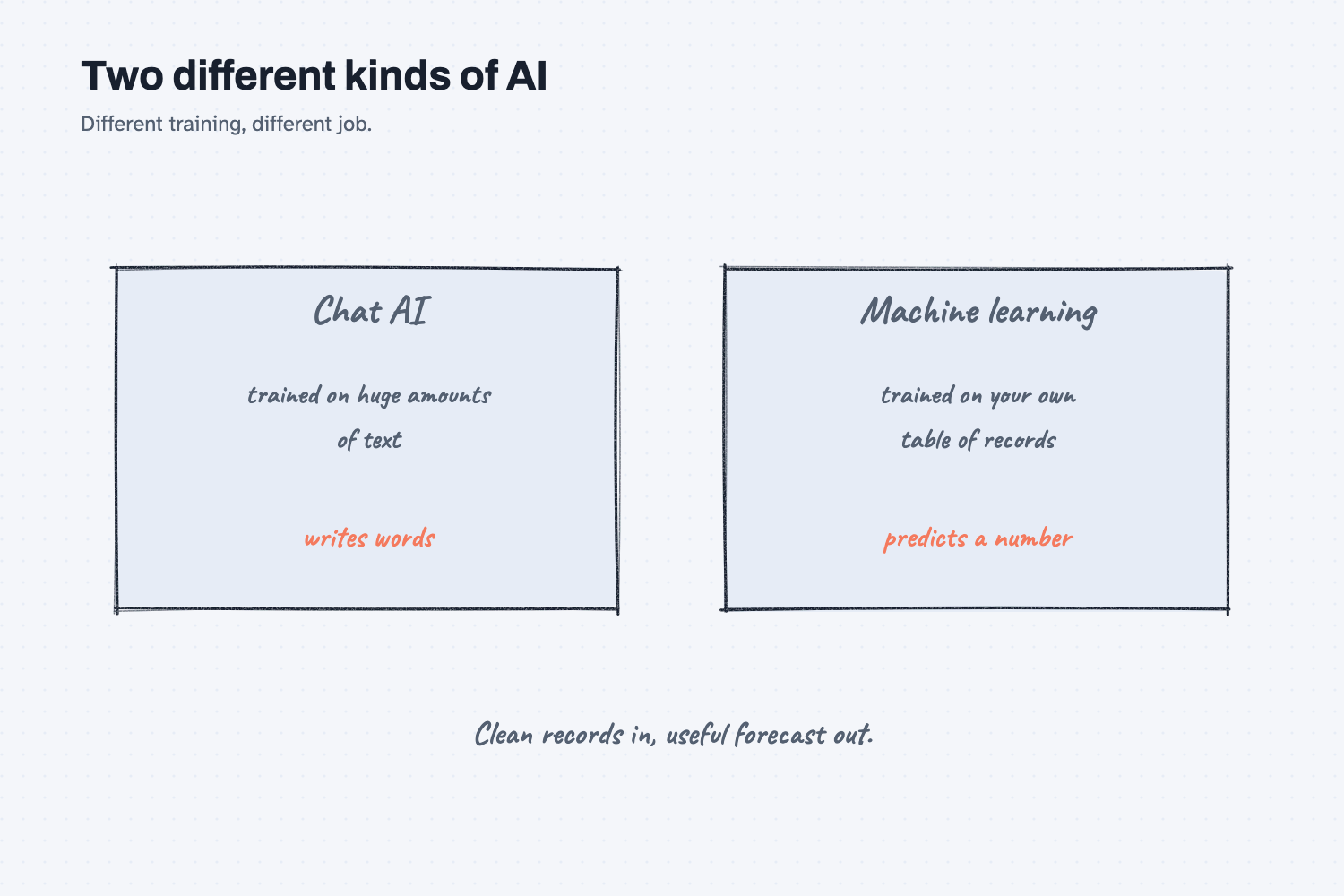
This is also how machine learning differs from a chat AI. A chat AI is trained on huge amounts of text and writes language, while machine learning, in the sense of this lesson, is trained on your own table of records and predicts a number or a category. They are different tools for different jobs, as types of AI explained lays out, and a chat AI can help you set up and explain a machine learning project without being one itself.
Where do people get it wrong?
Most mistakes come from expecting a prediction to be a promise.
- Using messy history. The software cannot tell a typo from a pattern, so fix the records first.
- Too little history. Three years of monthly numbers is only 36 points per part, which is thin, and rare events such as a major failure may not appear often enough to learn.
- Mistaking sales for demand. If you ran out of stock, the sales record shows what you sold and not what customers wanted.
- Trusting it with new situations. A new part, a new customer, or a supply shock has no history, so the model has nothing to learn from.
Try this in 2 minutes
This test asks an AI what a machine learning model could do with three years of sales history, and what would make it unreliable. You can use any chat tool.
- Open a new chat and paste this:
I have 3 years of monthly sales by part number. In plain words, give 3 bullets on what a machine learning model could do with that history, and 3 bullets on what would make its predictions unreliable. One line each.
- You should see uses such as forecasting and spotting seasons, and warnings about thin or distorted history.
- Pick the warning that applies to your own records.
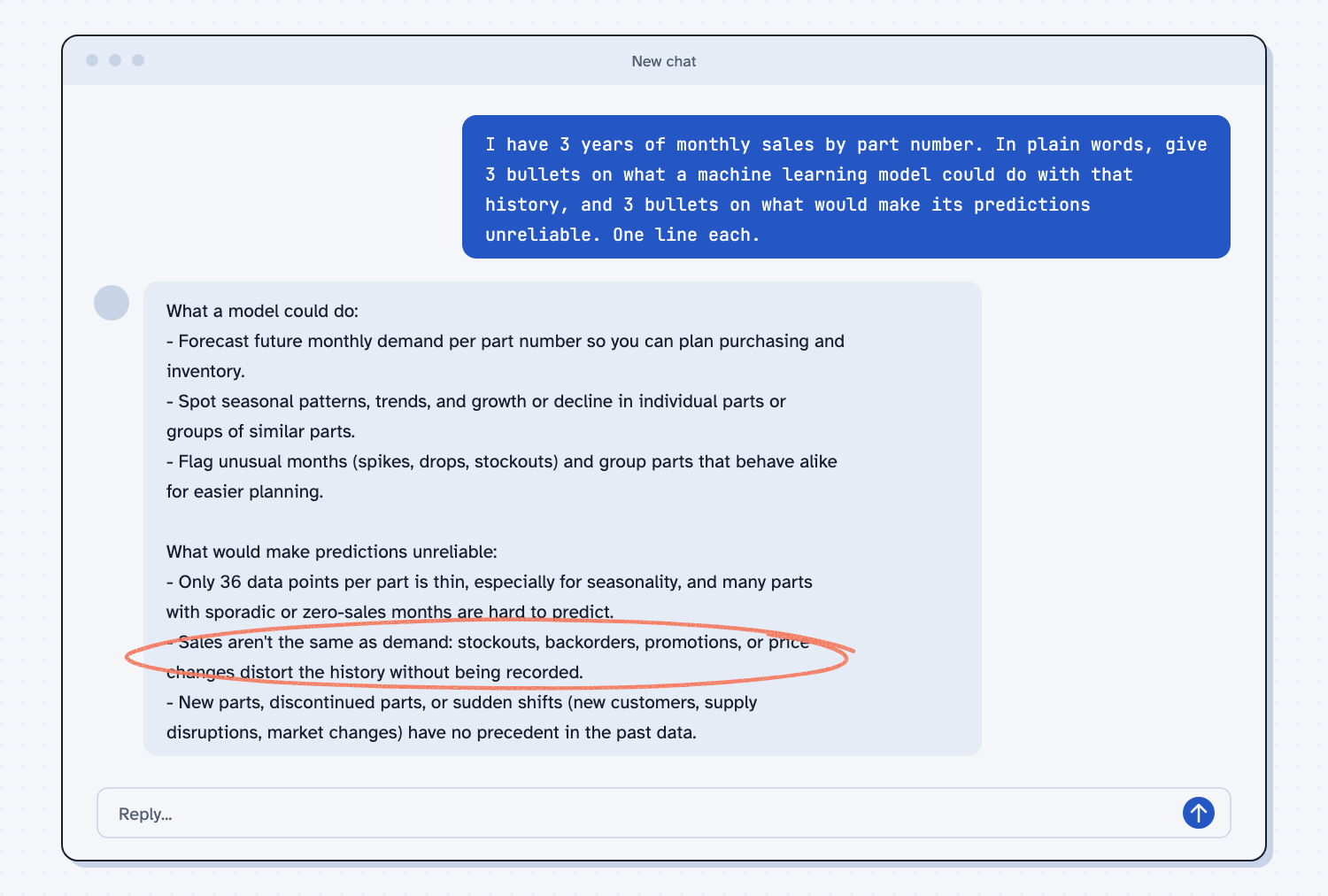
When I tried this, the reply said a model could "forecast future monthly demand per part number so you can plan purchasing and inventory," and it warned that "36 data points per part is thin, especially for seasonality." Its second warning is the one planners miss: "Sales aren't the same as demand: stockouts, backorders, promotions, or price changes distort the history without being recorded." That matches the lesson, because the quality of the history sets the ceiling on the quality of the prediction.
Frequently asked questions
Is machine learning the same as AI?
Machine learning is one kind of AI. Chat tools such as Claude are another kind. Types of AI explained shows how they relate.
Is ChatGPT machine learning?
Chat AI is built using machine learning on huge amounts of text, but in everyday talk, "machine learning" means a model trained on a table of your own records to predict something specific.
How much data do I need?
It depends on the problem, but more clean history is better, and rare events need enough examples to learn from. A data person can tell you if you have enough.
Do I need to code?
Often someone does, though some business software has these forecasts built in. A chat AI can help you plan the project and explain the results.
Use it today
- Find repeat failures in a maintenance log: the first step toward predicting failures is seeing the pattern in your records.
- Related ideas: Clean data before AI, what is an optimizer, and does AI learn from my data?.
From my training: before anyone talks about prediction, we look at whether the records are clean enough to learn from.