What Is a Skill Contract? The Promise You Check Every Result Against
With Josh Schultz ·
Answer. A skill contract is a numbered list of things every result must have, written as yes or no lines so you can check each one. It is the promise a skill makes every time it runs. Because every line can be checked, you compare each result against the contract instead of deciding whether it feels right.
The picture
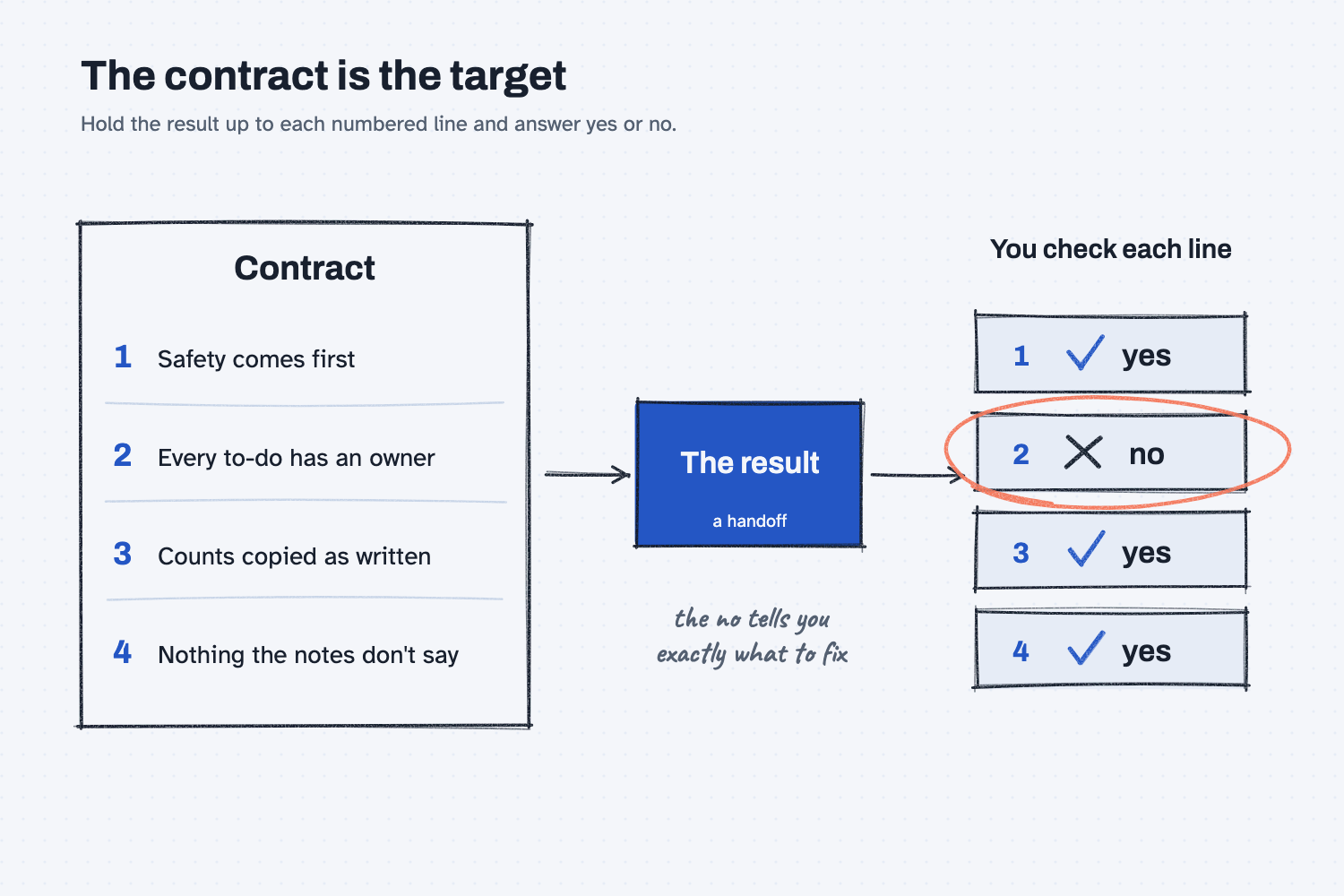
The contract on the left has four numbered lines, and each line is a question that can only be answered yes or no. The result in the middle is whatever the AI wrote, and you hold it up against the contract one line at a time. On the right, each line gets a yes or a no, and the circled no is the one that tells you exactly what to fix.
Think of it like this
Picture a drawing for a machined part. It never says "make a good shaft." It lists each dimension with a tolerance beside it, which is how far off that dimension can be and still pass. The inspector takes a gauge to each one, and the answer is pass or fail.
That is why two inspectors who have never met will agree about the same part. Nobody argues about whether it looks right, because the drawing already said what right means, one dimension at a time.
A skill contract is the drawing for an AI result. Instead of dimensions, it lists the things the result must have, and instead of a gauge, you use your own eyes on one line at a time.
Why does it matter at work?
Without a contract, "this doesn't look right" is all you can say about a result, and the next person may not agree with you. With a contract, you can say which line failed, so the problem has a name, and a name is something you can fix.
At Mesquite Ridge Metal Works (a made-up company in our sample data), 2nd shift's rough notes become a handoff that 1st shift reads at the 6 am meeting. In the guide that builds this skill, the contract has lines such as "Safety is first, even when the notes mention it last" and "Every line in section 6 starts with the word Owner."
On the first test, version 1 of the skill passed 8 of the 10 checklist lines. The two that failed could be named at once: one line stated a guess as a fact, and press brake 2 showed up in two sections. That is much more useful than a vague feeling that the handoff was a little off.
The contract also protects you from the AI's own opinion of its work. In that test, Claude ended by saying every line passed when two had not, so the contract is what let a person catch it (make AI check its own work).
How does it work?
A contract works because each line has four properties. The lines come from your own corrections, they are numbered, they can be answered yes or no, and they say what must not happen.
The lines come from your corrections. In the guide, you get one good result in a chat and correct it until it is right. Every correction you made is a line of the contract, because each one says something about what good looks like (teach AI your judgment).
Each line is numbered. Numbers let you say "line 5 failed" and let the next person look at the same line. They also let a checklist match the contract one to one.
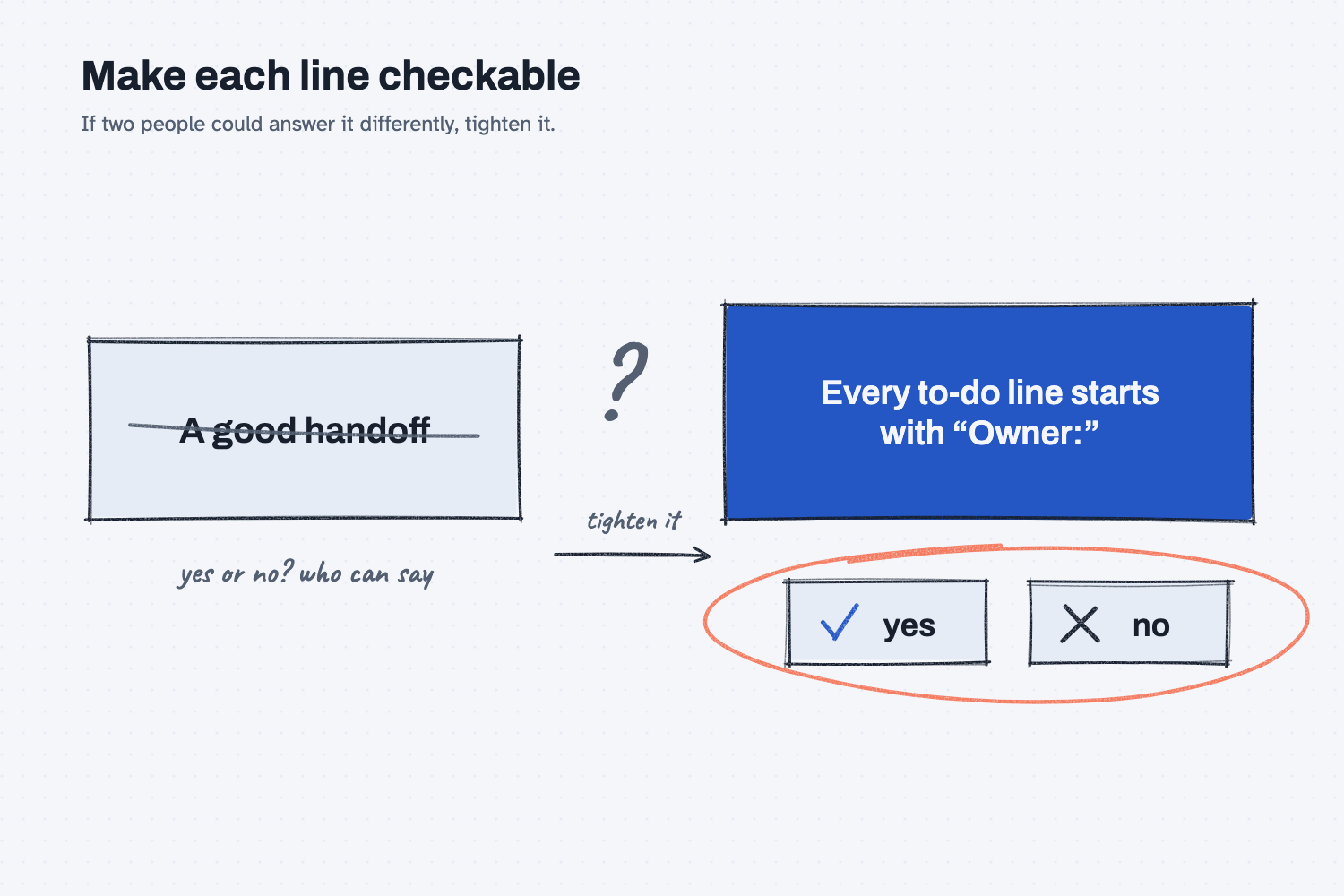
Each line is a yes or no. "A clear handoff" can mean anything, but "exactly seven sections" and "every line in section 6 starts with Owner:" can only be true or false. When a line can be answered two ways, the line is too loose, so tighten it.
Some lines say what must not happen. One of the sample lines reads "Nothing appears that the notes do not say." This kind of line keeps the AI from filling gaps with its own guesses, which is the most common way a good-looking result goes wrong.
The checklist is the contract turned into questions. For every contract line, the checklist has one yes or no question, and you walk it after each test. In the guide, the contract is the target and the checklist is how you check it.
Where do people get it wrong?
Most mistakes come from lines that sound good but cannot be checked. These are the four I would watch for.
- Vague lines. "Professional tone" and "friendly but firm" can be answered two ways, so two people will score the same result differently. Swap each one for something you can count or point at.
- Letting the AI grade itself. It may say every line passes while two have not, so you walk the checklist yourself.
- Writing it all up front. You will not think of every line on day one. The sample skill started with 10 lines and grew to 14 as tests found misses, and that is normal.
- A line nobody asked for. If the AI adds a line you never wanted, take it out. Every line should be something you would send back a result for breaking.
Try this in 2 minutes
This test shows what a contract changes. You will ask for the same handoff twice, once with no contract and once with four lines, and then check the results yourself. You can use any chat tool.
- Open a new chat and paste this:
Write a shift handoff for 1st shift from these notes.

2nd shift, Plant 1, notes by TV.
Forklift 3 horn not working, tagged out.
M7 still down, same as yesterday, waiting on the bearing.
1015 shafts done on M4. Tag says 42 but I counted 41 on the cart.
1031 skid goes out Thu 7am, Jen has the truck.
Bandsaw guard is loose, someone should fix it before 6.
Cruz asked for Saturday OT.
- Open a new chat and paste the same notes with these four lines added under the request:
It must meet this contract:
1. Safety items come first, even when the notes mention them last.
2. Every to-do line starts with "Owner:" and then a name, or "not stated."
3. Every count is written exactly as the notes write it. Counts that disagree go in a short Open questions section.
4. Nothing appears that the notes do not say.
- Check each reply against the four lines, one at a time, and mark each yes or no.
When I tried this, the reply with no contract put the bandsaw guard first under "Safety / Action Needed Before 6:00," but it left the forklift horn under Equipment status. It had no "Owner:" on any line, and it added "Needs a decision from 1st shift supervisor," which the notes never say. So lines 2 and 4 would have failed.
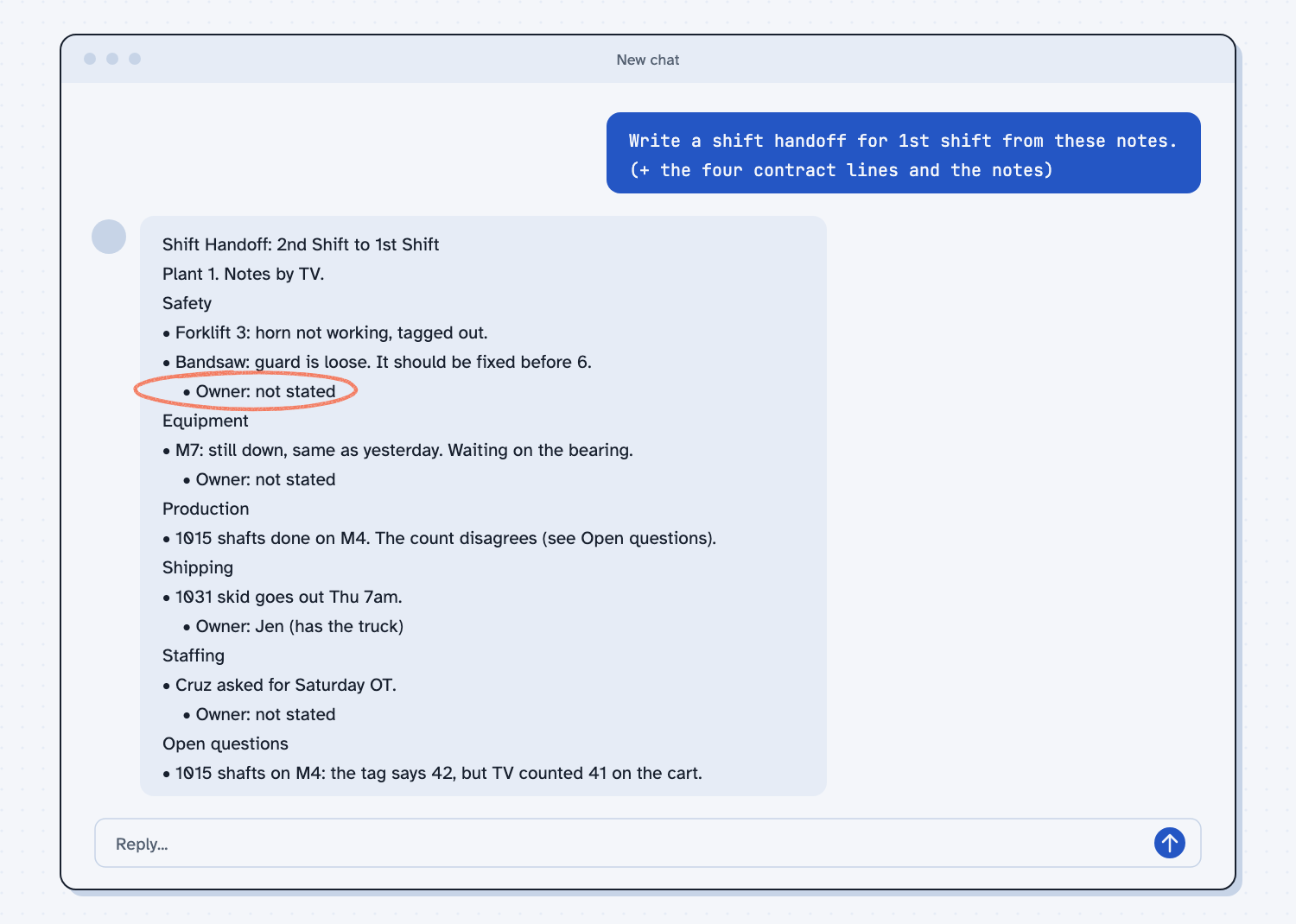
The reply with the contract put both safety items first, and it wrote "Owner: not stated" under the bandsaw guard, M7, and Cruz's overtime. It put "Owner: Jen (has the truck)" on the 1031 skid, and the count went where it belonged: "1015 shafts on M4: the tag says 42, but TV counted 41 on the cart."
It was not perfect, and that is the point of checking. The forklift horn line has no owner, which is fair, because tagging it out is already done and so it is not a to-do. That is a judgment call, so you decide whether the contract line needs to say more.
Frequently asked questions
How many lines should a contract have?
Start with the corrections you made in your good chat. The sample skill began with 10 lines and grew to 14 as testing found misses. Add a line only when a miss needs one.
Is a contract the same as a checklist?
No. The contract is the promise, written once in the skill. The checklist is the contract turned into one yes or no question per line, which you walk after each test.
Do I write the contract myself?
Claude can draft it from your good chat, but you judge every line. If a line is not something you would send a result back for, cut it.
Can the contract be checked by a program?
Some lines can, such as the number of sections. A small script can check those the same way every time (what deterministic means). Lines about judgment still need a person.
Use it today
- Turn a good chat into a reusable skill: build the contract from a chat that worked, then test it on new notes.
- Tune your skill until it does the job every time: add a contract line for each miss, and rerun every test.
- Related idea: SKILL.md is a router, where the contract lives in the skill.
From my training: this comes from the skill template we use for client work, where every skill carries a numbered contract and a yes or no checklist.