What Is a World Model? AI That Predicts What Happens Next
With Josh Schultz ·
Answer. A world model is an AI system that learns how a place or a thing behaves, so it can predict what happens next when something changes. A chat model predicts the next words in a sentence, while a world model predicts the next state of a warehouse, a machine, or a road.
The picture
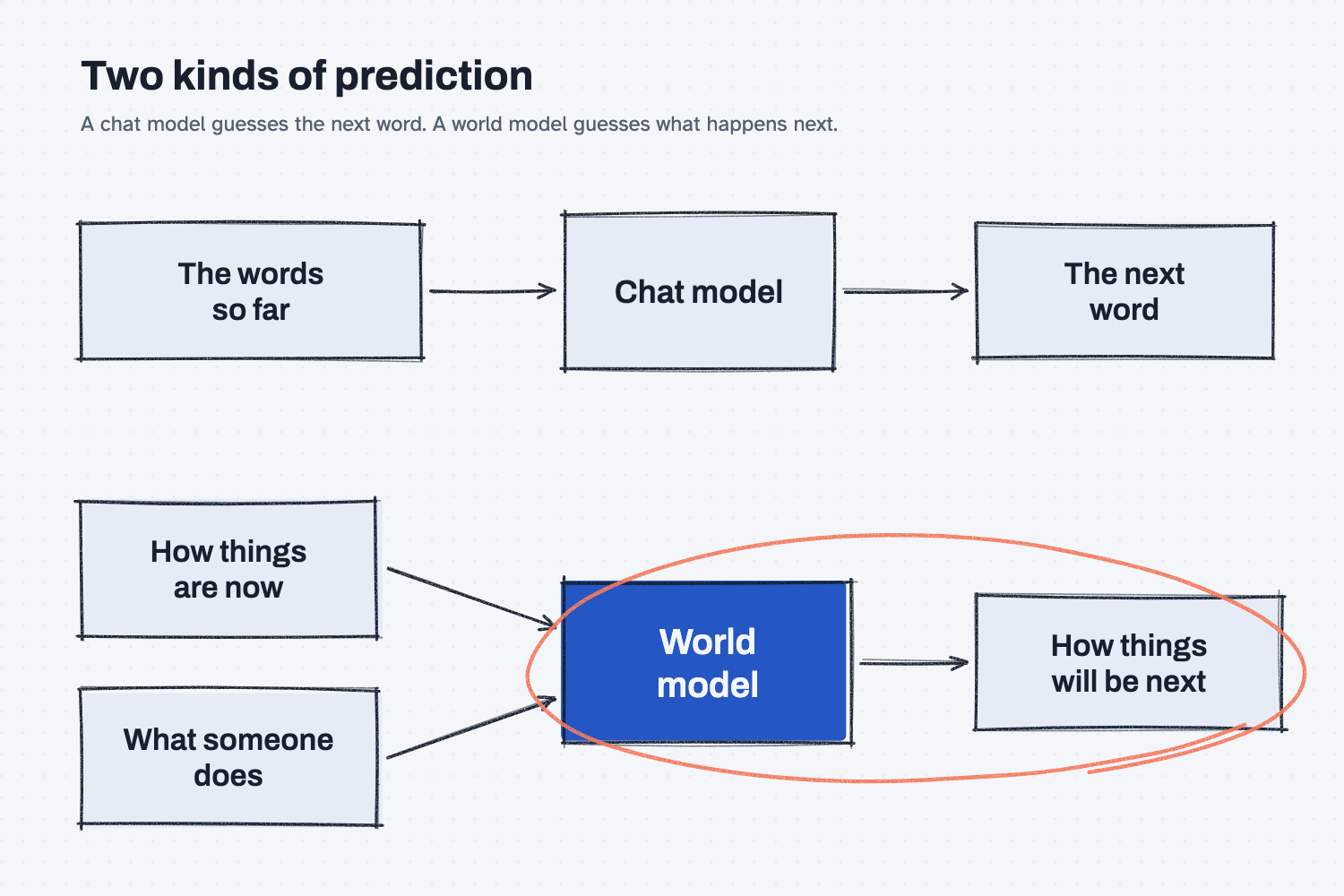
The top row shows the kind of AI you already use, which reads the words so far and guesses the next word. The bottom row is the new idea. A world model reads how things stand right now, such as where the pallets are, adds an action, such as a forklift putting one down, and predicts how things will stand afterward. The circle is on the bottom row because the action is what makes it different, since a world model can answer "what happens if we do this?"
Think of it like this
Think of the planner at your plant who has been there for twenty years. Ask Hector what happens if the big job moves to Thursday, and he does not need a spreadsheet, because he has a picture of the whole floor in his head. He knows which machine will back up, which operator is out, and which truck will be waiting.
That picture in his head is a world model. He built it by watching the place for years, and he uses it to predict what happens next. A world model in AI is the same thing, except the AI builds its picture by studying a very large number of examples, such as video, sensor readings, or recorded actions, instead of by working on the floor.
Why does it matter at work?
Most of the AI you use today works with language, so it is good at emails, summaries, and tables. It is much less natural for questions about physical places, like "will this pallet fit if I move that rack?" A world model is aimed at exactly that kind of question.
You should also know how it relates to something you may already have heard about. In what a digital twin is, people write down the rules of one shop, and the software copy plays them out. A world model is a close cousin, but it learns the rules from examples instead of having someone type them in. That makes it more flexible, and it also makes it harder to check, because nobody wrote the rules down for you to read.
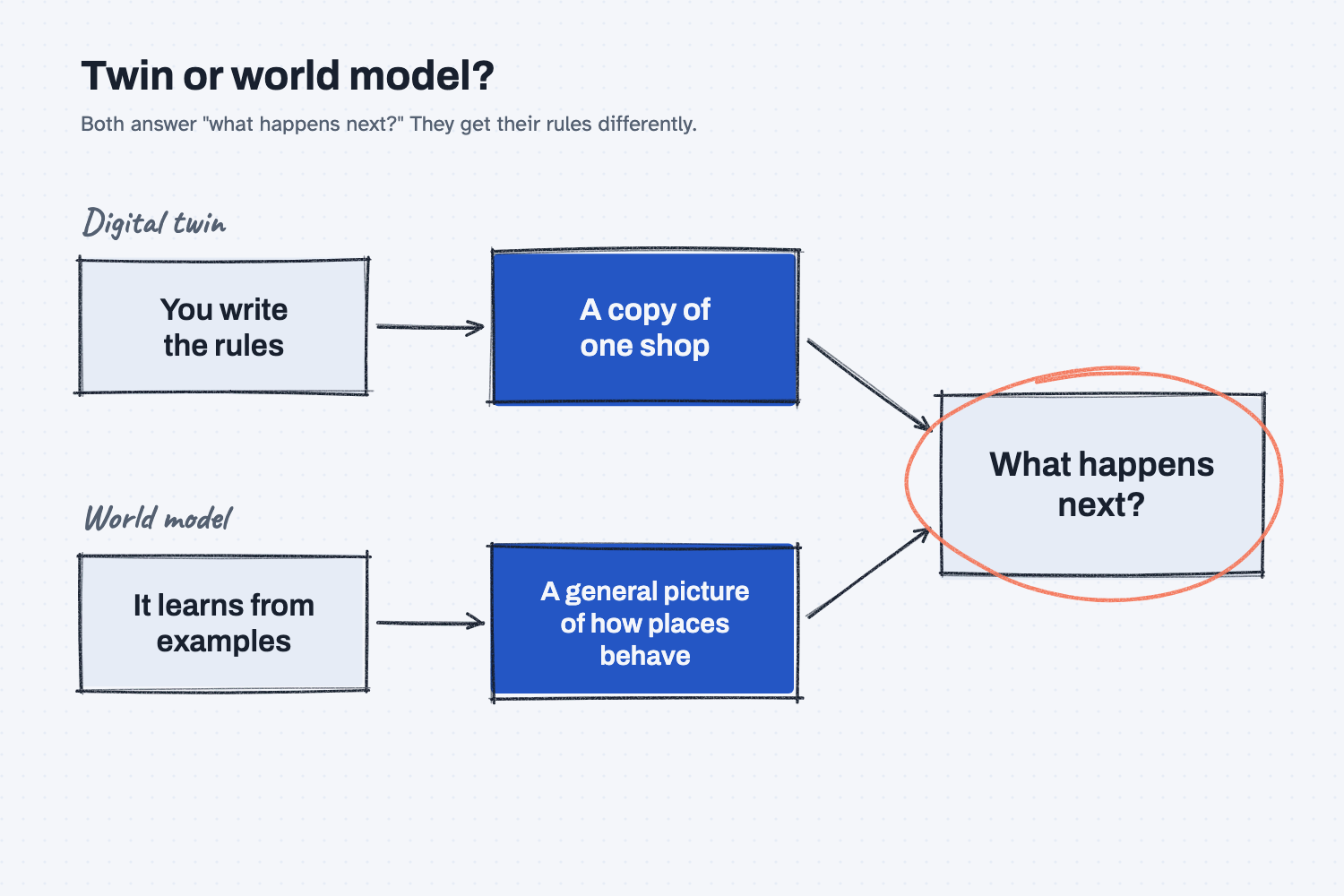
The two paths in the picture start differently, with rules on the left and examples on the right, but they end at the same question, which is what happens next if we do this.
A fair question is how much of this you can use today. NVIDIA, which builds these systems, describes world models as AI that "understand the dynamics of the real world," and says they are used to train robots and to test driving in simulation. The same page admits that results "can produce visually convincing results that are physically incomplete," and says real use needs domain data, closed-loop testing, guardrails, and human review. So the honest summary is that this is mostly research and robot and video work right now, and it has not become a tool for your purchasing desk.
How does it work?
There are three parts to understand, and none of them need math. The model learns from examples, it predicts the next state, and it gets better by being tested against what really happened.
It learns from examples. Instead of being given rules like "a rack that is full cannot take another pallet," it studies many recordings of places behaving and finds the patterns itself. This is the same general idea as other AI, where machine learning means learning patterns from examples.
It predicts the next state, not the next word. A state is a plain snapshot of how things stand, such as the position of every pallet and forklift. Given the snapshot and an action, the model produces the next snapshot, and you can then feed that back in to look further ahead.
It is checked against reality. A prediction is only useful if it matches what really happens, so builders compare the model's guesses to real outcomes and adjust it. This is why the people who build these systems talk about testing so much, and it is why you should ask a vendor how they know it is right for your kind of place.
Where do people get it wrong?
The most common mistake is to assume that because an AI can talk about a warehouse, it understands one. A chat model can describe how a forklift works in fluent sentences without having any reliable picture of where your pallets will be after the next move. You will see why in the test below.
- Treating a chat model as a world model. Chat tools are useful for reasoning through a small, clearly described situation, but they are not trained to track a physical place for you.
- Assuming a good-looking video means a correct prediction. A scene can look real and still break the rules of physics or of your process.
- Skipping the check. Any predicted outcome, like a late order or a jammed aisle, should be compared with what really happens before anyone relies on it.
Try this in 2 minutes
This test asks a chat tool to act like a tiny world model for a warehouse, so you can see what "predict the next state" looks like. You can use any chat tool.
- Open a new chat and paste this:
Here is a tiny warehouse. Rack A holds 4 pallets and is full. Rack B holds 4 pallets and has 1 pallet. A forklift starts at the dock carrying 1 pallet. Rules: a forklift can only put a pallet in a rack that has room, and driving to a rack takes 1 minute. Predict the state of the warehouse after each of these 3 actions: (1) drive to Rack A and put the pallet down, (2) drive to Rack B and put the pallet down, (3) drive back to the dock. Give a short table with columns: step, what happened, Rack A, Rack B, forklift, minutes used. Then one sentence on what you were predicting.
- What you should see is a table where Rack A stays full, because it had no room, and Rack B goes from 1 pallet to 2.
- Check each row yourself, because the whole point is that a prediction must be checked.
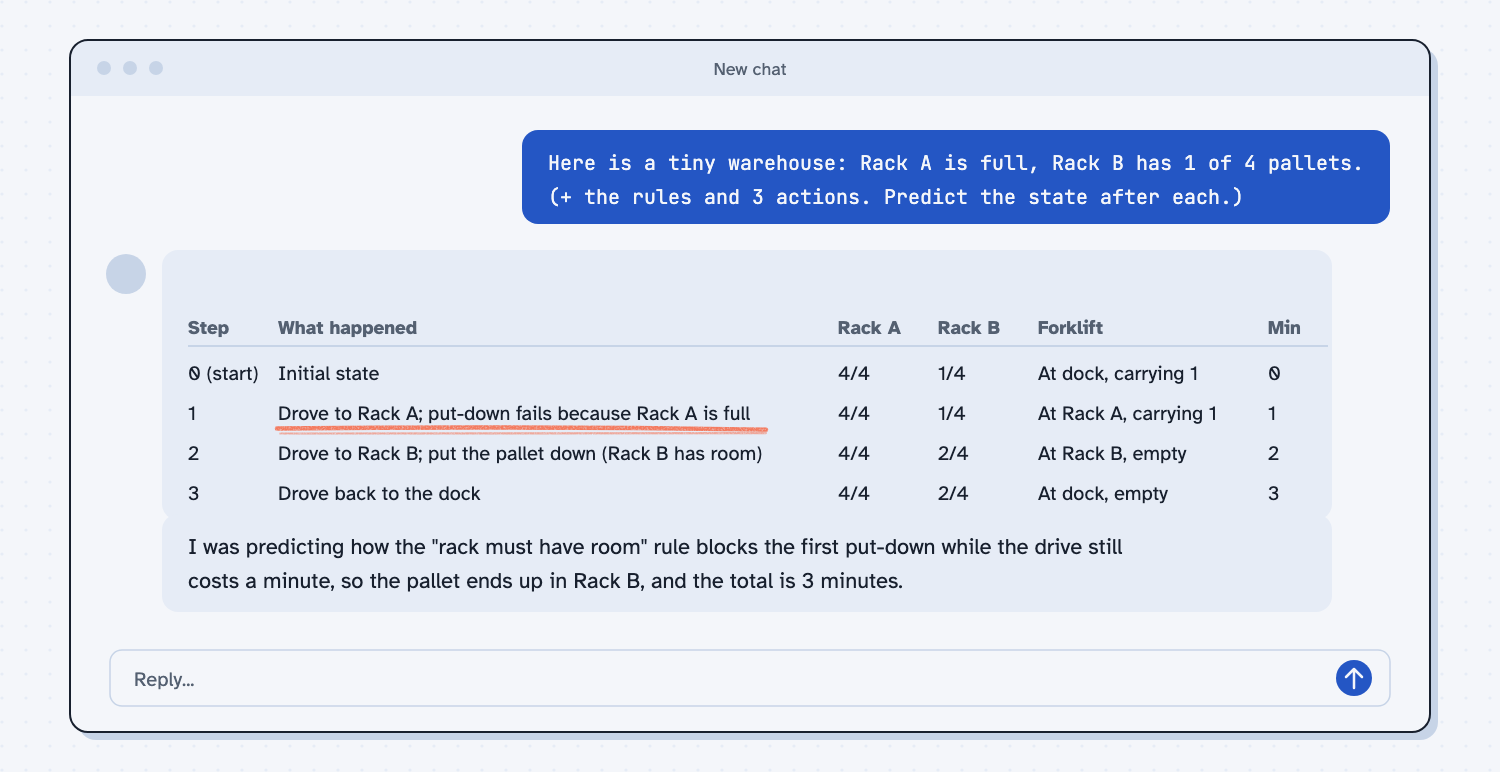
When I tried this, the reply caught the trap in step 1, with the line "Drove to Rack A; put-down fails because Rack A is full." It still charged the minute for the drive, and it ended with Rack B at 2 of 4 and the forklift back at the dock after 3 minutes. It also summed up the job in one line: "I was predicting how the 'rack must have room' rule blocks the first put-down while the drive still costs a minute."
That is the idea in a small size. The chat tool got it right because I wrote the rules in the prompt. A real world model is meant to learn rules like these on its own from many examples, with no one typing them in, and that is the hard part.
Frequently asked questions
What is the difference between a world model and a chat model?
A chat model predicts the next words in text. A world model predicts the next state of a place or thing, such as where objects will be after an action. Some systems combine both, but the jobs are different.
Is a world model the same as a digital twin?
No, but they are related. A digital twin follows rules that people write for one shop. A world model learns how things behave from examples. Both let you ask what happens next before you act.
Can I use a world model at my company today?
Probably not directly. They are mostly used in research, robot training, driving simulation, and video. For testing a shop change, a digital twin is the more practical tool today.
What should I ask a vendor who says they have one?
Ask what data it learned from, how they test its predictions against real outcomes, and where a person reviews the results.
Use it today
- Ask a sample shop twin what-if: try the practical cousin, where you test a change on a copy of a shop.
- Related ideas: what a digital twin is, types of AI, explained, and what an LLM is.
From my training: the site teaches it as "chat models predict words, world models predict what happens next," and then we compare it with a digital twin.