What Is Reinforcement Learning? Learning by Trying and Getting a Score
With Josh Schultz ·
Answer. Reinforcement learning is a way of training AI by letting it try things and giving it a score after each try. Over many tries it learns to repeat what scored well. It is one of the steps used to turn a raw language model into a helpful chat tool.
The picture
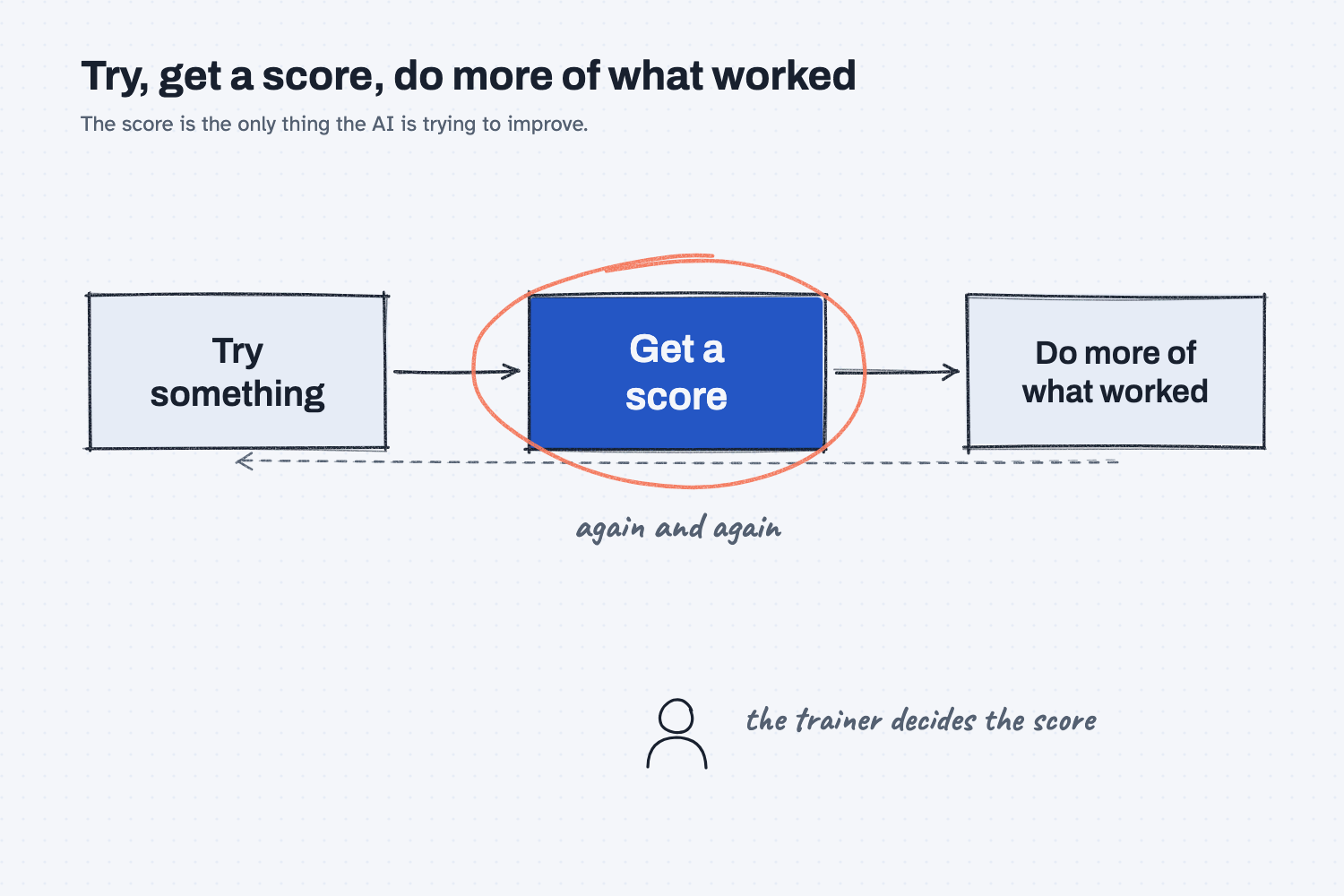
Follow the loop from the left. The AI tries something, such as an answer or a move, and then it receives a score. The score changes what it does next, so it leans toward the tries that scored well, and the loop runs again and again. The circle is on the score because the score is the only thing the AI is trying to improve, and that is where most of the trouble comes from.
Think of it like this
Picture a practice course for new forklift drivers, with cones to weave through, a pallet to place on a marked spot, and a stopwatch. After every run, the trainer gives the driver a score. Nobody explains the physics of steering. The driver just runs the course again and again, notices what raised the score, and does more of it.
That is reinforcement learning. The AI is the driver, the course is the task, and the score is the trainer's feedback. The method works well because the score is a simple signal that a machine can chase millions of times.
Now think about what happens if the trainer scores only on speed. Drivers will cut corners, clip cones, and drop the pallet a little crooked, because the course never told them any of that mattered. The driver is not being sneaky. The driver is doing exactly what the score rewards, and that idea runs through everything below.
Why does it matter at work?
You will hear about it in two places. It is part of how chat tools are trained to be helpful, and it is a way to train a system to make a series of decisions, like routing, by trying options and scoring the results.
The second place also teaches the most important lesson for anyone who sets targets at work. At Mesquite Ridge Metal Works, suppose Jen trains new order-entry operators and gives each one a daily score equal to the number of orders entered. People will rush, skip checks, and grab the easy orders, because that is what raises the number. Someone downstream then spends the afternoon fixing mistakes, and the score never shows that cost.
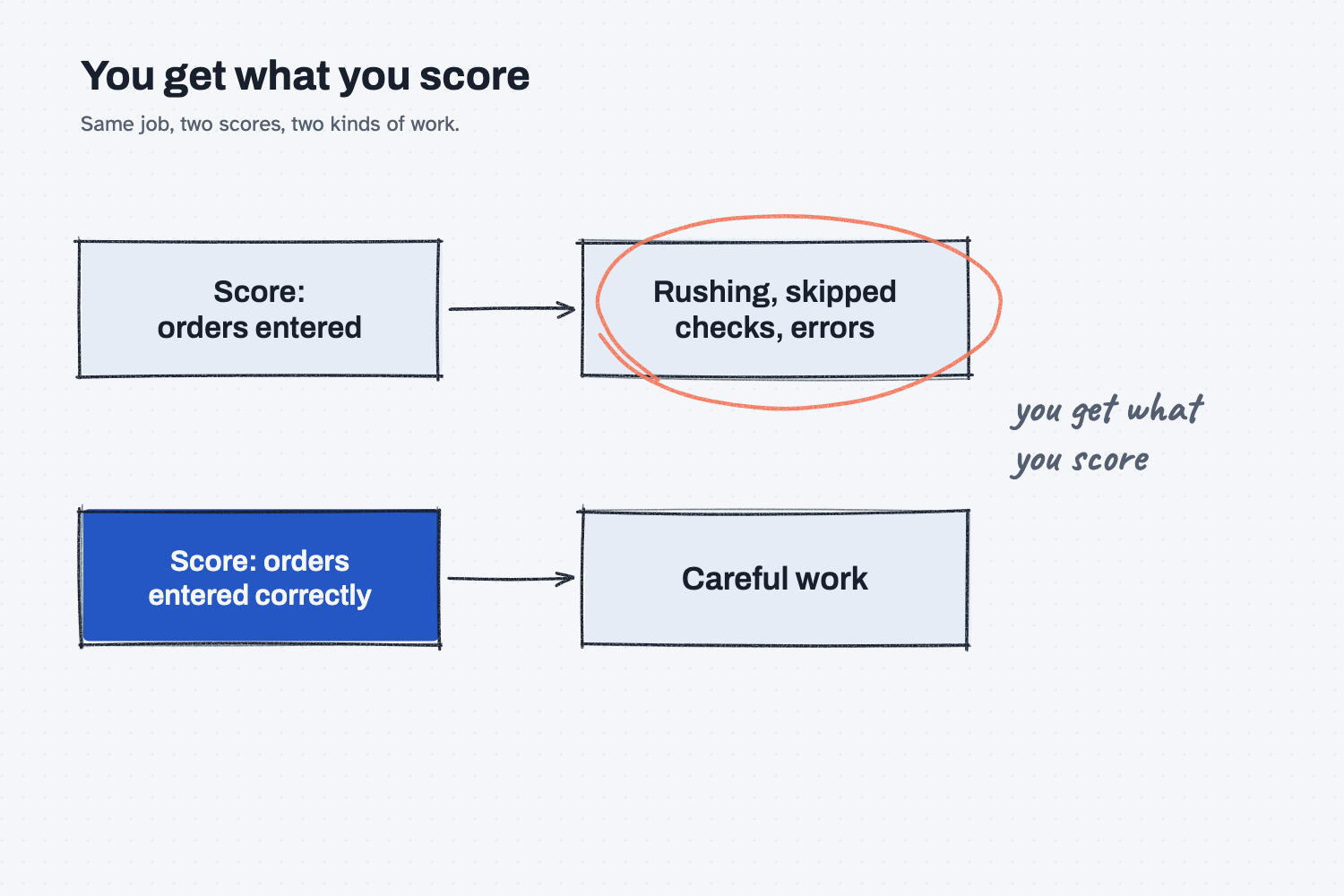
The picture shows two scores for the same job. The one on the left rewards speed alone and produces rushed work, while the one on the right rewards speed that is also correct and produces careful work.
An AI trained on a score behaves the same way, only faster and with more patience than any person. If a vendor tells you their system "optimizes" something, the useful question is what exactly it is being scored on, and what that score leaves out.
How does it work?
There are four parts. The AI tries something, a score comes back, the AI adjusts, and people design the score.
The AI tries something. At first its tries are close to random, so most of them score poorly. It does not know the rules and has to find out by trying, which is why this kind of training needs a great many attempts, usually in a simulation where mistakes cost nothing.
A score comes back. The score can be simple, such as points for a finished job, or it can come from a person. For chat tools, it often comes from people ranking answers. Anthropic's glossary describes it this way: human feedback "consists of ranking a set of two or more example texts," and the training "encourages the model to prefer outputs that are similar to the higher-ranked ones." This is called reinforcement learning from human feedback, or RLHF, and Anthropic says Claude has been trained with it to be a more helpful assistant.
The AI adjusts. Each score nudges the system toward what worked. Nothing is explained to it, and the lesson is only "that did better, so do more like that."
People design the score. This is the part that decides how the AI behaves, and it is where people make most of the mistakes. A researcher has to turn "helpful" into something a machine can measure, and any gap between the measure and the real goal gets exploited. Researchers have found, for example, that human ratings can lean toward answers that agree with the person asking, which is one reason a chat tool may be too eager to please. That is another reason to test an AI tool before you trust it.
Where do people get it wrong?
The biggest mistake is to think that a score measures the real goal. It only measures what someone was able to write down.
- Scoring the easy thing. Counting orders entered is easy, and counting orders entered correctly takes more work, but only the second one is the goal.
- Forgetting the side effects. A score that ignores rework, safety, or customer complaints will quietly trade them away.
- Mixing it up with all of AI. Reinforcement learning is one training method among several, and a chat model also learns from a large amount of plain reading first (see what an LLM is).
Try this in 2 minutes
This test shows "you get what you score." You will ask a chat tool what goes wrong when a training score counts only speed. You can use any chat tool.
- Open a new chat and paste this:
I train new order-entry operators. I plan to give each one a daily score equal to the number of orders they enter. In plain words, what will go wrong with that score? Then suggest a better score in 3 short lines. No jargon.
- What you should see is a list of ways people would game the number, followed by a better score.
- Pick one of your own measures at work and ask the same question about it.
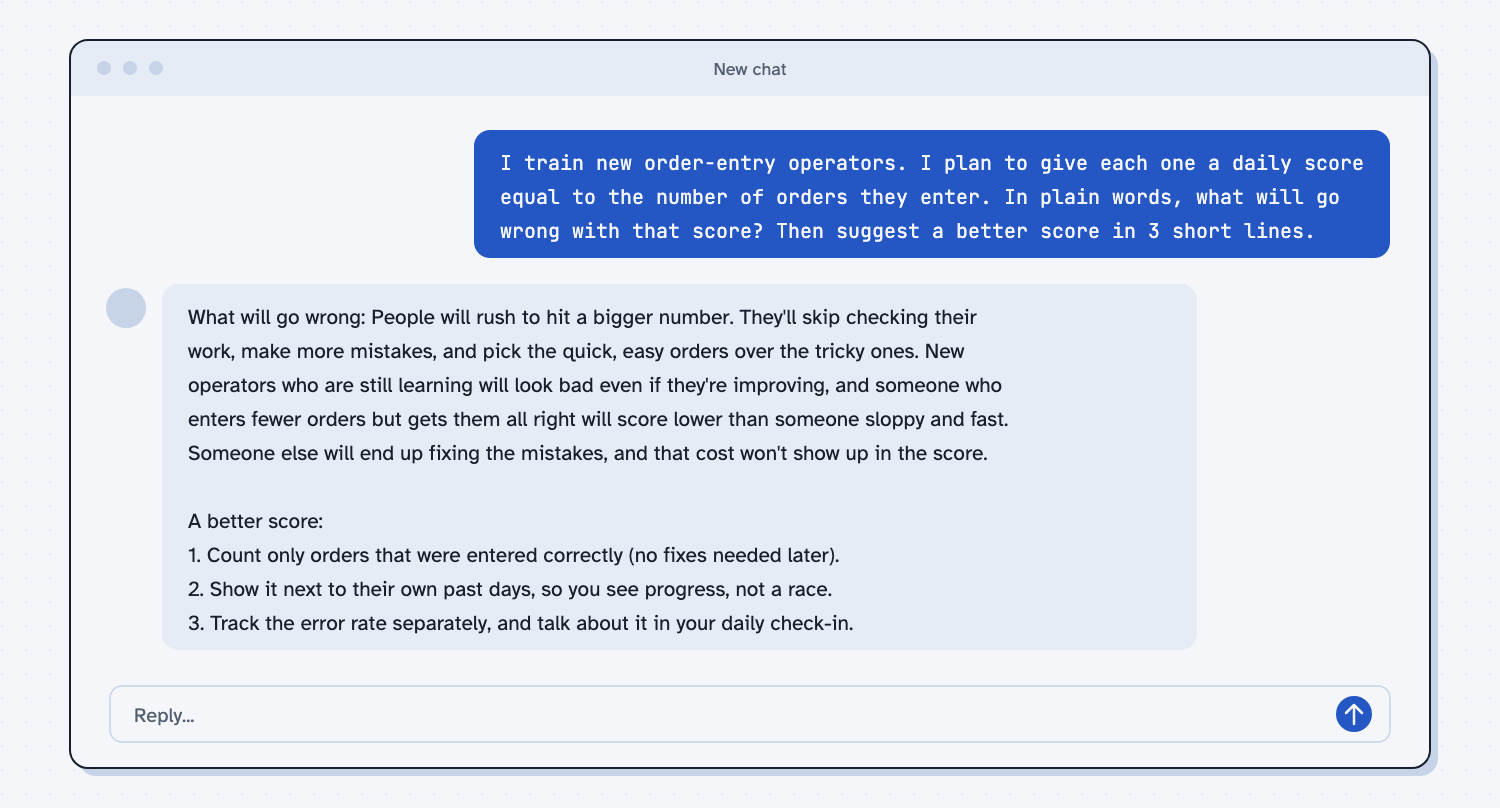
When I tried this, the reply said: "People will rush to hit a bigger number. They'll skip checking their work, make more mistakes, and pick the quick, easy orders over the tricky ones." It also noticed that "Someone else will end up fixing the mistakes, and that cost won't show up in the score." For a better score it suggested to "Count only orders that were entered correctly" and to "Show it next to their own past days, so you see progress, not a race."
Notice that a chat tool can reason about a bad score ahead of time. A trained system cannot, because it only feels the score. It will find the shortcut, and no one is warned.
Frequently asked questions
What is reinforcement learning in simple words?
It is training by trial and score. The AI tries something, gets points for good results, and slowly learns to repeat what earns points. A new driver on a practice course learns the same way.
How is reinforcement learning used to train chat models?
After a model learns language from lots of text, people rank different answers. A score based on those rankings pushes the model toward the answers people preferred, which makes it more helpful and easier to talk to.
Is reinforcement learning the same as machine learning?
It is one kind of machine learning. Other kinds learn from examples that already have the right answer attached. This one learns from a score after each try.
What does "reward design" mean?
It means choosing what the score counts. A badly chosen score gets gamed, so the system does what earns points instead of what you wanted.
Use it today
- Compare supplier quotes every time: a task where you decide what counts as a good answer before you let AI do it.
- Related ideas: make AI check its own work, what is machine learning, and what is a world model.
From my training: the site teaches this with the practice course, and then asks "what is the score counting?" about any target you set.