Make Every Ask Easy to Answer: One Numbered List, One Date
With Josh Schultz ·
Answer. A numbered ask is an email where every question has its own number, every question asks for one thing, and the whole email gives one reply-by date. The supplier can answer line by line, and you can match each reply to its question without guessing, so fewer questions fall through the cracks.
The picture
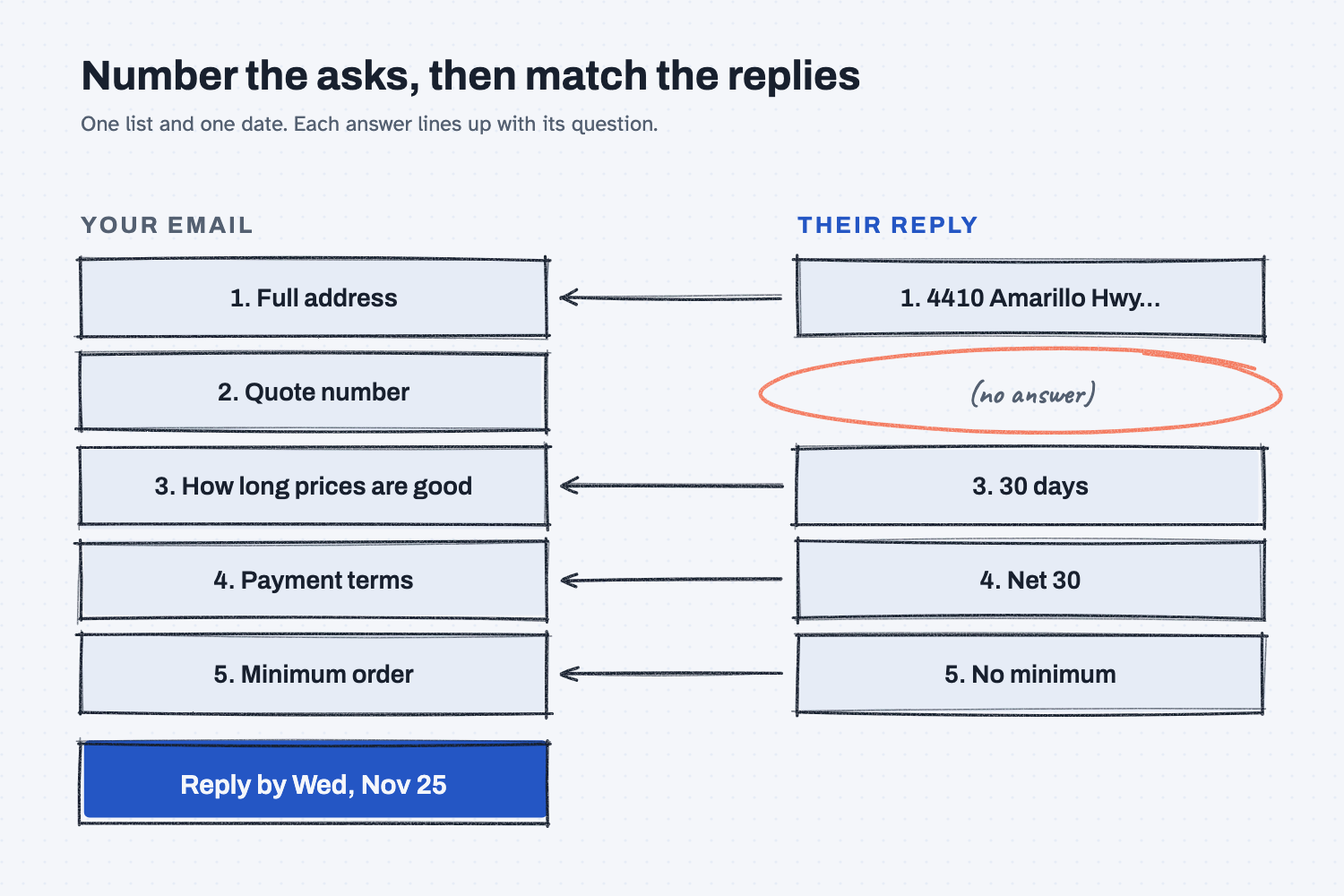
On the left is the email you send, with five questions numbered one to five and a single date at the bottom. On the right is the reply, where the supplier answered by number. Each arrow connects an answer to the question it belongs to, and because the numbers line up, the gap shows up right away. There is no answer next to number 2, so you know exactly what is still missing without rereading anything.
Think of it like this
Think about the difference between a paper form and a letter. When a supplier fills out a form with numbered boxes, the answer to box 3 goes in box 3, and an empty box is easy for both of you to see. When you write a letter and tuck your questions into paragraphs, the supplier has to dig out the questions before answering them, and you have to dig through the reply to figure out which answer belongs to which question.
A numbered ask is the form version of an email. The supplier does less work to answer, and you do less work to read the answer, and that is why more of the questions get answered.
Why does it matter at work?
It matters because a follow-up email only helps if it gets answered completely, and a question that is hard to find is a question that gets skipped. Nobody means to skip it, but a busy person replying between phone calls will answer what is easy to see.
Here is an example from the sample company, Mesquite Ridge Metal Works. Dana Ortiz, a buyer, needs five things from Panhandle Bar and Plate: the full address, a quote number, how long the prices are good, the payment terms, and the minimum order. If she writes one friendly paragraph, Mike at Panhandle has to find five questions inside it, and he might answer three. If she sends five numbered lines with a reply-by date, Mike can type "1. 4410 Amarillo Hwy, Hereford, TX 79045" and keep going down the list.
This is also how the supplier follow-up guide builds every email. A script picks the asks, and a fixed template turns them into one numbered list, as covered in the guide on emailing suppliers.
How does it work?
There are three parts. Each question gets its own number, each question asks for only one thing, and the email gives one specific date.
Each question gets its own number. The number gives the supplier a way to answer ("3. 30 days") and gives you a way to check. When you read the reply, you go down your own list and look for each number, so a missing number is easy to spot.
Each question asks for one thing. "Your address and a quote number" is two questions wearing one number, and a supplier may answer only the first. Split it into two lines, so each one can be answered or left open on its own.
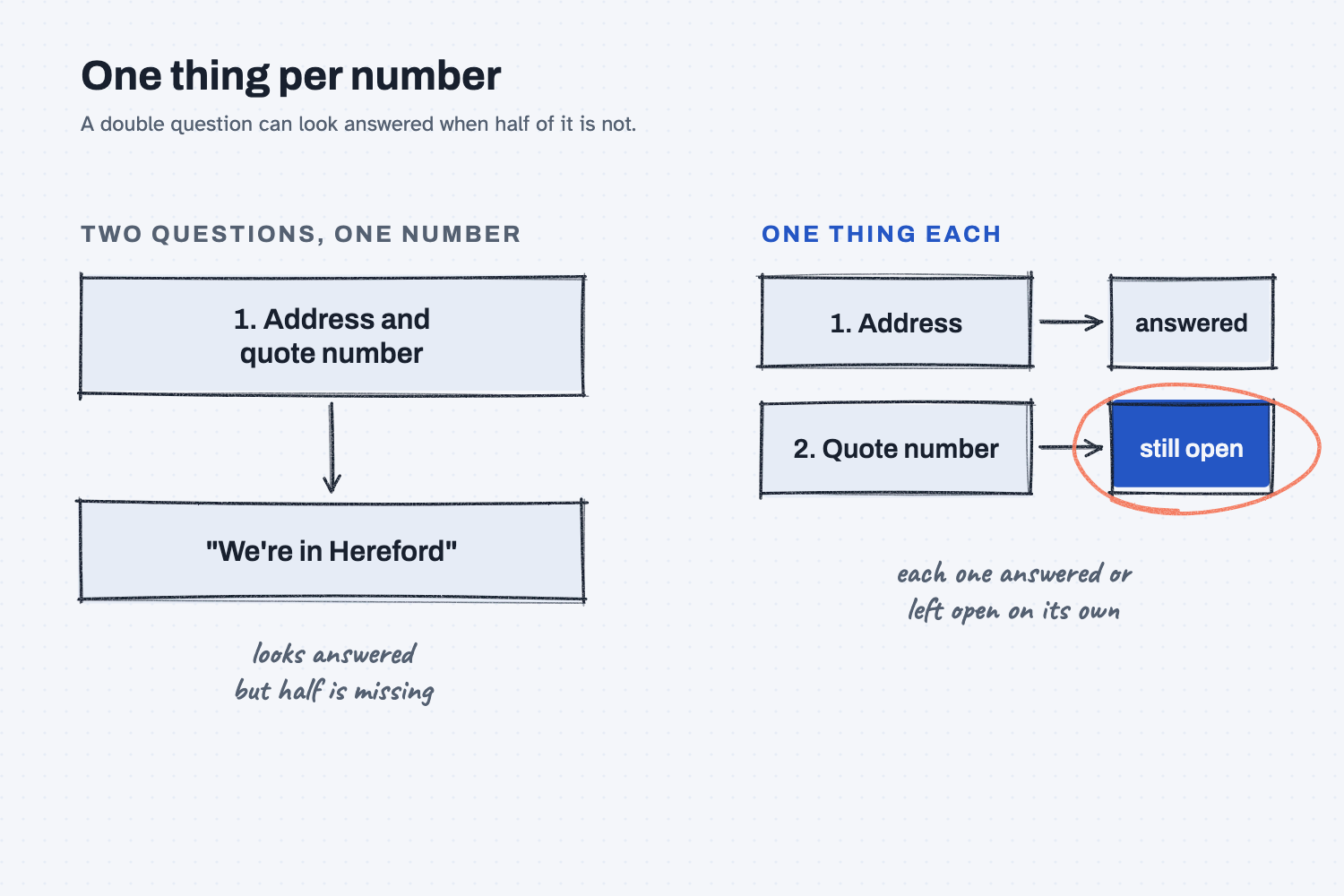
The picture shows why the split matters. On the left, one answer makes the line look finished even though half of it is missing, and on the right, the same two questions on two lines let the missing half stand out.
The email gives one reply-by date. "Soon" and "when you can" mean something different to everyone who reads them. A real date, like Wednesday, November 25, tells the supplier when you need it and tells you when to follow up. One date for the whole email is also easier to track than a different date for each question.
When the same template builds every email, as in the guide, the list is the same shape each time. That is a small example of giving AI a form to fill in, and it also means the replies come back in a shape you can put back into your data.
Where do people get it wrong?
Most mistakes come from making the supplier do the sorting. These are the four I would watch for.
- The questions are buried in a paragraph. A friendly paragraph feels polite, but the supplier has to hunt for what you want, and some questions get missed.
- Two questions share one number. One answer to a double question looks like a full answer, so you may not notice half of it is missing.
- The deadline is a feeling. "As soon as you can" gives the supplier nothing to act on and gives you no date to follow up.
- The list changes from email to email. If one supplier gets five bullets and another gets a paragraph, you have to relearn how to read every reply. A script that gives the same result each time keeps the shape steady.
Try this in 2 minutes
This test gives AI the same questions in two forms, a paragraph and a numbered list, plus a reply to each. You ask it to match each reply to the question it answers. You can use any chat tool.
- Open a new chat and paste the first version, the paragraph:
Below is an email I sent a supplier and the reply I got. Match each part of the reply to the question it answers, and tell me which of my questions got no answer.

My email:
"Hi Mike, thanks for the quote. Could you send us your address, and a quote number if you have one, and let us know how long the prices are good, what your payment terms are, and whether there is a minimum order? We need this soon. Thanks, Dana"

His reply:
"Hi Dana, we are out in Hereford. Net 30 works for us, and prices are good for a month. Mike"
- Then open another new chat and paste the numbered version:
Below is an email I sent a supplier and the reply I got. Match each part of the reply to the question it answers, and tell me which of my questions got no answer.

My email:
"Hi Mike, thanks for the quote. To finish our comparison, please send:
1. Your full address
2. A quote number we can put on our PO
3. How long the prices are good
4. Your payment terms
5. Your minimum order
Please reply by Wednesday, November 25. Thanks, Dana"

His reply:
"Hi Dana,
1. 4410 Amarillo Hwy, Hereford, TX 79045.
3. 30 days.
4. Net 30.
5. No minimum.
Mike"
- Compare the two replies. In both versions the quote number never got an answer. Look at how sure the AI is about that gap, and how much it has to interpret along the way.
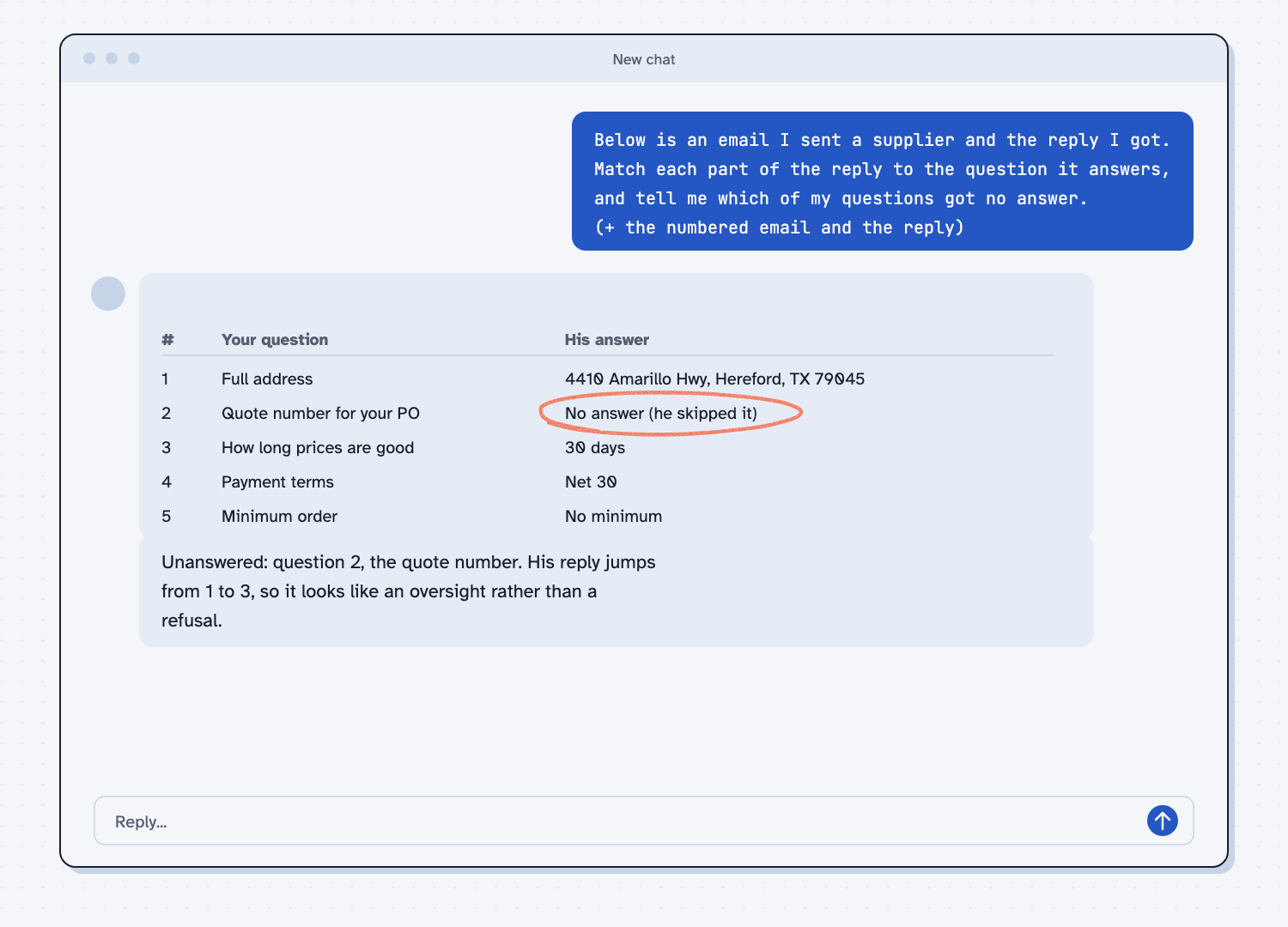
When I tried this, the paragraph version made Claude work harder. It had to decide that "we are out in Hereford" was only a town, so it called that a partial answer: "'Hereford' gives you the town but not a street address or zip." For the quote number it could only say, "He didn't mention one, so either he doesn't have one or he skipped it."
With the numbered list, the reply was cleaner. Claude put the answers in a table that matched your numbers, and said: "Unanswered: question 2, the quote number. His reply jumps from 1 to 3, so it looks like an oversight rather than a refusal." The AI was able to do that because the numbers carried the structure, and you can do the same thing by eye when a real reply comes in.
Frequently asked questions
Is a numbered list too formal for a supplier I know well?
No. A short numbered list reads as considerate, because it respects the supplier's time. You can still write a warm opening and a thank-you line around it, and the numbers only apply to the asks.
How many questions should one email have?
Only the ones you truly need answered. Five or six is easy to answer in one sitting. If you have many more, ask yourself which ones can wait, because a long list is also easier to skip.
What if the supplier answers in a different order?
That is fine, because the numbers tell you which answer goes where. Go down your list and check each number against the reply.
Does this work for emails to coworkers and customers too?
Yes. Any email that needs several answers gets better with numbers and one date, whether you are asking a coworker for a status update or a customer for missing paperwork.
Use it today
- Email suppliers about what's missing from their quotes: every draft uses one numbered list and one reply-by date.
- Related idea: Put the answer back in the data, what to do once the reply comes in.
- Related idea: Show AI one finished example, the same idea pointed at AI instead of a supplier.
From my training: the supplier follow-up workflow, where every email has the same numbered list, a reply-by date, and a sign-off.