What Is an AI Harness? The Model Is the Engine, the Harness Is the Truck
With Josh Schultz ·
Answer. A harness is the setup built around an AI model that gives it its instructions, its files, its tools, and its rules, and that runs the loop of thinking and acting. The model is the engine that supplies the power, and the harness is the truck that turns that power into useful work. That is why the same model can behave very differently in two different apps.
The picture
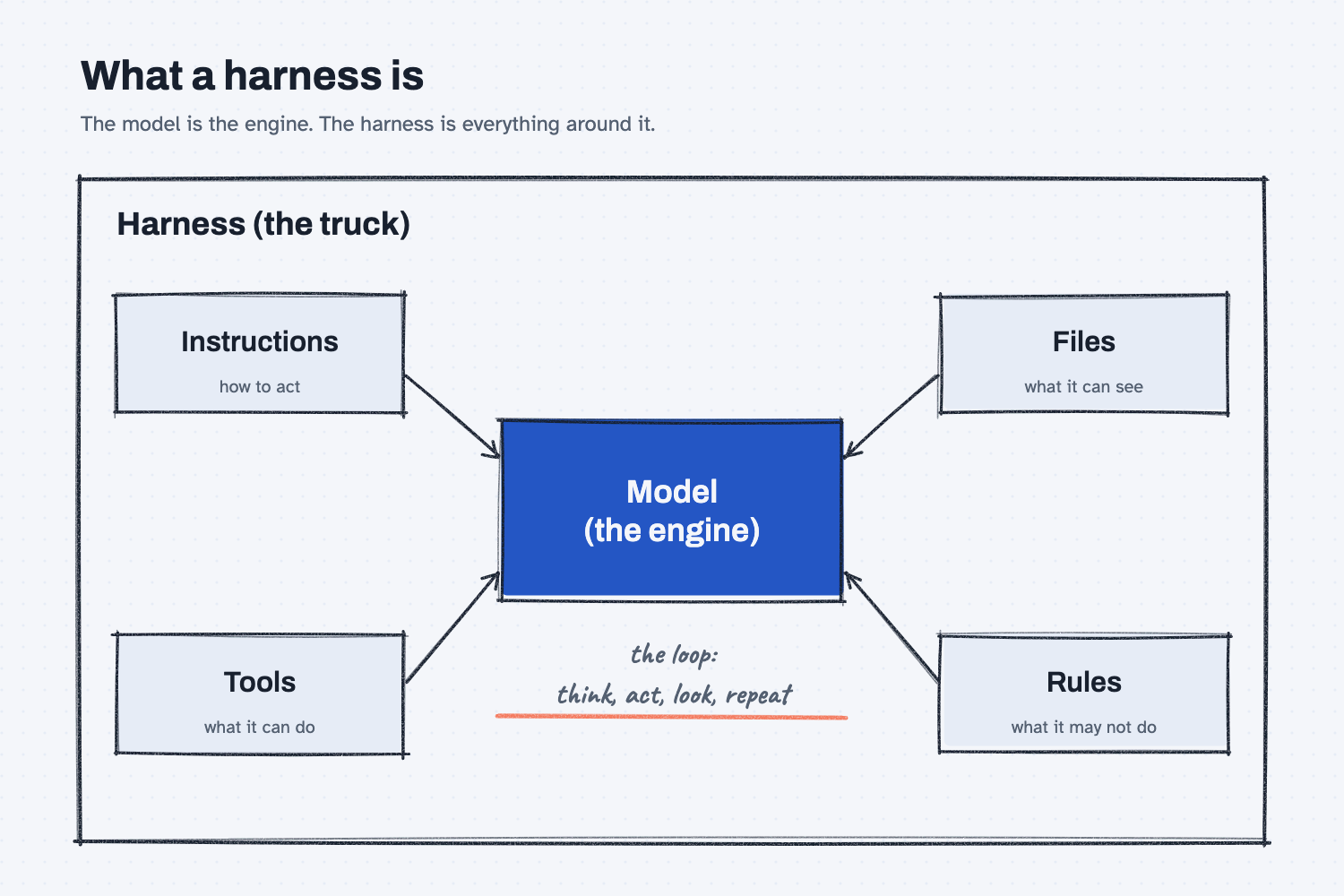
The large box is the harness, and the blue box in the middle is the model. Around the model are the four things a harness supplies, which are the instructions it starts with, the files it can see, the tools it can use, and the rules it must follow. The note under the model describes the loop, where the model decides something, the harness carries it out, and the result goes back in for the next decision. Everything outside the blue box is the harness, and that is the part you get to choose.
Think of it like this
An engine on a workshop floor is impressive, and it is also useless. It makes power, but it has no wheels, no steering, no cargo bed, and nobody to tell it where to go. To get work out of it you put it in a vehicle.
The same engine can go into a pickup, a school bus, or a dump truck, and each one drives differently even though the power underneath is identical. What the vehicle does depends on how it was built around the engine.
An AI model is the engine, and the harness is the vehicle. The model on its own can only take in text and write text back. The harness is what lets it work out of a particular truck, with a particular job and a particular set of controls.
Why does it matter at work?
It matters because when you judge an AI tool, you are almost never judging the model alone. You are judging the model plus the harness, and the harness often explains the difference between a tool that helps and one that frustrates.
Consider Hector Lee, the planner at Mesquite Ridge Metal Works. He tries the same underlying model in two places. In one app, it has no files and a short set of default instructions, so it gives a general answer about scheduling. In another, the harness hands it his shop file, tells it to answer as a planner would, and lets it open the open-orders spreadsheet. The second answer is far better, and the model did not get smarter. The truck got better.
So when you pick a tool, do not only ask "which model is it?" Ask what instructions it starts with, what files and systems it can reach, and what it will not do without your approval. (Which AI tool should I use walks through the choice.)
How does it work?
A harness has four jobs, and a fifth that holds the others together. It gives instructions, supplies files, offers tools, enforces rules, and runs the loop.
It gives the model its instructions. Before you type anything, a harness usually hands the model standing instructions, such as how it should answer and what to avoid. You never see them, but they shape every reply (see what a system prompt is), which is one reason the same model feels different from app to app.
It supplies the files and memory. A model only knows what is on its desk, which is the idea behind the context window. The harness decides what gets put there, whether that is your uploaded files, a project folder, or notes it saved earlier. Some harnesses read a plain text file of instructions at the start of every session, so your shop's rules are already in front of the model.
It offers tools. A model cannot open a spreadsheet or send an email by itself, so the harness does those things for it (see how AI uses tools and scripts). A tool the harness does not offer is a tool the model cannot use, however clever it is.
It enforces the rules. The harness is where permissions live. It can let the model read files but not change them, or ask you before it sends anything, as described in AI tools and permissions. Because the harness is the thing that actually does the acting, the rules in it are stronger than a polite request in a prompt.
It runs the loop. An agent works by repeating a cycle: the model decides on a step, the harness carries it out, and the result is shown back to the model so it can decide the next step. Anthropic describes agents as "typically just LLMs using tools based on environmental feedback in a loop." The harness is the part that keeps the loop going until the job is done or it needs you.
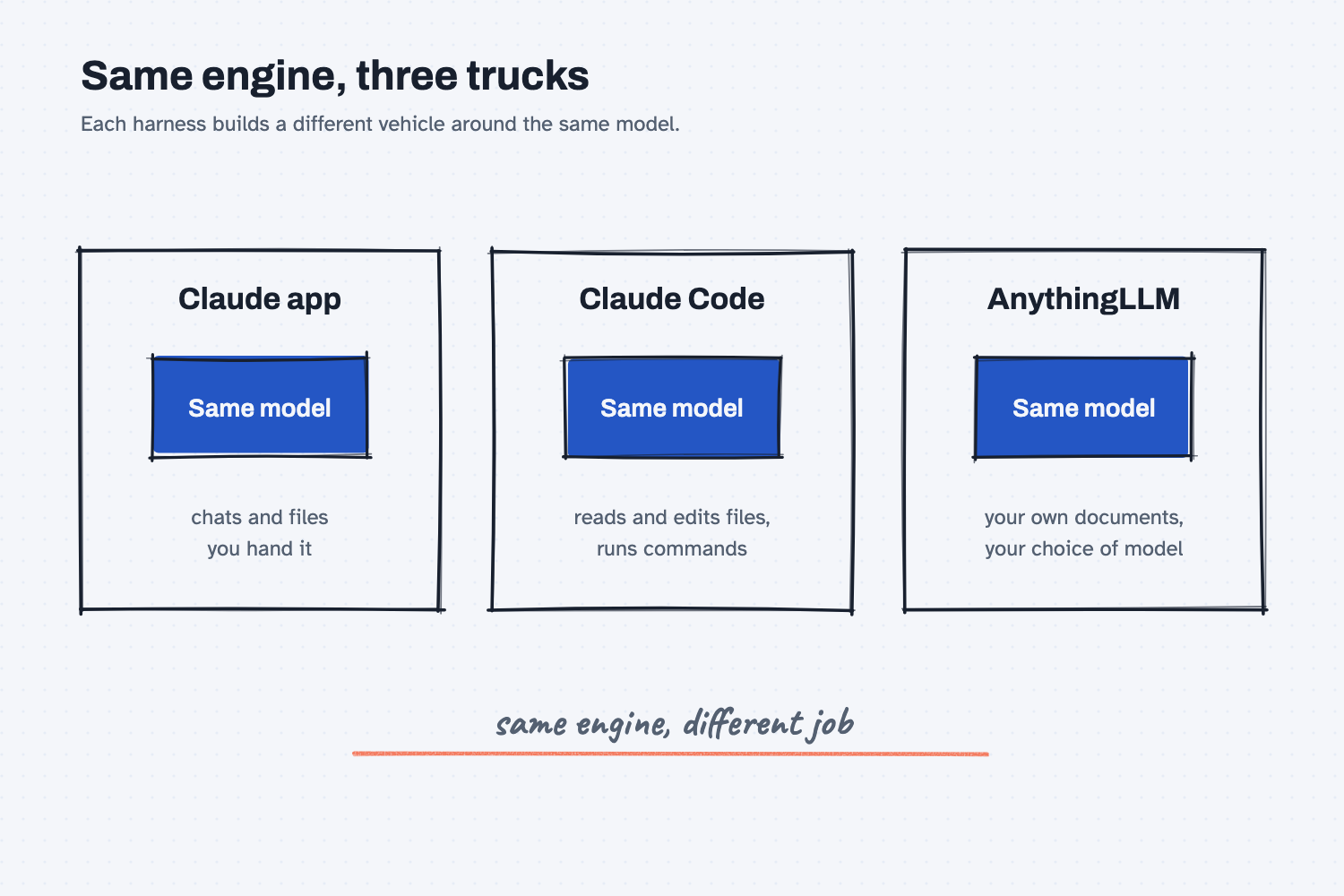
You have probably already used harnesses without the name. The Claude app, Claude Code, and AnythingLLM are all harnesses. Claude Code is built to read and change files on a computer and run commands, so its truck is made for that work. The Claude app is built for conversations and files you hand it. AnythingLLM is an app that you can set up with your own documents and with a choice of models inside it. Each wraps a model in a different way, so each one drives differently.
Where do people get it wrong?
Most mistakes come from treating the model as the whole product. These are the ones I see most.
- Blaming or crediting the model for everything. If an answer is poor, the model may be fine and the harness may simply have given it the wrong files or no instructions. Check what the tool can see before you judge it.
- Expecting the same behavior everywhere. A prompt that works in one app may do something different in another, because the instructions, tools, and rules around the model are different. Test it again in each place.
- Ignoring what the harness is allowed to do. The permissions live in the harness, so read them. A tool that can change files or send messages needs more care than one that can only talk.
Try this in 2 minutes
This test asks AI to explain a harness with the engine and truck comparison, and to say why one model acts differently in two apps. You can use any chat tool.
- Open a new chat and paste this:
I am not technical. In 4 plain sentences, explain what a harness is for AI, using the comparison that the model is the engine and the harness is the truck. Then tell me in 2 sentences why the same AI model can act differently in two different apps.
- Check that the explanation names what the harness supplies, such as tools, instructions, and rules.
- Think of two AI apps you have used, and write one difference you noticed between them.
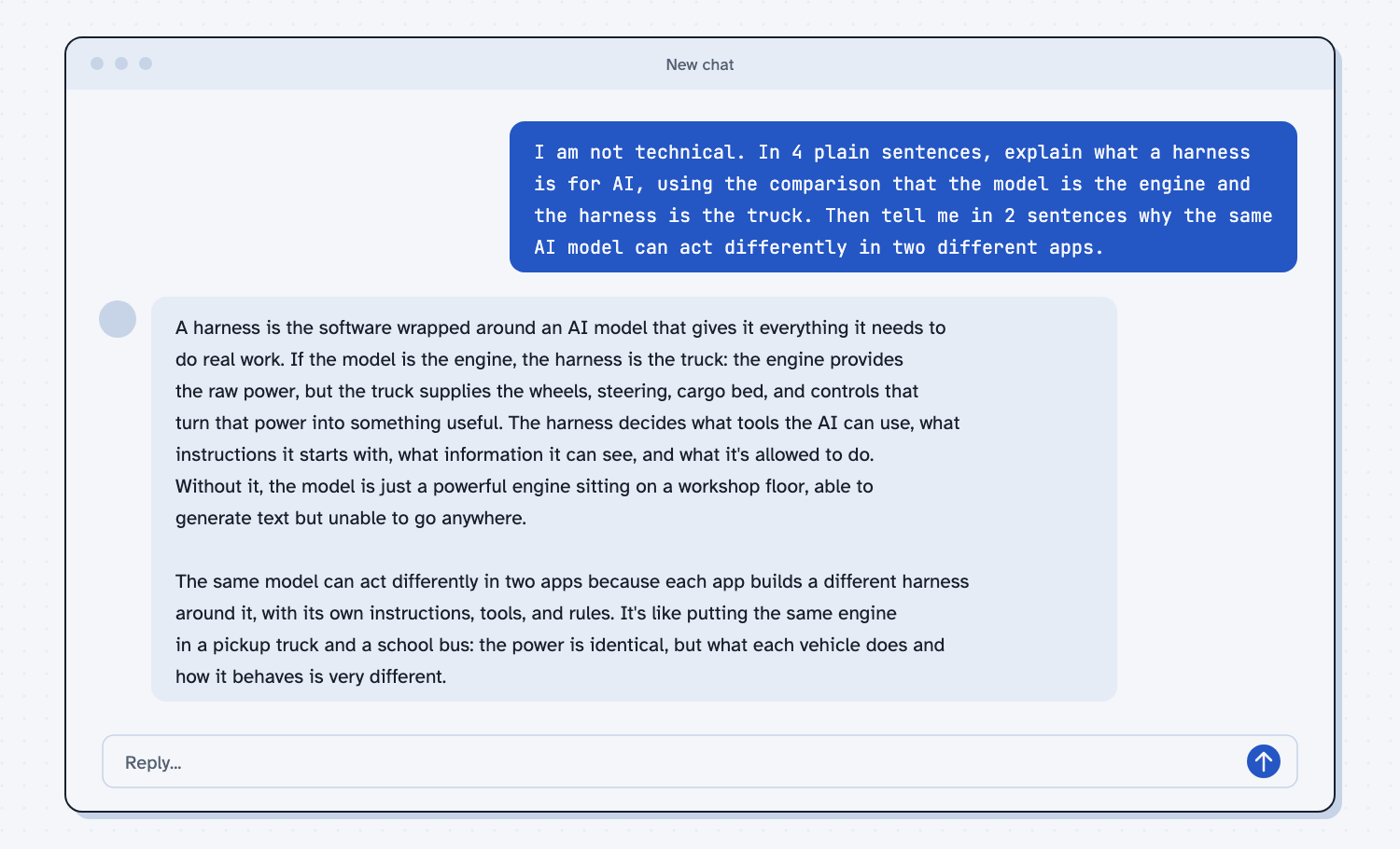
When I tried this, the reply said "If the model is the engine, the harness is the truck: the engine provides the raw power, but the truck supplies the wheels, steering, cargo bed, and controls that turn that power into something useful." It added that the harness "decides what tools the AI can use, what instructions it starts with, what information it can see, and what it's allowed to do."
The closing two sentences gave the answer to the second question: "each app builds a different harness around it, with its own instructions, tools, and rules." That is the reason a test of one app tells you little about another, even when both say they use the same model.
Frequently asked questions
What is the difference between a model and a harness?
The model is the part that reads and writes, and it does the thinking. The harness is everything around it that supplies instructions, files, tools, and rules, and that carries out the model's choices. You need both to get work done.
Is Claude a model or a harness?
Both words get used for it. Claude is the name of the model family, while the Claude app and Claude Code are harnesses built around those models. Other companies and open tools build their own harnesses around their own models.
Why does the same AI give different answers in different apps?
Because each app puts different instructions, files, tools, and rules around the model. The engine is the same, but each truck is built for a different job, so the results differ.
Do I need to build a harness?
Usually not, because you pick one that fits your work. What you do control is what goes in, such as your files, your instructions, and your permissions, and this site shows how in what an AI skill is.
Use it today
- Turn a good chat into a reusable skill: put your own instructions into the harness so every answer starts from your rules.
- Related idea: What is a system prompt.
- Related idea: How AI uses tools and scripts.
- Related idea: Chat vs agent.
From my training: this site teaches the model as the engine and the harness as the truck, because the truck is the part you get to choose and set up.