Count It Before You Argue: A One-Week Tally Beats Everyone's Guess
With Josh Schultz ·
Answer. Count it before you argue means you keep a simple tally of how often something really happens, for one week, before anyone debates it. A tally is a sheet with one row or mark each time the thing happens. The number from a week of marks settles the argument, and it is often different from what everyone remembered.
The picture
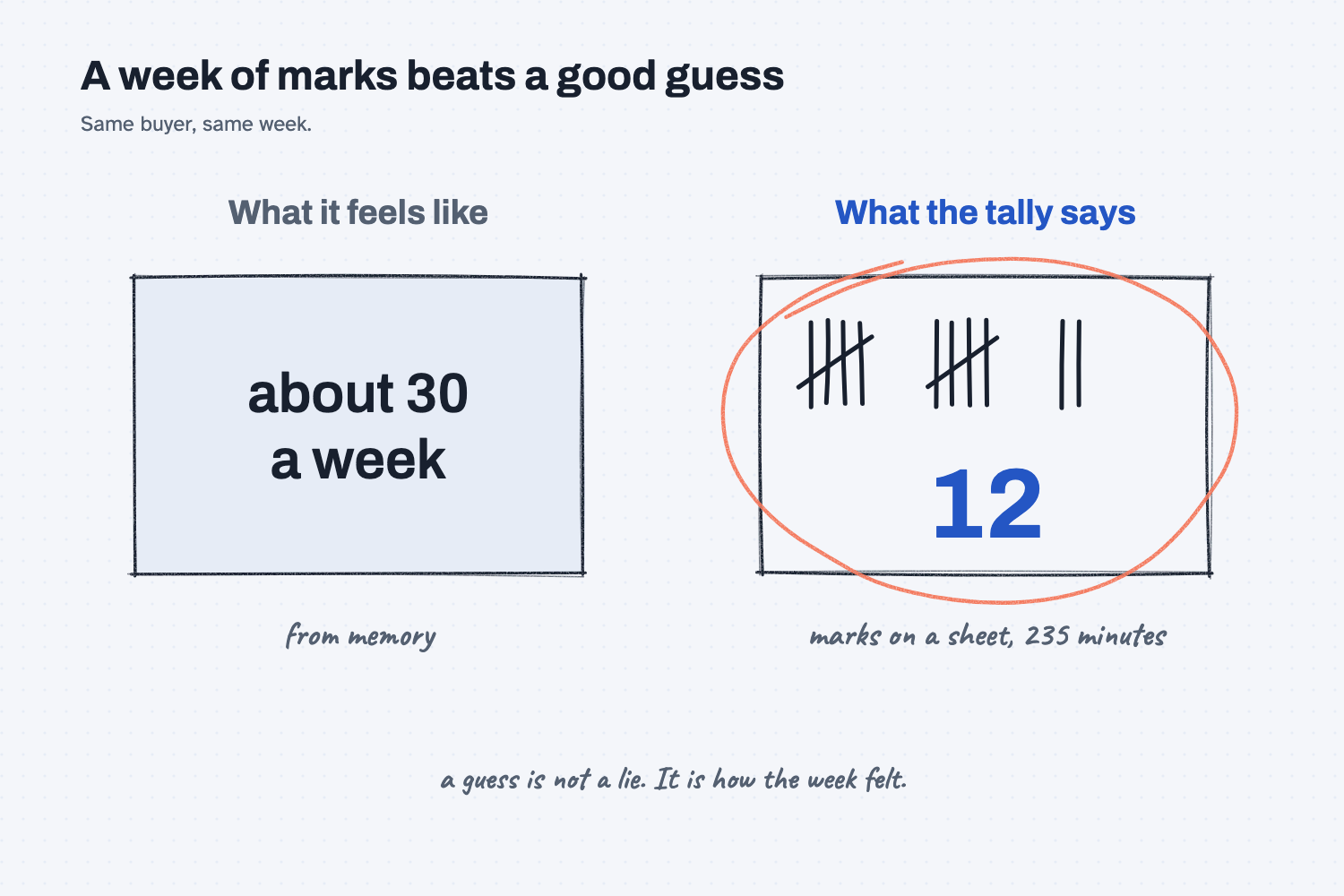
Both boxes describe the same buyer in the same week. The one on the left is what it felt like, and the one on the right is what a sheet of marks says. The gap between thirty and twelve is not a lie on anyone's part. It is what happens when the hard days stay in memory and the easy ones fade, which is true of everybody.
Think of it like this
Picture a clipboard hanging by the dock door. Every time a truck arrives, someone makes a mark. If you ask ten people how many trucks come in on a normal day, you will get ten answers, and each person will defend theirs. If you read the clipboard on Friday, you get one number, and the conversation changes from "I think" to "here is what happened."
That clipboard is all a tally is. It costs almost nothing, and it can end an argument that a long meeting would not.
Why does it matter at work?
It matters because the size of a problem decides the size of the fix. If everyone believes thirty and the truth is twelve, you may pay for a big solution to a small problem, or you may skip a fix because the problem seemed rare.
Dana is the senior buyer at Mesquite Ridge Metal Works, and she was sure she chased about thirty late purchase orders a week. She kept a tally for one week, with a row for every chase and the minutes it took. The sheet said twelve chases and 235 minutes, which is about 3.9 hours. Three of those chases were for steel that was already on the dock, and two were repeat questions about dates she already had. Her guess was an honest feeling, not a lie. But the real numbers pointed at a different fix, which was to give each promise date one home instead of keeping it in four places. The same pattern shows up in the guide on cleaning up a process.
How does it work?
There are four steps. You decide what counts as one, you write a row each time it happens, you stop after one week, and you read the numbers together before you talk about fixes.
In my process coaching notes, I put the principle this way: "Count it before you argue about it. When two people remember the same thing differently, a week of marks on a tally sheet settles it and no amount of discussion will."
Decide what counts as one. Before the week starts, write one sentence that says what earns a mark, because two people will count the same day differently if they do not. This matters more than it sounds, as the test below shows.
Write a row when it happens. Add the day, what it was about, and how long it took. Do it in the moment, not at the end of the day, because by evening memory has already started rounding.
Stop after one week. A week is long enough to see a pattern and short enough that people finish it. If it was an odd week, such as a holiday or a plant shutdown, count another one.
Read the numbers together, then talk. Total the rows, look at the biggest group, and look for anything that surprises you. Only then should the discussion begin, and it will usually be a smaller one.
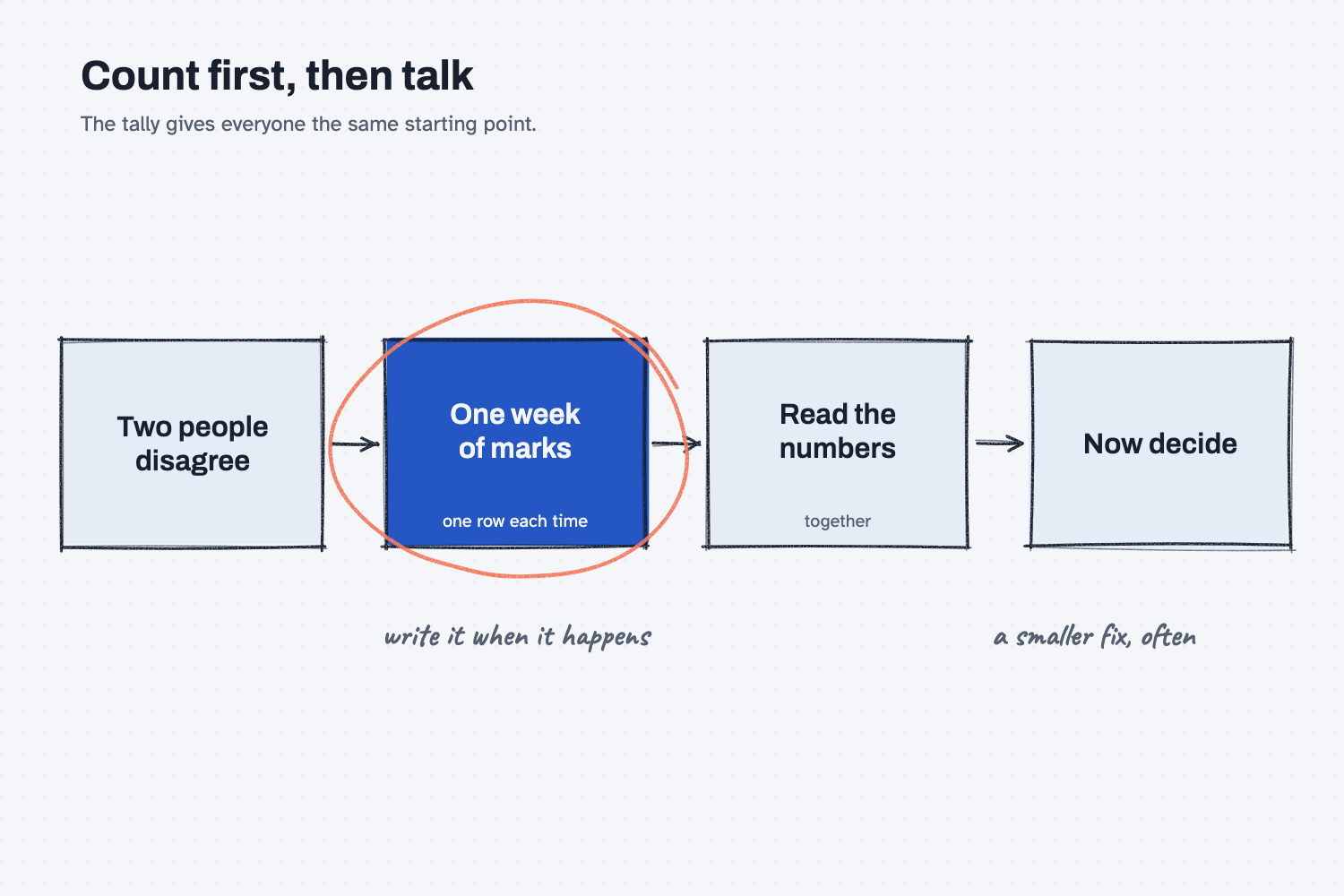
A tally can feed other work, too. In the guide on making a repeat mistake impossible, one week of mistakes showed that eight of twenty real mistakes were a wrong ship-to address, more than any other kind. That told the team where to look, and it is also how you decide what to fix first.
Where do people get it wrong?
Most mistakes come from how the marks are made, not from the idea itself.
- The tally is written from memory. Marks added on Friday for the whole week are just a better-looking guess, so write each one when it happens.
- The definition changes in the middle of the week. If "a chase" meant a phone call on Monday and any message by Thursday, the total means nothing, so write the rule down first.
- The tally becomes a way to blame someone. The sheet is about the work, not the person, so say that out loud before anyone starts counting.
- The tally is skipped because it feels too simple. A sheet of marks is cheap, but it often changes the decision, so it earns its place before any software does. (Never automate a mess.)
Try this in 2 minutes
This test uses Dana's real tally rows from the sample company. You will first ask AI to confirm a guess, and then give it the rows. Any chat tool works.
- Open a new chat and paste this:
Our senior buyer says she chases about 30 late purchase orders a week. Is that right? Answer in a few lines.
- Open a second new chat and paste this:
Here is a week of tally marks. Each line is one time our buyer chased a late purchase order.
Mon 11/9, PO 40211, Red Creek Steel Supply, Ray via Teams, 25 min, new date 11/13
Mon 11/9, PO 40198, Panhandle Bar and Plate, Monday past-due report, 15 min, already on our dock since Friday
Mon 11/9, PO 40225, Blue Heron Coatings, Hector walked over, 20 min, new date 11/16
Tue 11/10, PO 40230, Lone Oak Harness, Ray via Teams, 10 min, new date 11/12
Tue 11/10, PO 40207, Red Creek Steel Supply, Hector walked over, 35 min, no reply by noon, called Marco, new date 11/17
Tue 11/10, PO 40219, Bolt Barn Industrial, Monday past-due report, 10 min, already on our dock since Monday
Wed 11/11, PO 40233, Kestrel Electronics, Hector walked over, 30 min, no answer yet (overseas)
Wed 11/11, PO 40211, Red Creek Steel Supply, Ray via Teams, 10 min, asked again, same date as Monday
Thu 11/12, PO 40236, Cedar Flats Metals Service, Ray via Teams, 15 min, called the counter, ships 11/13
Thu 11/12, PO 40240, Northbay Circuit Assembly, Hector walked over, 20 min, new date 11/19
Fri 11/13, PO 40229, Blue Heron Coatings, Friday walk-around, 25 min, already on our dock since Wednesday
Fri 11/13, POs 40225, 40207, 40230, Friday walk-around, 20 min, asked again, same dates as earlier in the week
How many chases was that, how many total minutes, and how many chases were for material already on our dock? Answer in three short lines.
- Here is what I expect: 12 chases, 235 minutes, and 3 chases for material already on the dock. Add up the minutes yourself to check.
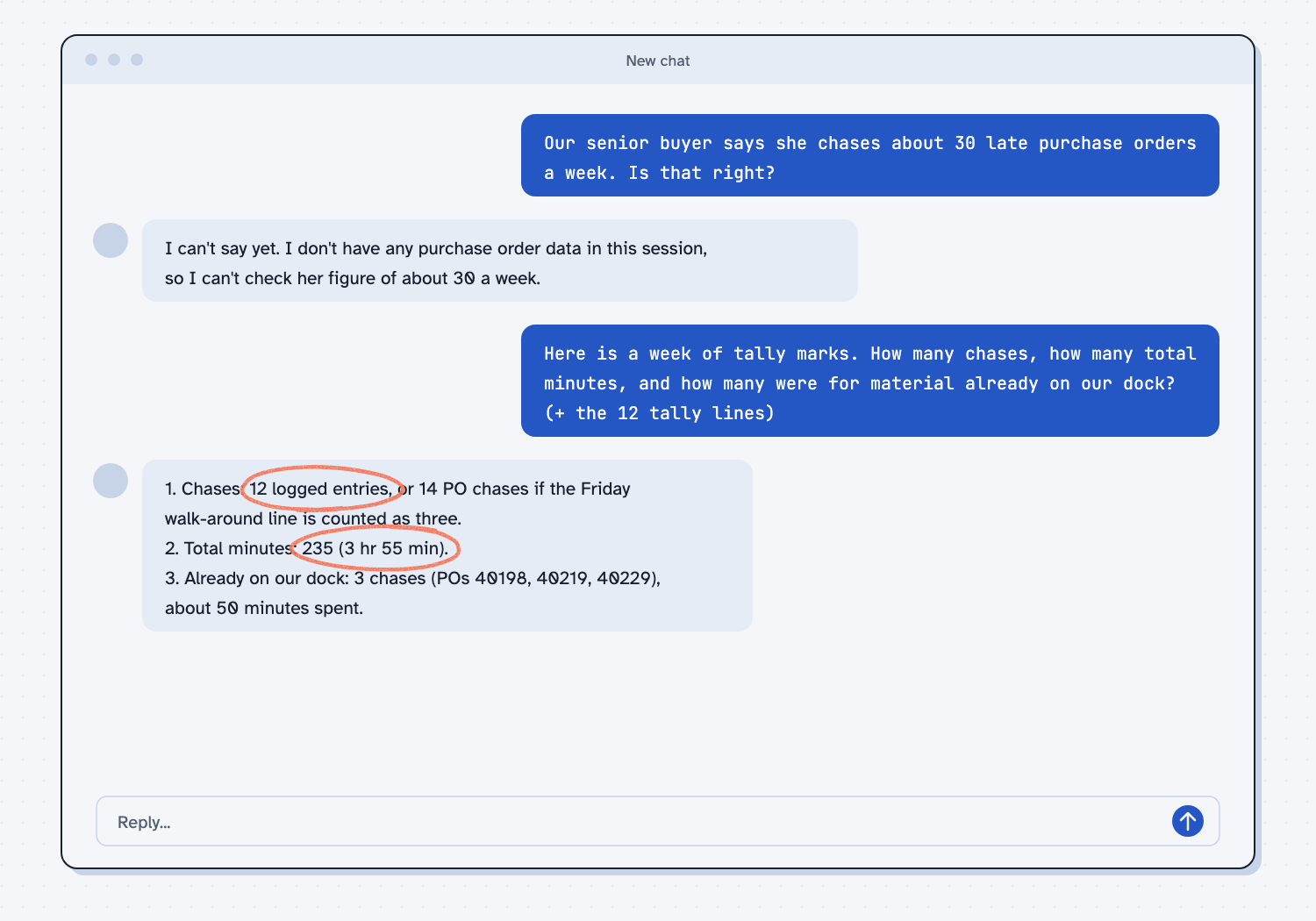
The first chat could not confirm or deny the guess. It said, "I can't say yet. I don't have any purchase order data in this session, so I can't check her figure of about 30 a week," and added, "Agree on one definition before comparing." That is the right answer, because a guess is not data, and AI cannot count what it never saw. The second chat counted well, with one useful wrinkle: "12 logged entries, or 14 PO chases if the Friday walk-around line is counted as three." The last row covers three POs in one walk-around, which is why you decide what counts as one before the week starts. The other two lines were "235 (3 hr 55 min)" and "3 chases (POs 40198, 40219, 40229), about 50 minutes spent."
Frequently asked questions
What is a one-week tally?
It is a simple sheet where you add one row each time something happens, such as a late PO chase or a mistake, for seven days. At the end, you total the rows, and that total replaces everyone's guess.
Why one week?
One week is long enough to show a pattern and short enough that people actually finish it. If the week was unusual, count a second one before you decide anything.
Can AI do the counting for me?
AI can total and group rows you give it, but it can only count what it has seen, and the work happens in your shop, not in its chat. Keep the tally yourself, then let AI sort it.
What if the count proves me wrong?
Then you learned something cheaply. A real number is easier to accept than someone else's opinion, and it usually points to a smaller fix than you feared.
Use it today
- Clean up one process before you automate it: count a week of late PO chases first, then have Claude clean up the process.
- Make a repeat mistake impossible: count a week of mistakes, then trace the biggest one to where it starts.
- Related idea: Make the mistake impossible.
From my coaching notes: "Reach for the cheap count first, every time."