Make Mistakes Impossible: A Ladder From Training to Error-Proofing
With Josh Schultz ·
Answer. To make mistakes impossible, you change the process so the wrong thing cannot happen, instead of asking people to be careful. Fixes sit on a ladder with six rungs, from impossible at the top to training at the bottom, and the goal is to climb it.
The picture
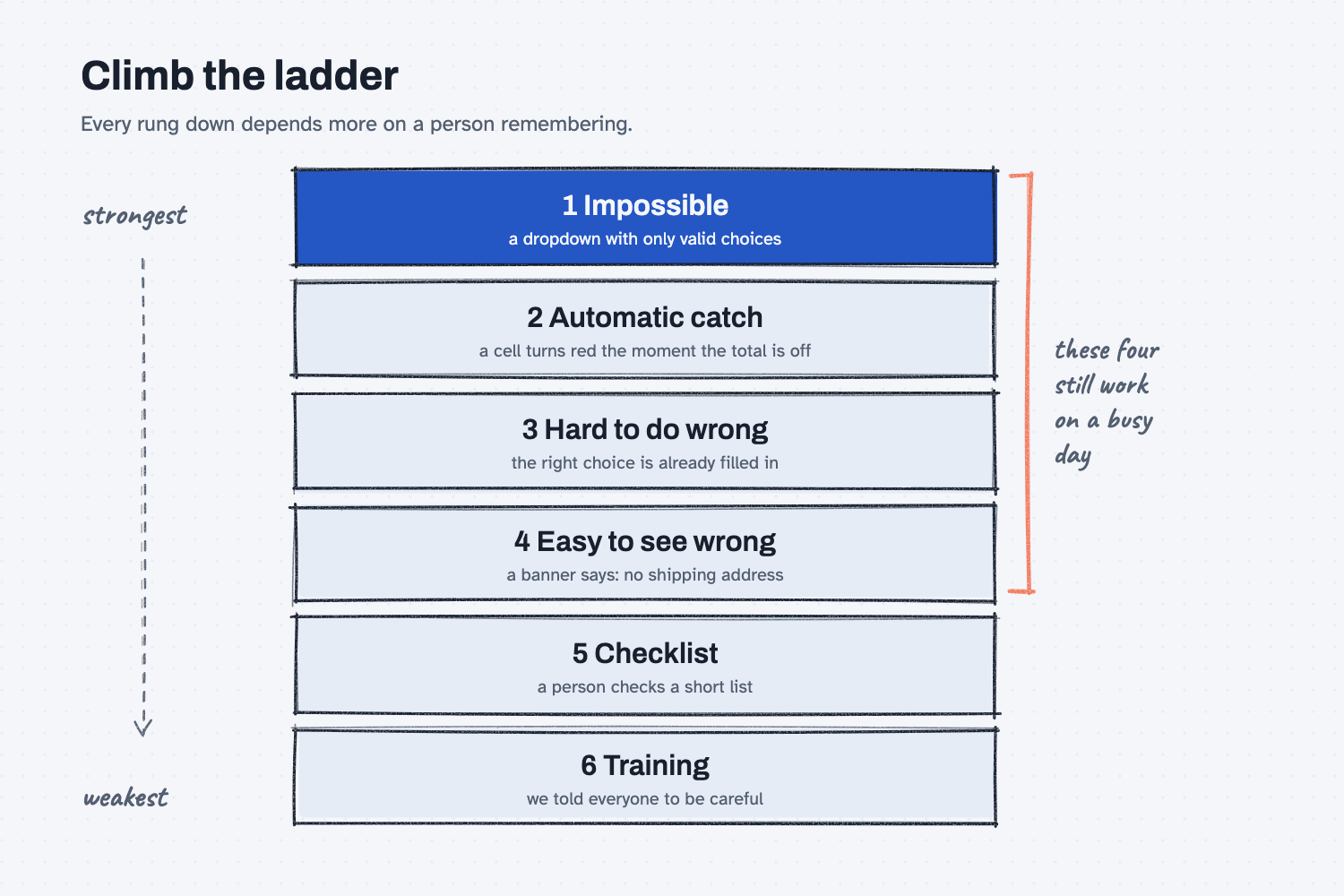
Read the ladder from the top. The strongest fix is to make the mistake impossible, and each rung below it relies a little more on a person noticing and remembering. The checklist and training sit at the bottom, because they only work when someone is paying full attention on a busy day. The top four rungs are circled because those are the ones that still work when people are tired, rushed, or new.
Think of it like this
Picture a fixture on a machine, the clamp that holds a part while it is cut. A well-made one has a pin, so if the part is turned the wrong way, it simply will not sit down. Nobody has to be careful, and nobody can get it wrong.
Now picture the weak version, where the part fits either way and there is a note taped to the machine that says "check orientation." The note works until the day someone is in a hurry. The pin works every day, and that is the whole difference between the top of the ladder and the bottom.
Why does it matter at work?
When the same mistake keeps happening, the usual response is to remind people to be careful. That feels responsible, yet it fails over and over, because it depends on everyone paying attention every single time.
Here is an example. A buyer at Mesquite Ridge Metal Works orders 500 boxes of bolts when the plan was 500 bolts, because the unit of measure on the order says "box of 100" and the buyer was moving fast. It is the third time this year. The team already holds a training session and has a checklist item that says to confirm the unit.
So the team asks a different question, which is how to make the mistake impossible. They change the unit cell on the order from a free-text box into a dropdown that only offers the units in the item catalog. Now a buyer cannot type the wrong unit, and the training session no longer carries the weight.
As I put it: "When the same mistake keeps happening, it's not a careless person. It's a process that sets a trap. We're going to remove the traps." That also takes the blame out of the conversation, which helps people tell you the truth about how the mistakes happen.
How does it work?
The ladder has six rungs, and the question is always whether you can move the problem up one. Each rung down is easier to build, and it fails more often. In my words: "What would it take to make that mistake impossible instead of remembered?"
1. Impossible. The wrong action cannot happen. A form that will not submit without the required field is an example, and so is a dropdown that only contains valid choices.
2. Automatic catch. The mistake can happen, but it is caught the instant it does. If the order total does not match the quote, a cell turns red before anyone can save it.
3. Hard to do wrong. The right choice is already filled in, so the easy path is the correct path. Examples are a pre-filled template or a file that names itself.
4. Easy to see wrong. Errors stand out. Color coding, a banner that says an order has no shipping address, and highlighted mismatches all help here.
5. Checklist. A person checks a short written list at the moment it matters. That is better than nothing, but it depends on someone doing it every time.
6. Training and reminders. This is the weakest rung, because it relies on memory. It is still needed, but it should never be the only fix for a mistake that keeps coming back.
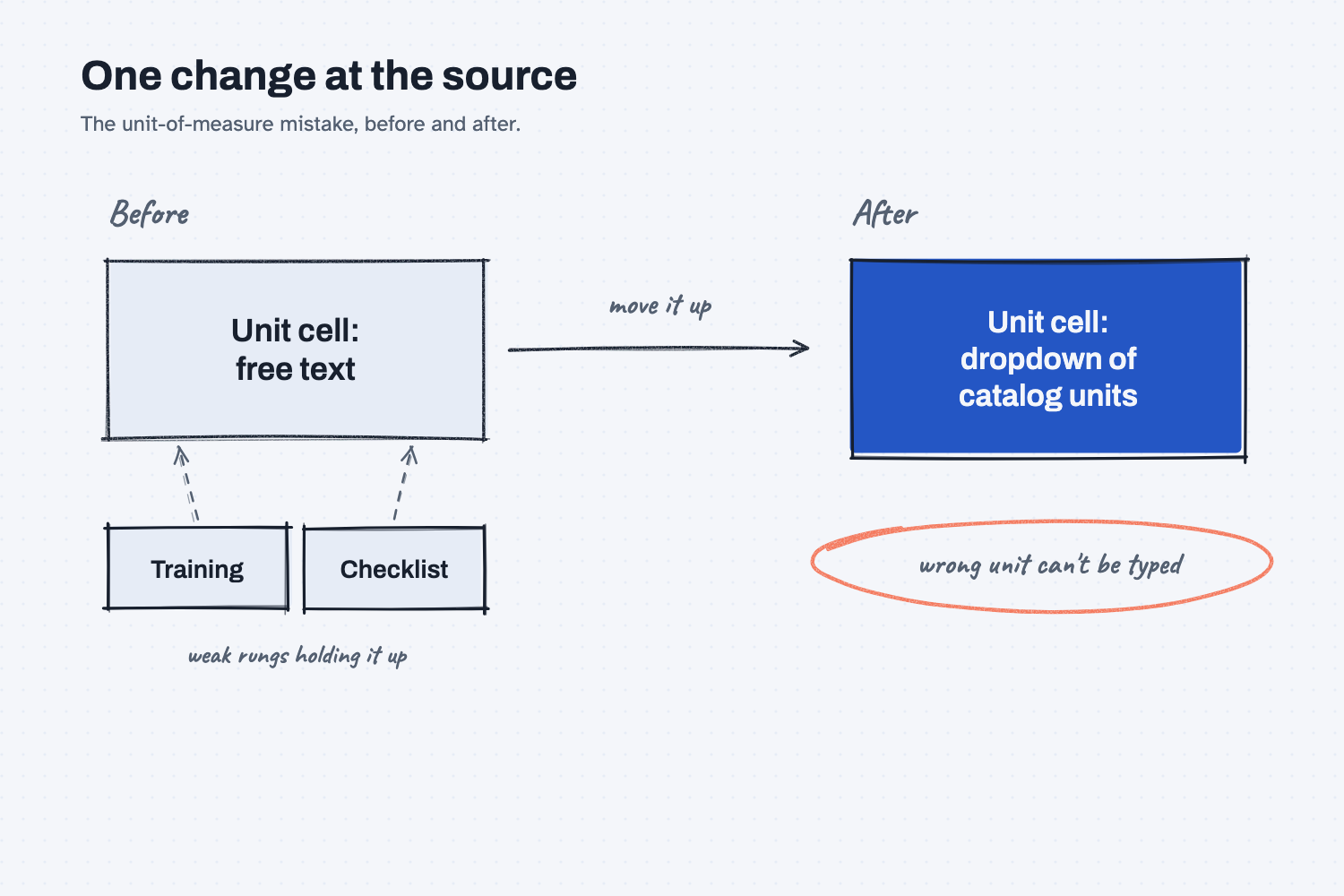
The left side shows the unit-of-measure problem as it started, with free text and two weak fixes propped up under it. The right side shows the climb, where one change at the source takes the problem from the bottom rungs to the top. Many processes can climb at least one rung without new software, such as turning a free-text field into a dropdown.
Where do people get it wrong?
Most mistakes come from reaching for the easiest fix, which is also the weakest. These are the four I see most often.
- Jumping to training. A training session feels productive, but it sits on the bottom rung, so ask what would stop the mistake without anyone remembering anything.
- Blaming the person. If the same mistake happens to different people, the process is the trap, and replacing the person will not remove it.
- Growing the checklist. Adding one more line after every error makes a list that people stop reading, so look for a way to move the check up a rung.
- Asking AI to double-check. An AI check can catch some mistakes, but it can also miss them, which makes it a catch and not a guarantee (see make AI check its own work). When the AI itself makes the mistake, fix the instructions, as in fix the instructions, not the output.
Try this in 2 minutes
This test asks AI to rank six fixes for the unit-of-measure mistake. You can use any chat tool.
- Open a new chat and paste this:
Our buyers keep ordering the wrong unit of measure on purchase orders (each versus box of 100). Rank these six fixes from strongest to weakest at stopping the mistake, one line each with a short reason:
1. Train everyone in a 30-minute session.
2. Add a checklist item: confirm the unit.
3. Pre-fill the unit from the item catalog.
4. Turn the unit cell red when it differs from the catalog.
5. Only allow units from a dropdown that matches the catalog.
6. Flag the order right away when the quantity is 10 times the usual.
Give the order as numbers first, then the reasons.
- Here is what I expect: the dropdown (5) first, the automatic flag (6) next, then pre-fill (3), the red cell (4), the checklist (2), and training (1) last.
- Compare its ranking to the ladder and notice where you disagree.
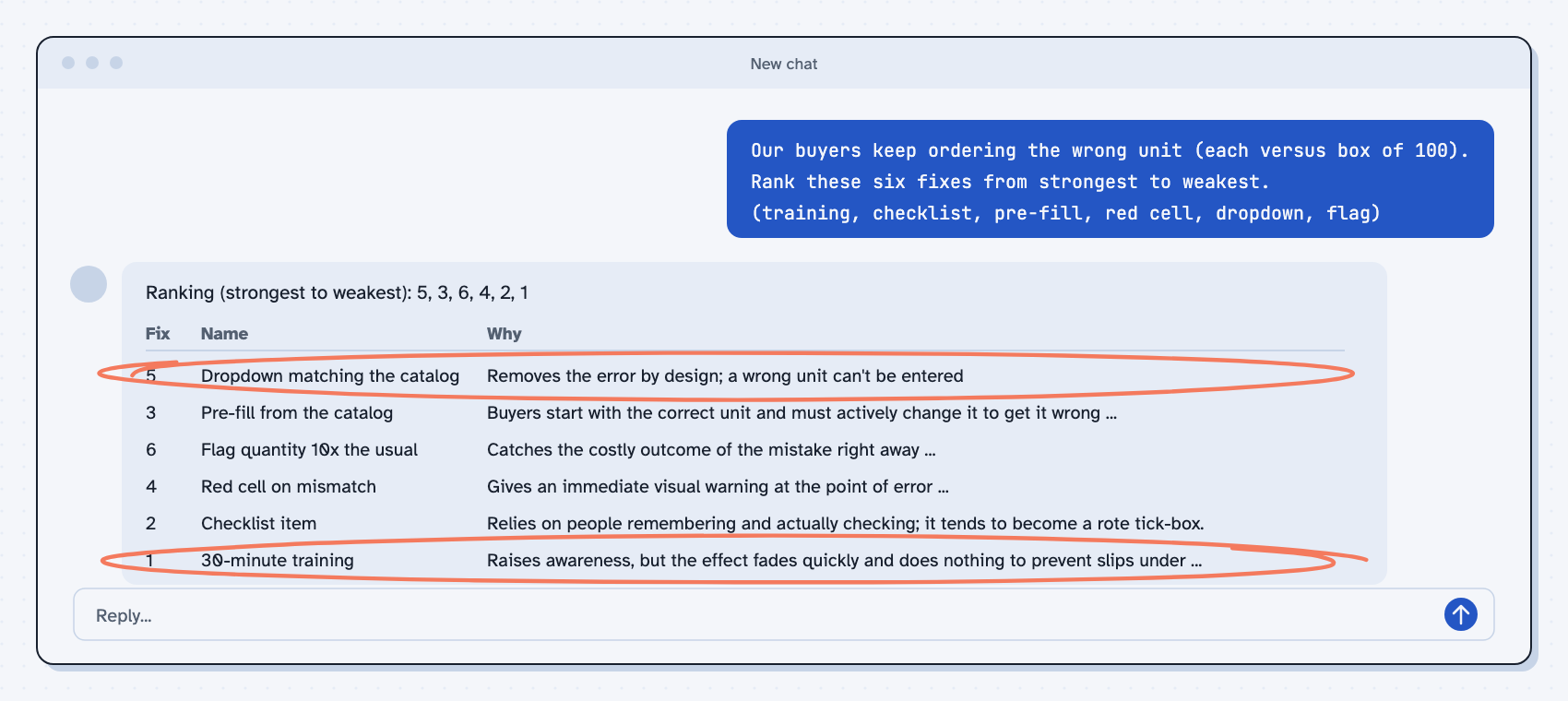
When I tried this, the ranking came back as "5, 3, 6, 4, 2, 1." The dropdown was first, with the reason "Removes the error by design; a wrong unit can't be entered." It also added a caution that the dropdown only helps if the catalog lists just the right unit for each item. Training came last, with "Raises awareness, but the effect fades quickly and does nothing to prevent slips under time pressure."
Its top and bottom matched the ladder. It put pre-fill ahead of the automatic flag, which is a fair thing to argue about, because it can depend on how your team works. The point is that it ranked the fixes that change the process above the ones that depend on a person remembering.
Frequently asked questions
What does it mean to error-proof a process?
It means changing the process so a mistake cannot happen, or is caught the moment it does, so you are not relying on people to be careful. Some people call this a mistake-proof design.
Why doesn't training stop repeat mistakes?
Training depends on people remembering it on a busy day, and memory fails when someone is rushed, interrupted, or new. Training is still useful, but it is the weakest rung and should not be the only fix.
Do I need new software to error-proof a job?
Often not. Turning a free-text field into a dropdown, pre-filling a template, or adding a red mismatch cell in a spreadsheet can all be done with the tools you already own.
Where do I start?
Pick one mistake that has happened more than once and write down what the person was looking at when it happened. Then ask which rung the current fix sits on, and what it would take to move it up one.
Use it today
- Make a repeat mistake impossible, not remembered: find your top repeat mistake and climb the ladder with Claude.
- Find repeat failures in a maintenance log: AI tags each work order from your own lists, a script counts and ranks them.
- Browse the guides for a step-by-step way to try this on your own job.
- Related idea: Clean up before you automate.
- Related idea: Find the bottleneck first.
- Related idea: Humans plan, AI does.
From my training: when a mistake repeats, I look for the trap in the process before I look at the person.