What Is a CLAUDE.md File? A Standing Instruction Sheet for Your AI Helper
With Josh Schultz ·
Answer. A CLAUDE.md file is a short page of plain-text instructions that Claude reads automatically at the start of every session in a folder. It holds the rules you would otherwise repeat each time, such as how to write, what to avoid, and how your team does things. Anthropic's documentation treats it as guidance Claude follows, not a lock that forces it.
The picture
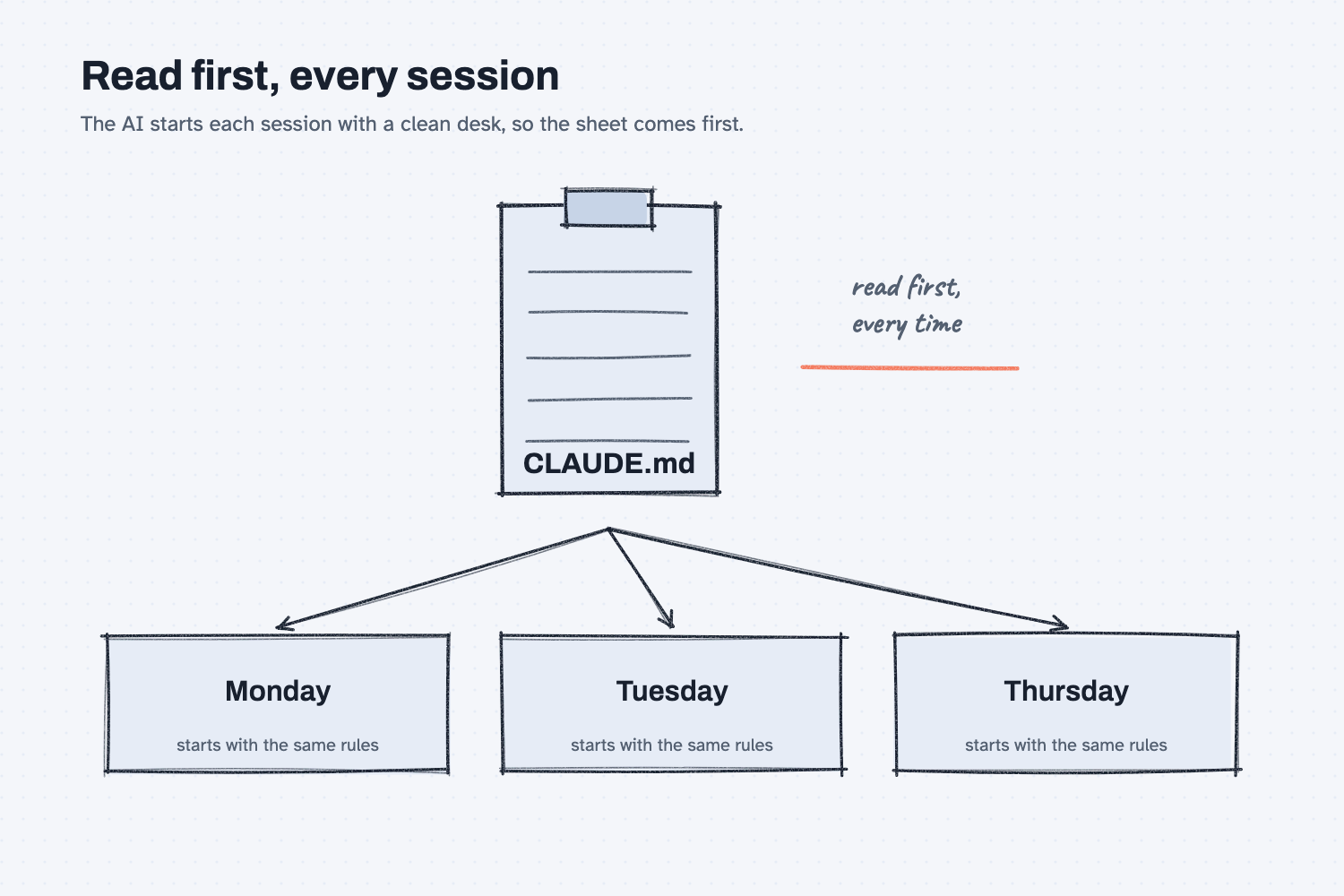
At the top is the instruction page, shown as a binder. Below it are three separate working sessions on three different days, and each one begins by reading the same rules before any work starts. The point of the picture is that the AI does not remember Monday on Thursday, so the page is what keeps the rules the same each time. You write the rules once, and they show up in every session without you typing them again.
Think of it like this
Think of the laminated instruction sheet taped above a workstation. A new hire, or a temp from the agency, may never have met you, but the first thing they do is read the sheet: how we label parts, who signs off on what, what we never do.
That sheet is not the whole job, and it does not make anyone follow it. It is what makes the first hour go well, since the person starts with your rules instead of guessing at them. A CLAUDE.md file is that sheet for an AI helper, and because the AI starts every session with a clean desk, as the lesson on the context window explains, the sheet is read at the start of every one.
Why does it matter at work?
It matters because without it, you re-teach the same preferences in every chat, and the results change depending on how much you remembered to say. With it, a whole team can start from the same rules, which means the helper behaves the same way no matter who opens it.
Here is a small example at Mesquite Ridge Metal Works. Hector Lee, the buyer, is tired of telling the AI to keep supplier emails short, to name the PO number, and to never promise a payment date. He writes those rules once on the standing sheet, and from then on every draft starts from them, whether he or a coworker asks. A page like this is also a place to record decisions, so a new teammate learns the shop's habits from the sheet instead of from a string of corrections.
How does it work?
Claude Code is the version of Claude that works on files in a folder on your computer, with your permission, and you can read how to get it set up in the install guide. The CLAUDE.md file lives in that folder, and four ideas explain how it behaves.
It is read at the start of every session. The file is plain text, so you can open it in any editor. Claude reads it before it does anything else, which is why the rules apply from the first message. There can be a personal sheet that follows you across all your projects, a project sheet for one team, and, according to Anthropic's documentation, an organization-wide sheet that IT can deploy to every machine.
There is a second set of notes. Anthropic describes a second feature called auto memory, in which Claude writes its own notes based on your corrections and preferences. The difference is who writes it: you write the CLAUDE.md file, and Claude writes the auto memory notes. Both are read at the start of each session, and you can open and edit either one.
It works better short and specific. The documentation says the more specific and concise the instructions are, the more consistently Claude follows them, and it suggests aiming for under about 200 lines per file. A line like "keep emails under 90 words" can be checked, while "write well" cannot. If a sheet grows long, the documentation recommends moving task-specific material into a skill, which loads only when needed.
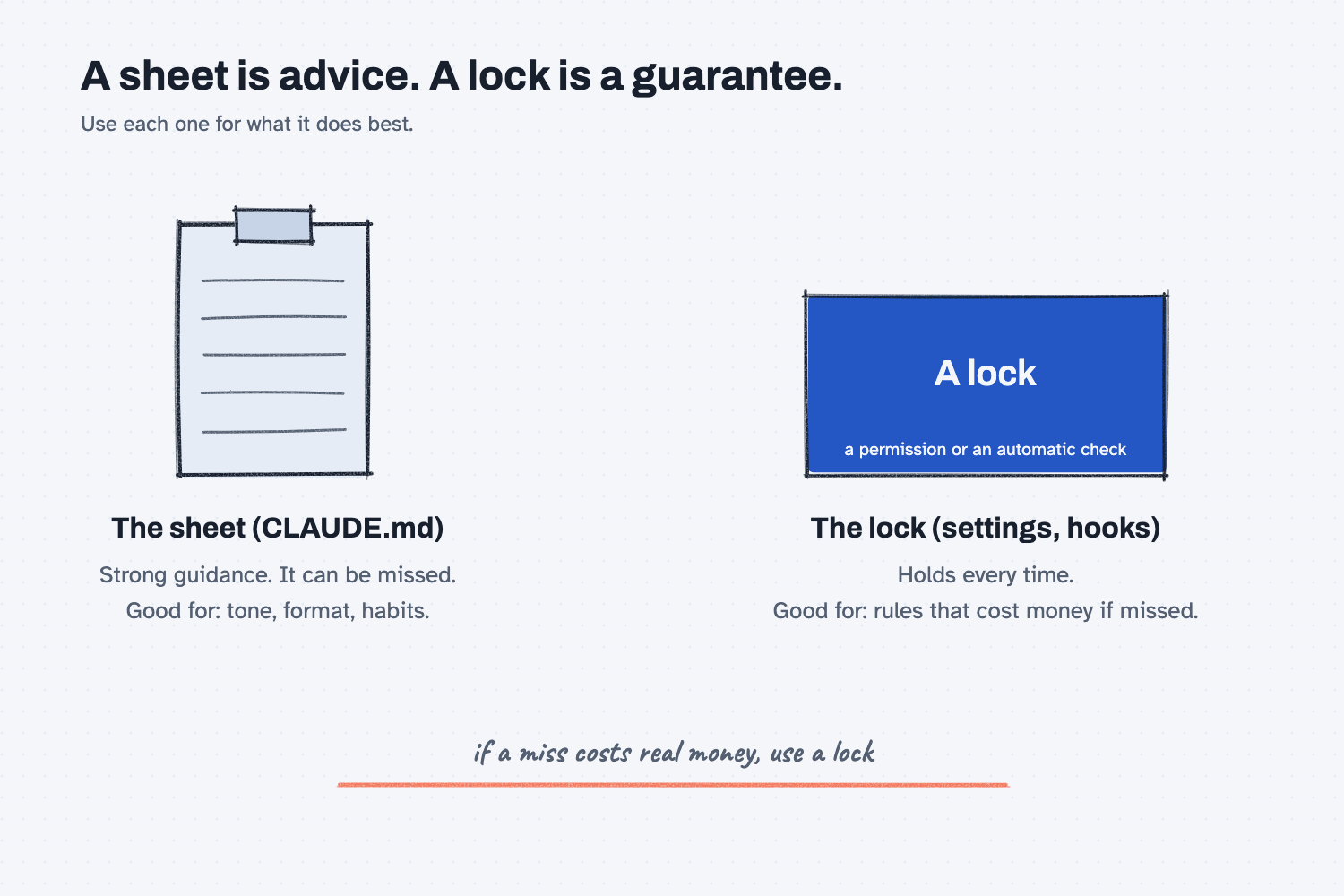
It is advice, not a lock. Anthropic's documentation says plainly that Claude treats these files as "context, not enforced configuration." That means a rule like "never touch the finance folder" is a strong request, but it is not a guarantee. When a rule must hold every single time, the documentation points to a different tool, called a hook, which runs automatically at a set moment without the AI deciding anything. The lesson on a markdown file explains why these sheets are saved in that plain format, and a system prompt covers the hidden instructions that every AI app starts with.
Where do people get it wrong?
Most problems come from treating the sheet as either magic or a dumping ground.
- Writing a novel. A sheet with hundreds of lines buries the rules that matter. Keep it to the standing rules and move everything else into skills or separate notes.
- Writing vague rules. "Be professional" gives the AI nothing to check. "Sign emails with the buyer's name and title" does.
- Expecting a guarantee. A rule on the sheet can be missed, especially deep into a long session. For anything where a miss costs real money, add a check that does not depend on the AI's judgment.
- Never updating it. When the AI gets something wrong twice, the fix belongs on the sheet. Anthropic's own advice is that a repeated mistake is a reason to edit the file, not to correct it again in chat.
Try this in 2 minutes
You can feel the difference a standing sheet makes in any chat, without installing anything. You will ask for the same email twice, once with the rules and once without.
- Open a new chat and paste this:
A buyer asks: "Draft a short email to a supplier saying our Dec 5 delivery is late."
- Open a second new chat and paste this:
Standing instructions for every chat in our purchasing office:
- Write as the buyer at Mesquite Ridge Metal Works, signed Hector Lee.
- Keep emails under 90 words. Plain words, no apologies.
- Always state the PO number and the new date we need, and ask for a reply by end of day.
- Never promise payment dates.

A buyer asks: "Draft a short email to a supplier saying our Dec 5 delivery is late." (PO 4411, Ridgeline Steel, needed Dec 5.)
- Compare the two emails side by side. The second should be shorter, signed, and specific.
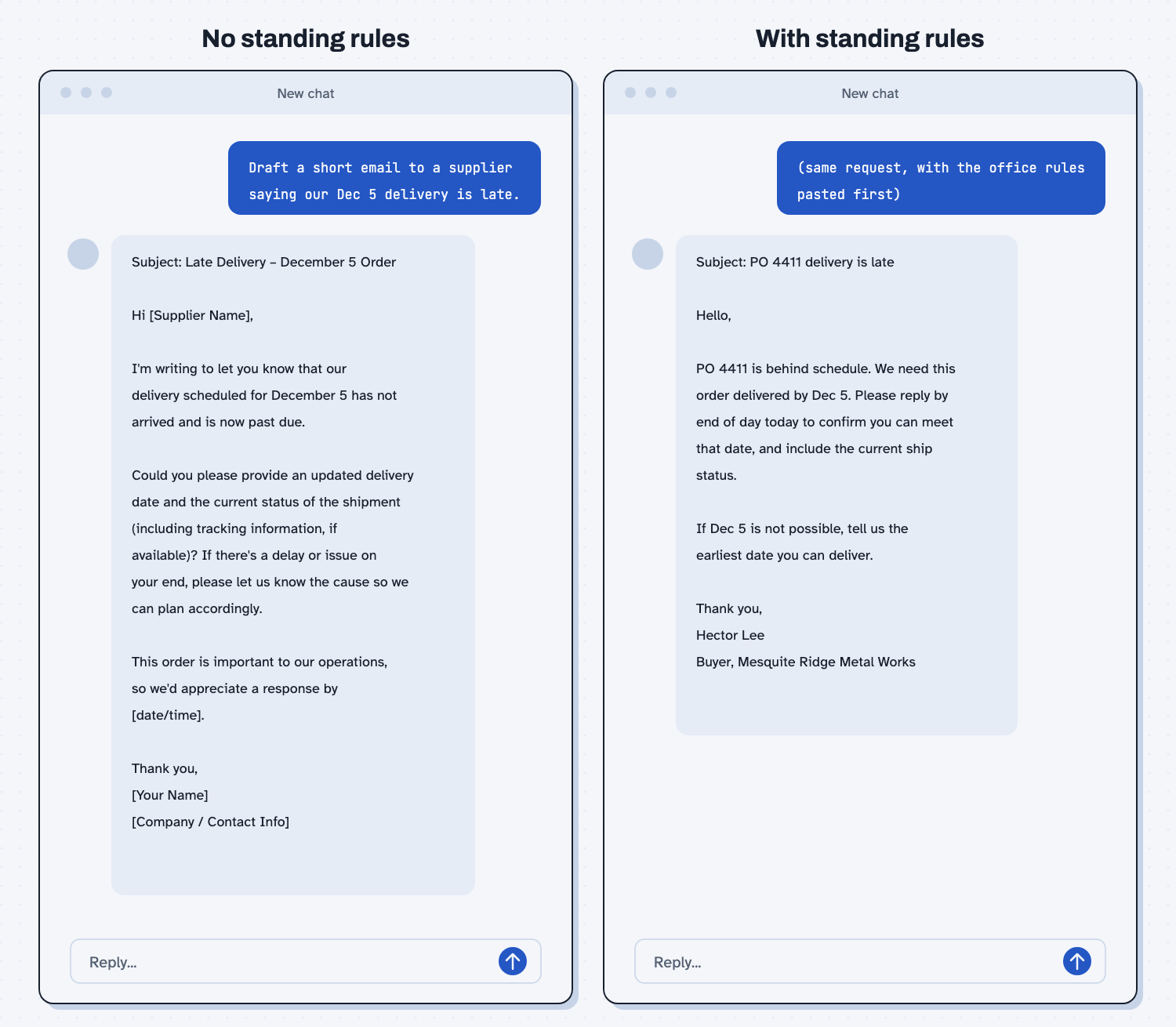
When I tried this, the reply without instructions opened with "Hi [Supplier Name]," asked for a response by "[date/time]," and was signed "[Your Name]," so every blank was left for me to fill. The reply with the standing sheet had the subject "PO 4411 delivery is late," said "Please reply by end of day today to confirm you can meet that date," and was signed "Hector Lee, Buyer, Mesquite Ridge Metal Works." It even added, "The email makes no promises about payment." A CLAUDE.md file does this same job automatically, so you do not have to paste the rules each time.
Frequently asked questions
What does CLAUDE.md do?
It gives Claude standing instructions that load at the start of every session in a folder. You use it for rules you would otherwise repeat, such as tone, format, and things to avoid.
Is CLAUDE.md the same as a skill?
No. The CLAUDE.md file loads every session and holds always-on rules. A skill loads only when it is needed and holds a specific procedure. Put "always" rules on the sheet and step-by-step jobs in skills.
Does Claude always follow CLAUDE.md?
Not always. Anthropic describes it as context, not enforced configuration, so it is strong guidance that can still be missed. For rules that must hold every time, use a hook or a permission setting.
Do I need to code to write one?
No. It is a plain text file written in everyday sentences. If you can write a short note to a new hire, you can write one.
Use it today
- Turn a good chat into a reusable skill: once your rules grow past a short sheet, a skill is the next step.
- Related ideas: does AI remember past chats and keep your rules in one place.
From my training: our guides keep standing rules in one plain-text place, so they are written once and every chat starts from them.