Ask AI for the Tool, Not the Answer, Even for Hard Problems
With Josh Schultz ·
Answer. Ask AI for the tool, not the answer: instead of asking for this week's number or schedule, ask AI to build the calculator, checker, report builder, or solver that produces it, then run your data through that tool. The tool is deterministic, which means the same input gives the same answer, so it can be reused, checked, and handed to anyone.
The picture
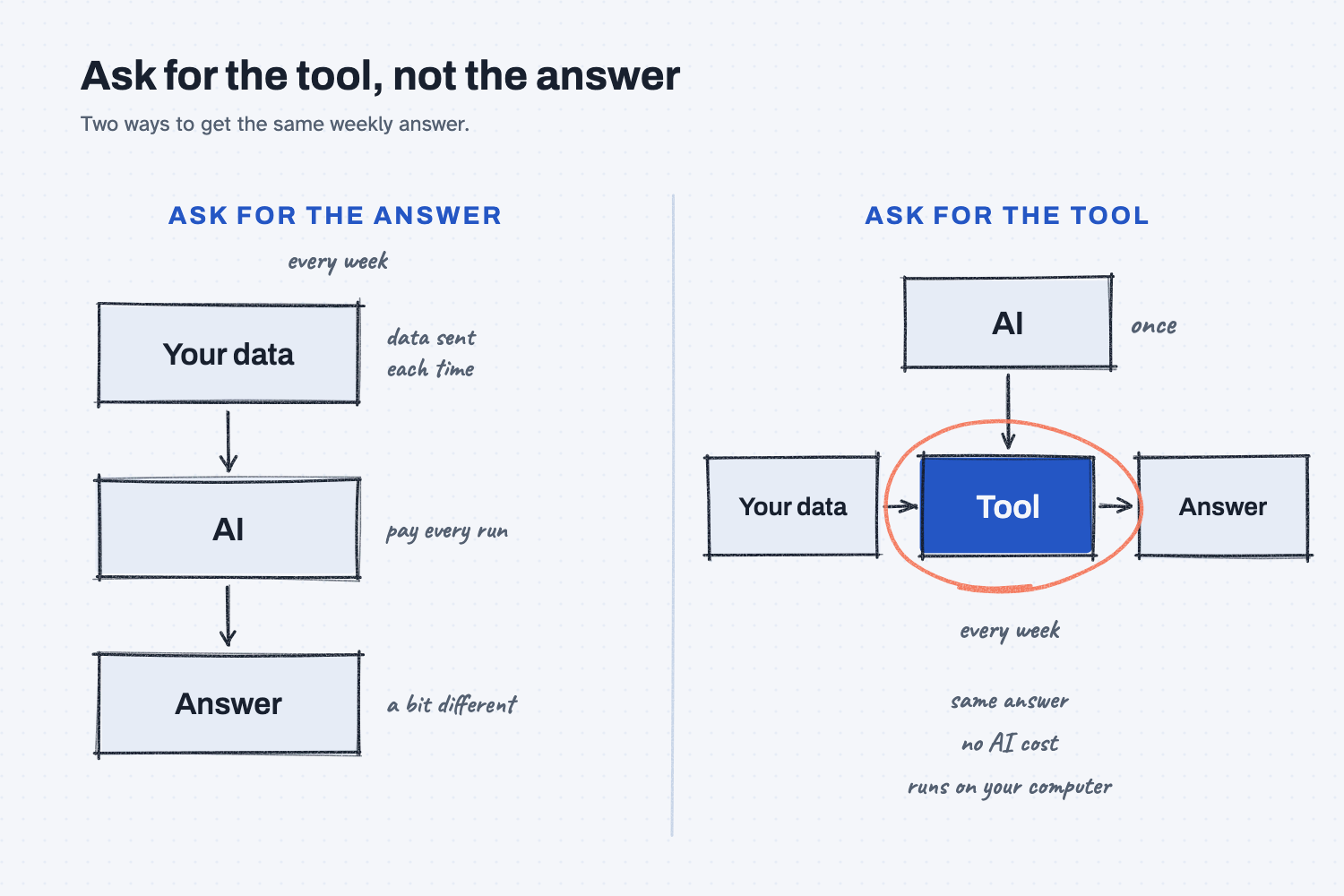
The picture shows two ways to get the same weekly answer. On the left, you send your data to AI every week, so every week you pay for the run, send the data again, and get an answer that comes out a little differently. On the right, you use AI once to build the tool, and after that your data goes through the tool every week. The tool is circled because it is the thing you keep.
Think of it like this
Think of the best numbers person in your office, the one everybody calls for a cost or a price. You could call them every Monday with your figures, but every call takes their time, and the answer depends on how their day is going.
The smarter move is to ask that person to build you the spreadsheet. You test it once against prices you already know, and after that anyone can type in numbers and get the same answer without calling them. AI is that numbers person, and this lesson is about asking it to build the sheet.
Why does it matter at work?
It matters because most work questions come back every week, and an answer you ask for again costs again, can change, and needs checking again.
Kevin Thao, a buyer at Mesquite Ridge Metal Works, buys control boards from Kestrel Electronics overseas, with a 25 percent duty and ocean freight, and from Northbay Circuit Assembly at home. For every order he wants the landed cost, which is the price per board after duty and freight. Instead of pasting each quote into a chat, he asks AI to build a small landed cost calculator from the column names, the rule, and two made-up rows, tests it on one order he already worked out by hand, and then runs each new order through it on his own computer. The first run shows what the quote price hides: Kestrel quotes less per board, but once duty and freight are added, Northbay costs less.
How does it work?
You describe the job, AI builds the tool, and you run your data through it from then on.
Describe the rules, not the data. Tell AI the columns, the rule in plain words, and what to do when a row is missing something, and give it two or three made-up sample rows.
Test it once against answers you know. Run the tool on a small file where you already know the right answer, the way you would check a new gauge against a master part. If something is off, tell AI which rule is wrong and it fixes the tool.
Change a rule when the rules change. When the duty rate changes, you change that one rule and run it again, instead of asking for a new answer and hoping only that part moved. How AI uses tools and scripts shows the same idea from the AI's side.
Why is a tool better than an answer?
For repeat work, a tool gives the same result every time, costs nothing to run again, and can be checked line by line.
- Same answer every time. Ask a chat the same question twice and a word or even a number can change, while a tool gives the same output from the same file, which is what deterministic means.
- No AI cost per run. AI is billed by tokens, the small pieces of text it reads and writes. You spend them once to build the tool, and running it next week uses no AI, so it costs nothing and does not count toward your usage limit.
- Reuse it and hand it off. The tool keeps working after the chat is closed, and a coworker who has never used AI can run it.
- Your data can stay with you, if you build it that way. If you give AI only the column names, the rules, and a few fake rows, and run the real file yourself, the real file never goes to the AI. If Claude Code opens your real files while it builds, it reads them, so choose that on purpose (is it safe to put company data in AI).
- You can check it. A tool has rules you can read, and you can test it against an answer key or add a separate checker that marks each rule PASS or FAIL, while an answer you cannot trace is hard to trust.
- It is fast at any size. The same tool handles 60 rows or 60,000 in about the same few seconds.
How big a problem can a tool solve?
Much bigger than most people expect. AI can build hard tools, not only simple calculators, and that is the part people underestimate.
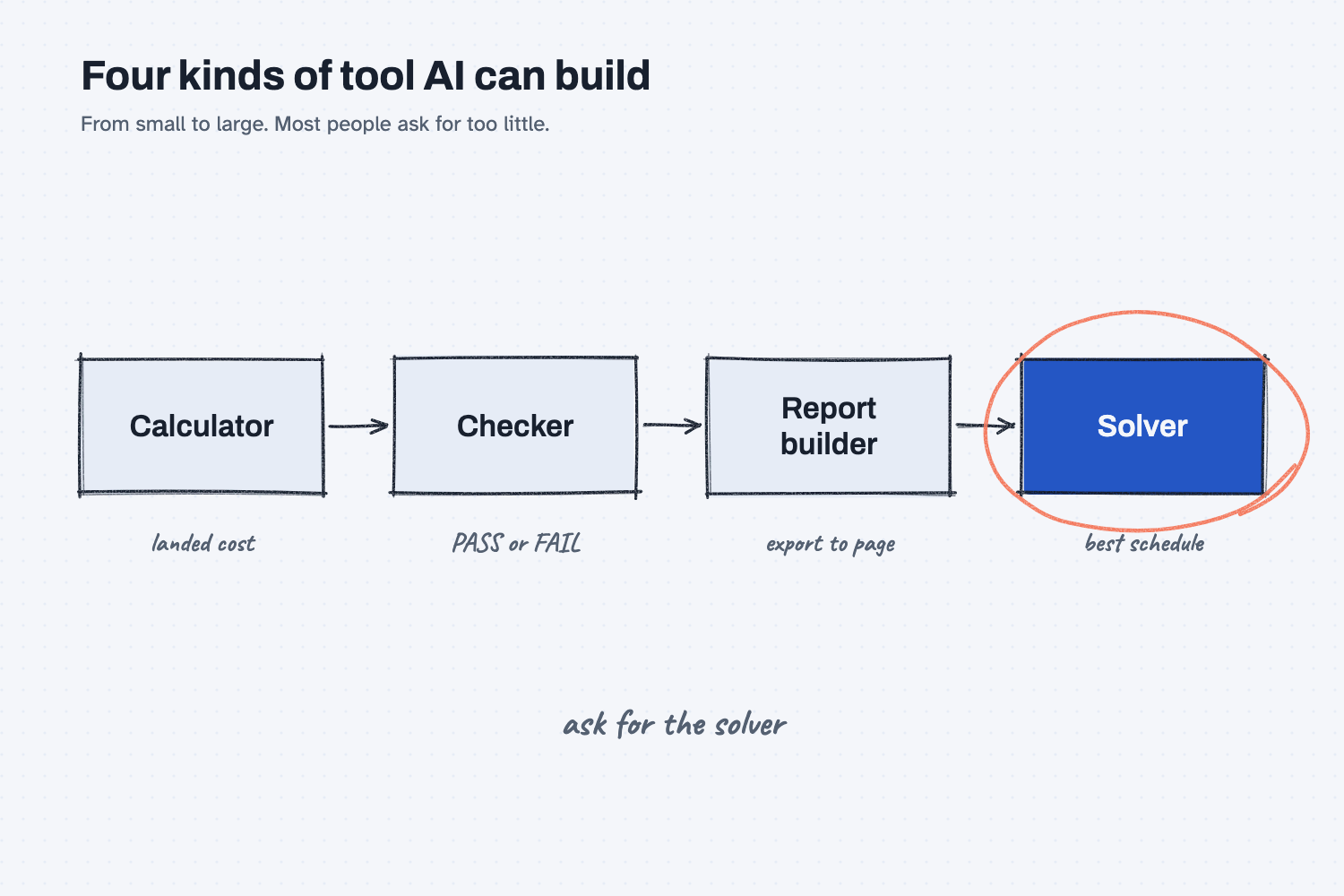
A calculator does one piece of math, a checker marks each rule PASS or FAIL, and a report builder turns an export into the same page every week. A solver, also called an optimizer, searches every possible plan for the best one, which no person can do by hand once there are more than a handful of people.
Here is a real case. At one company event, someone used Claude Code to put 89 people into breakout sessions, and instead of asking Claude for a schedule, they asked it to write a Python solver. The solver tried all 18 ways to order the time slots, honored 108 of the 126 survey picks, showed that no plan could honor more under the rules, and explained every miss. As it was put at the event, "Then you have a pretty good starting point from which to adjust." A chat asked for the same schedule writes one that looks right, and it can quietly put someone in two places at once.
When should AI stay in the loop?
AI stays in the loop for the fuzzy parts, such as reading messy emails, matching names people typed themselves, drafting, and judgment calls, with a person checking what it flags (human in the loop). The tool takes every step that follows a clear rule.
Where do people get it wrong?
Most mistakes come from asking AI for too little or trusting the tool too soon.
- Asking for the schedule instead of the solver. People assume a solver is too big an ask, so they settle for an answer that only looks right.
- Skipping the test. A wrong tool is wrong the same way every time, so check it once against answers you know.
- Building a tool for a one-off. For a short job you will do once, just ask for the answer and check it.
For messy data, where AI should write rules instead of guessing at 2,000 rows, see use AI to build a tool.
Try this in 2 minutes
This test has AI build a tool from a description and two made-up rows, and then the tool runs on a file the AI never sees. You need Claude Code, or any chat tool plus Python on your computer.
- Paste this into Claude Code in an empty folder, or into a chat and save the script it gives you as
landed_cost.py:
Write a small Python script called landed_cost.py. It reads a CSV file named on the command line and prints the landed cost per unit for each row, then the total landed cost for the whole file.

Columns: part, supplier, qty, unit_price, duty_pct, freight
Rule: landed cost per unit = unit_price + (unit_price x duty_pct / 100) + (freight / qty). Round to cents.
If a row is missing a number, print that row as SKIP with the reason. Do not guess.

Two sample rows (made up):
RL-230,Kestrel Electronics,200,38.50,25,640.00
RL-235,Lone Oak Harness,150,22.75,0,0

Save the script. Do not open or run any other file.
- Save this as
december-order.csvin the same folder:
part,supplier,qty,unit_price,duty_pct,freight
RL-230,Kestrel Electronics,500,37.90,25,1180.00
RL-230,Northbay Circuit Assembly,500,46.20,0,210.00
RL-231,Kestrel Electronics,500,18.40,25,420.00
RL-235,Lone Oak Harness,300,22.75,0,0
MR-2001,Bolt Barn Industrial,,0.42,0,35.00
- Run
python3 landed_cost.py december-order.csvtwice and compare.
When I tried this in Claude Code, the reply began, "I saved landed_cost.py. I haven't run it, because you said not to open or run any other file." It also raised a judgment call on its own: "'Total landed cost for the whole file' could mean two things, so I had to pick one."
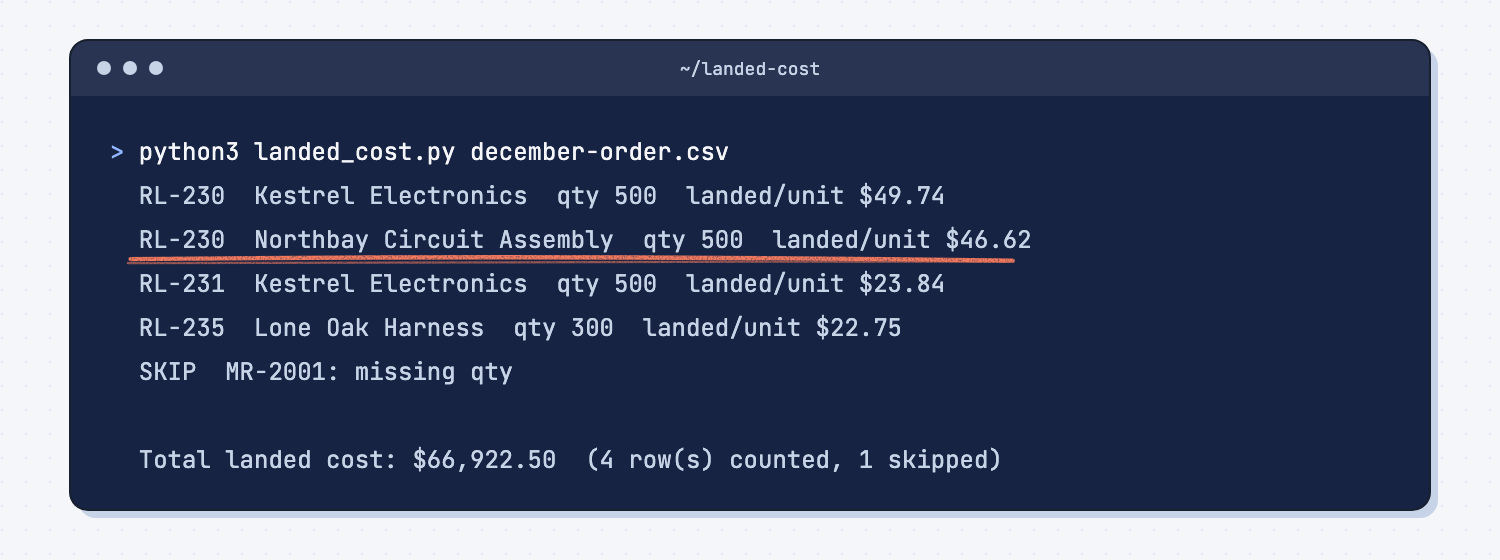
Both runs on the December file printed exactly the same lines. Kestrel quoted $37.90 a board against Northbay's $46.20, but landed, Northbay is cheaper at $46.62 against $49.74. The bolt row with no quantity was set aside instead of guessed at.
Frequently asked questions
Do I need to know how to code?
No. You describe the rules in plain words, AI writes the code, and you test it on a few rows where you know the answer.
Does my data stay private if I do this?
Only if you build it that way, which is a separate question from whether AI learns from your data. Give AI the column names, the rules, and a few made-up rows, then run the real file yourself. If you let Claude Code open your real files while it builds, it reads them.
When should I just ask for the answer?
Ask for the answer when the job is small, you will do it once, and you can check it by eye. Build the tool when the job comes back, the file is big, or the answer has to be the same every time.
Use it today
- Schedule a training day so nobody is double-booked: a solver honors 64 of 84 picks, proven best, and a checker prints PASS lines.
- Check if your Infor orders fit your work centers: a load calculator you build once and run each Monday.
- Have Claude build your quote report: a script builds the same page every time.
- Match sign-up names to your roster: the fuzzy part stays with AI.
From my training: this comes from a real company event where someone asked Claude Code for a scheduling solver instead of a schedule, and from my own habit of asking AI for tools.